
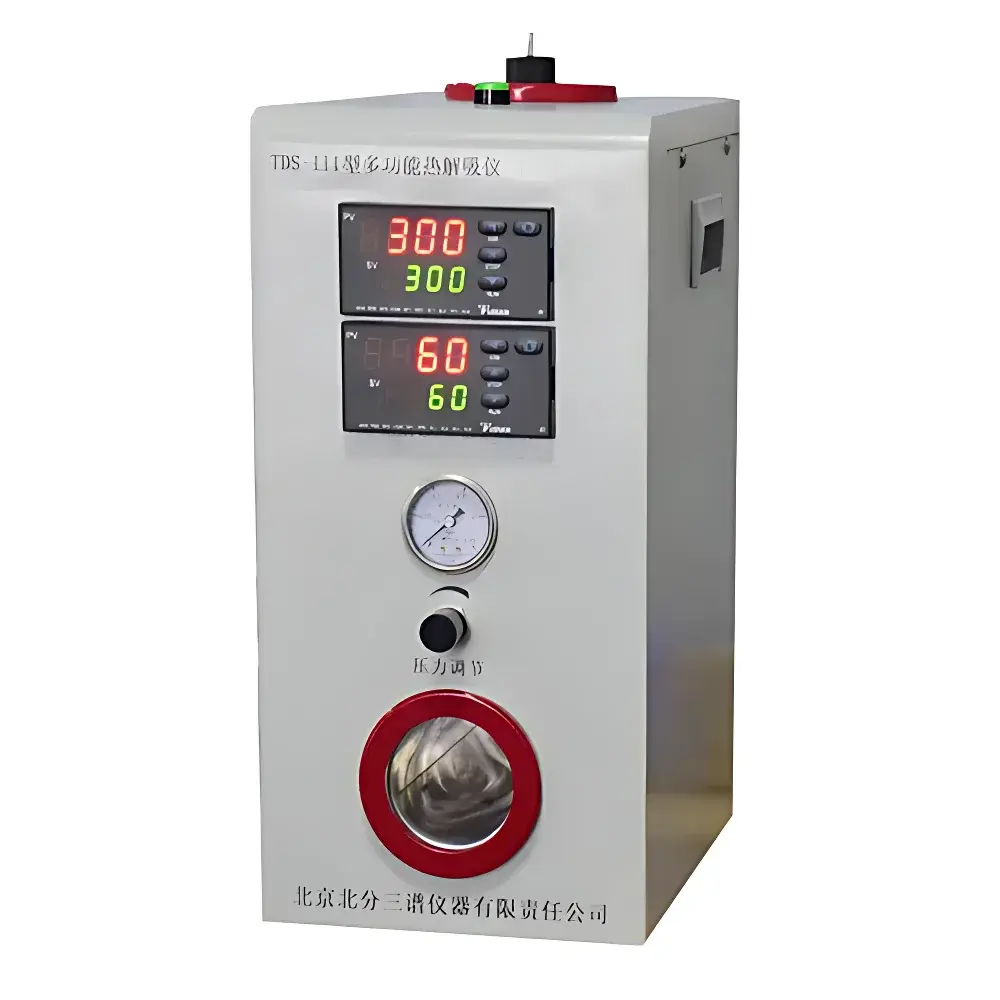
Beifen Sanpu BFTDS-III Multi-Function Thermal Desorption Unit for Acetone, Methyl Ethyl Ketone (MEK), and Methyl Isobutyl Ketone (MIBK) Analysis
| Brand | Beifen Sanpu |
|---|---|
| Origin | Beijing, China |
| Manufacturer Type | Manufacturer |
| Product Origin | Domestic (China) |
| Model | BFTDS-III |
| Pricing | Upon Request |
Overview
The Beifen Sanpu BFTDS-III Multi-Function Thermal Desorption Unit is a dedicated sample pre-concentration and introduction system engineered for compliant, reproducible analysis of volatile organic compounds (VOCs) — specifically acetone, methyl ethyl ketone (MEK), and methyl isobutyl ketone (MIBK) — in workplace air matrices. It operates on the principle of thermal desorption: analytes adsorbed onto activated carbon sorbent tubes during active or passive sampling are thermally released under controlled inert gas flow (typically nitrogen), collected into a calibrated 100 mL gas-tight syringe, and manually introduced into a gas chromatograph (GC) equipped with a flame ionization detector (FID). This method aligns with standardized protocols including GBZ/T 300.62–2017 (Occupational Health Standards for Determination of Acetone, MEK, and MIBK in Workplace Air) and supports compliance-driven workflows in industrial hygiene, occupational safety, and indoor air quality (IAQ) laboratories.
Key Features
- Integrated dual-zone temperature control system: independent heating modules for both thermal desorption furnace (RT–400 °C) and 100 mL syringe heater (RT–100 °C), each with ±0.5 °C stability and 1 °C programmable resolution
- Optimized desorption geometry: zero-dead-volume interface between desorption tube (6 mm OD or 1/4″) and syringe, minimizing analyte loss and carryover
- High recovery performance: >85% average thermal desorption efficiency across target ketones under standardized conditions (350 °C, 50 mL/min N₂ flow)
- Flexible flow regulation: precision mass-flow-controlled carrier gas delivery (10–200 mL/min) with <0.1% long-term stability
- User-centric design: simplified tube loading mechanism and intuitive manual operation — suitable for laboratories with varying operator expertise levels
- Compact benchtop footprint (390 × 170 × 360 mm) and low power consumption (~500 W), supporting space-constrained analytical environments
Sample Compatibility & Compliance
The BFTDS-III is validated for use with standard activated carbon sorbent tubes (100 mg bed mass) per GBZ/T 300.62–2017 and compatible with broader VOC monitoring frameworks including GB 50325–2006 (Indoor Environmental Pollution Control for Civil Engineering Projects). It supports quantitative determination of acetone, MEK, and MIBK at concentrations ranging from 0.0 to 2.0 μg/mL in sampled air volumes, with linearity verified via calibration curves (r ≥ 0.999). The system enables full traceability through documented temperature setpoints, flow rates, and desorption durations — essential for GLP-compliant reporting and internal QA/QC audits. While not inherently 21 CFR Part 11–compliant (as it lacks electronic audit trail functionality), its operational parameters are fully recordable in laboratory notebooks or LIMS-integrated log sheets.
Software & Data Management
The BFTDS-III is a hardware-only thermal desorption platform requiring no embedded firmware or proprietary software. All instrument settings — including desorption furnace temperature, syringe heater temperature, carrier gas flow rate, and desorption duration — are configured via front-panel digital controllers with LED display. Data acquisition and quantitation occur externally within the connected GC system (e.g., Shimadzu GC-2010 or equivalent), where peak integration (height or area), calibration curve generation, and concentration calculation are performed using vendor-supplied chromatography data systems (CDS). Users retain full control over integration parameters, baseline correction methods, and report formatting — ensuring method transparency and regulatory flexibility.
Applications
- Occupational exposure assessment in chemical manufacturing, paint formulation, and solvent-based coating facilities
- Verification of workplace air quality against permissible exposure limits (PELs) for acetone (ACGIH TLV®: 250 ppm), MEK (TLV®: 200 ppm), and MIBK (TLV®: 25 ppm)
- Method validation and routine QC for accredited environmental testing laboratories operating under CNAS-CL01 (ISO/IEC 17025)
- Supporting TVOC (Total Volatile Organic Compounds) profiling when used with FFAP capillary columns (30 m × 0.25 mm × 0.25 μm) and FID detection
- Educational and research applications in analytical chemistry curricula focusing on sample preparation, GC method development, and VOC kinetics
FAQ
Is the BFTDS-III compatible with autosamplers?
No — the BFTDS-III is designed exclusively for manual syringe transfer and injection. It does not support robotic autosampler interfaces.
What sorbent tubes are recommended for acetone, MEK, and MIBK analysis?
Standard 100 mg activated carbon tubes (6 mm OD, stainless steel or glass) meeting GBZ/T 300.62–2017 specifications are required. Alternative sorbents (e.g., Tenax TA) are not validated for this application.
Can the unit perform tube activation prior to sampling?
Yes — the integrated desorption furnace supports conditioning (baking out) of activated carbon tubes at up to 400 °C under nitrogen purge, per method requirements.
Does the system include gas flow calibration capability?
The unit provides adjustable flow control but requires external calibration using a certified bubble meter or mass flow calibrator to verify delivered flow accuracy.
What GC column is specified for optimal separation of these ketones?
A polar FFAP fused-silica capillary column (30 m × 0.25 mm i.d. × 0.25 μm film thickness) is mandated by GBZ/T 300.62–2017 for baseline resolution of acetone, MEK, and MIBK under programmed temperature conditions.





