
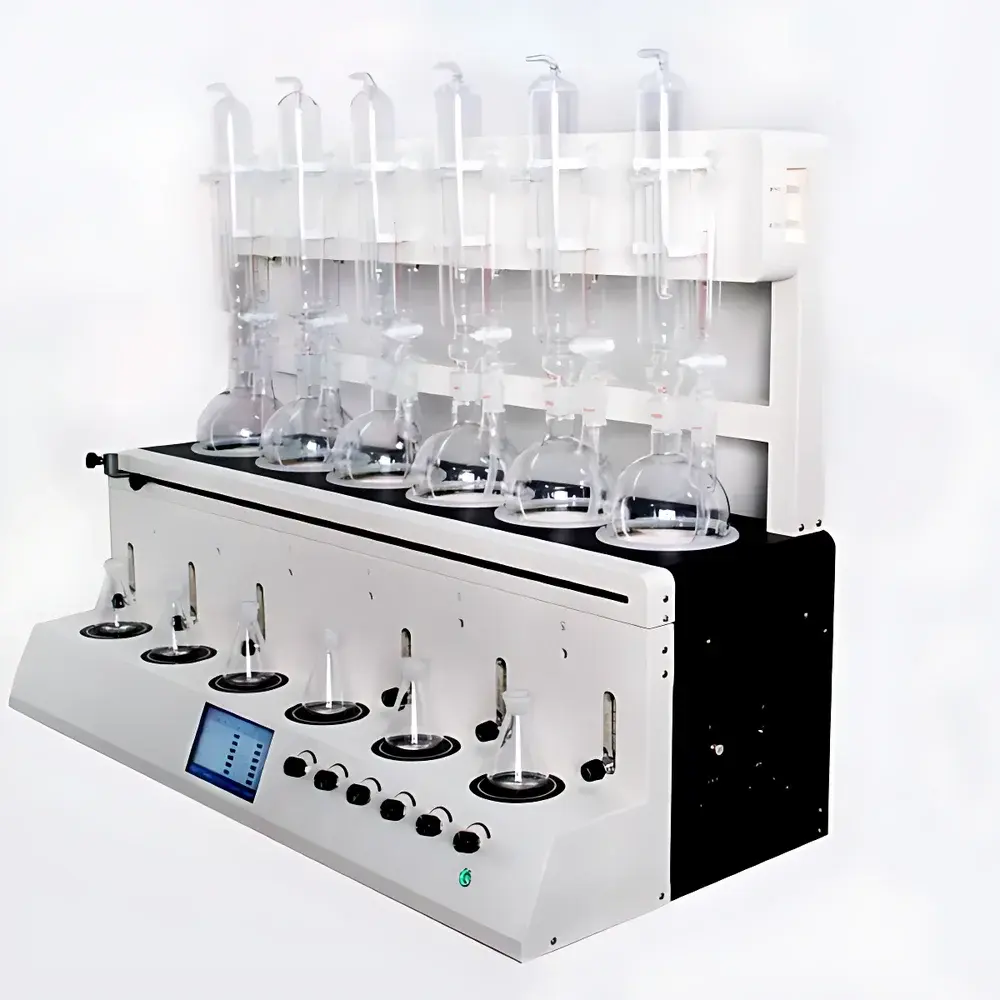
Beifen Sanpu CA-E2000 Food Sulfur Dioxide Distillation System
| Brand | Beifen Sanpu |
|---|---|
| Origin | Beijing, China |
| Manufacturer | Yes |
| Country of Origin | Domestic (China) |
| Model | CA-E2000 |
| Price | Upon Request |
| Heating Method | Far-infrared Ceramic Heater |
| Distillation Positions | 6 independent channels |
| Cooling System | Integrated Compressor-based Closed-loop Recirculating Chiller (Condensate Temp. <15 °C) |
| Nitrogen Flow Control | 0–2 L/min per channel (adjustable) |
| Timing Range | 1–999 min per channel (individual programmable) |
| Anti-suckback Valve | Integrated electromagnetic anti-backflow valve |
| Stirring | Built-in magnetic stirrer per receiving flask (speed adjustable) |
| Titration Fixture | Dedicated titration clamp integrated on mainframe |
| Power Consumption | ≤5000 W total (per-channel power adjustable) |
| Distillate Rate | 2–12 mL/min (channel-specific) |
| Heating Ramp Time | 5–8 min to setpoint |
| Flask Capacity | Six 1000 mL round-bottom flasks (customizable) |
| Dimensions (Main Unit) | 1100 × 470 × 800 mm |
| Dimensions (Compressor Unit) | 710 × 480 × 880 mm |
| Voltage | AC 220 V / 50 Hz |
Overview
The Beifen Sanpu CA-E2000 Food Sulfur Dioxide Distillation System is a dedicated, multi-channel distillation platform engineered for standardized sample preparation in sulfur dioxide (SO₂) residue analysis—specifically aligned with pharmacopoeial and national food safety testing protocols. It implements steam distillation under controlled nitrogen atmosphere, a methodologically validated approach for quantitative liberation and collection of bound SO₂ from complex organic matrices including dried herbs, processed foodstuffs, fruit products, and traditional Chinese medicinal materials. The system operates in full compliance with the analytical pre-treatment requirements specified in the *Chinese Pharmacopoeia* (2015 and 2020 editions) for SO₂ residue determination in herbal slices and decoction pieces, as well as GB 5009.34–2022, the official People’s Republic of China National Standard for “Determination of Sulfur Dioxide in Foods.” Its modular architecture enables parallel processing of up to six samples with independent thermal, gaseous, and temporal control—eliminating cross-channel interference and ensuring method reproducibility across high-throughput laboratory workflows.
Key Features
- Six independently controllable distillation channels, each equipped with far-infrared ceramic heating elements offering flameless, waterproof, and uniform thermal delivery; power per channel is individually adjustable to prevent bumping or foaming during volatile analyte release.
- Integrated compressor-driven closed-loop recirculating cooling system maintains condensate temperature below 15 °C without external water supply—critical for consistent condensation efficiency across extended batch runs.
- Per-channel nitrogen flow regulation (0–2 L/min) with digital mass flow control ensures inert atmosphere maintenance during distillation, minimizing oxidative loss and improving recovery accuracy for labile SO₂ species.
- Individual programmable timer (1–999 min) with auto-shutdown function per position, synchronized with heating activation and termination—supporting unattended operation while preserving method integrity.
- Dedicated electromagnetic anti-suckback valves installed in each vapor path to prevent post-distillation backflow of condensate into distillation flasks—a key safeguard against contamination and analytical bias.
- On-board magnetic stirring units integrated into each receiving flask holder, with manual speed adjustment, ensure homogeneous mixing during titration-ready collection and improve endpoint detection precision.
- Front-panel 7-inch capacitive touch interface with intuitive icon-driven navigation and real-time parameter monitoring—including temperature trend, elapsed time, nitrogen flow status, and cooling system performance.
Sample Compatibility & Compliance
The CA-E2000 accommodates heterogeneous solid and semi-solid food and botanical matrices, including but not limited to dried fruits, sulfited seafood, wine lees, fermented soy products, and whole or powdered herbal materials. Its 1000 mL distillation flask configuration supports both standard and modified pharmacopoeial procedures requiring larger sample masses or dilution volumes. All operational parameters—including heating ramp profiles, nitrogen purge duration, distillation hold times, and cooling setpoints—are fully configurable to align with method validation requirements under GLP and ISO/IEC 17025 frameworks. While the instrument itself does not carry CE or FDA 510(k) certification, its design and functional outputs are traceable to internationally recognized reference methods (e.g., AOAC Official Method 995.11, ISO 5775-1:2021), and raw data logs generated via optional USB export support audit readiness for regulatory submissions.
Software & Data Management
The CA-E2000 operates via embedded firmware with no external PC dependency. All user-defined methods—including channel-specific heating power (%), nitrogen flow rate (mL/min), timer settings (min), and stir speed levels—are stored locally in non-volatile memory with timestamped versioning. System event logs record start/stop timestamps, thermal anomalies, cooling fault alerts, and valve actuation cycles—retained for ≥30 days. For laboratories implementing electronic records governance, optional USB data export provides CSV-formatted session reports compatible with LIMS integration. Though not natively 21 CFR Part 11 compliant, the system supports procedural controls (e.g., operator ID entry, method lockout, audit trail review) when deployed within validated SOP environments.
Applications
- Preparative distillation for SO₂ quantification in herbal raw materials and processed TCM products prior to iodometric or spectrophotometric titration.
- High-volume SO₂ residue screening in food quality control labs servicing fruit processors, wineries, and dried seafood exporters.
- Method development and robustness testing for alternative SO₂ liberation protocols under varying pH, salt content, or matrix complexity.
- Teaching laboratories conducting validated analytical chemistry experiments aligned with pharmacopoeial curriculum standards.
- Regulatory testing facilities performing contract analyses for national food safety surveillance programs governed by GB 5009 series standards.
FAQ
Does the CA-E2000 meet ISO/IEC 17025 method validation requirements?
Yes—the instrument’s per-channel independence, programmable repeatability, and documented thermal/gas control parameters enable full method validation per ISO/IEC 17025 Clause 7.2.2, provided laboratories implement appropriate calibration and verification protocols.
Can the distillation flasks be replaced with custom glassware?
Yes—flask holders accept standard 24/40 or 29/32 ground-glass joints; users may substitute 500 mL or 2000 mL flasks depending on sample volume and method specifications.
Is remote monitoring or Ethernet connectivity available?
No—this is a standalone benchtop system with local HMI only. Networked data acquisition requires third-party serial-to-Ethernet gateways and custom scripting.
What maintenance intervals are recommended for the compressor cooling system?
Compressor oil and refrigerant levels should be verified annually; condenser coils require bi-monthly dust removal. Full service is advised every 24 months by authorized Beifen Sanpu technical personnel.
How is nitrogen flow calibrated and verified?
Each channel includes a factory-calibrated digital mass flow controller (MFC). Users may perform field verification using a NIST-traceable rotameter or bubble flowmeter at the outlet port prior to critical validation runs.
Related Products







