
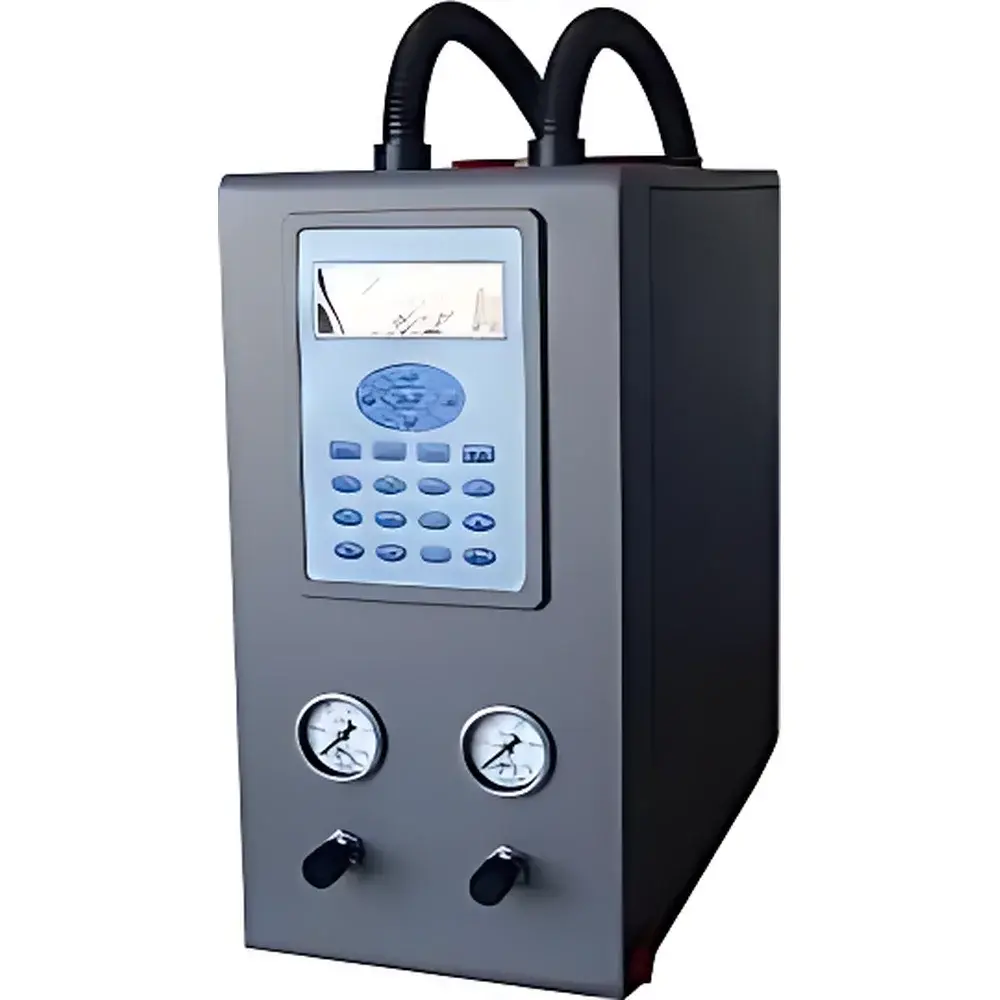
Beifen Sanpu DK-6900A Automatic Headspace Sampler
| Brand | Beifen Sanpu |
|---|---|
| Origin | Beijing, China |
| Manufacturer Type | Manufacturer |
| Product Category | Domestic |
| Model | DK-6900A |
| Instrument Type | Static Headspace Sampler |
| Automation Level | Semi-Automatic |
| Vial Heating Range | Ambient to 200 °C |
| Valve & Loop Heating Range | Ambient to 200 °C |
| Sample Loop Volume | 1 mL (0.5 mL or 3 mL optional) |
| Temperature Control Accuracy | ±0.1 °C |
| Vial Positions | 9 or 12 |
| Vial Capacity | 20 mL (10 mL optional) |
Overview
The Beifen Sanpu DK-6900A Automatic Headspace Sampler is a statically operated, semi-automated sample introduction system engineered for precise and reproducible analysis of volatile and semi-volatile organic compounds in complex matrices via gas chromatography (GC). It operates on the fundamental principle of static headspace equilibrium: a sealed sample vial is heated to a user-defined temperature, allowing volatile analytes to partition between the solid/liquid phase and the overlying gas phase. Once thermodynamic equilibrium is achieved, a precisely metered volume of the equilibrated headspace vapor is transferred—via positive-pressure sampling—through a thermostatted transfer line into the GC inlet. This methodology eliminates matrix interference from non-volatile components, reduces column contamination, and enhances detection sensitivity for trace-level volatiles. The DK-6900A integrates three independently controlled heating zones (vial block, valve/loop assembly, and transfer line), ensuring complete thermal management across the entire sample pathway to prevent condensation, adsorption, or fractionation prior to injection.
Key Features
- Electrically actuated, custom-designed 6-port rotary valve with precision-machined quantitative loop (1 mL standard; 0.5 mL or 3 mL optional), enabling high-fidelity, positive-pressure sampling and minimizing carryover.
- Circularly arranged vial heating positions (9 or 12 stations) with uniform thermal distribution, reducing inter-vial temperature gradients (< ±0.5 °C) and improving inter-run reproducibility (RSD ≤ 1.5% demonstrated at 40 ppm ethanol in water, n = 5).
- Triple-zone independent temperature control: vial block (ambient to 200 °C, 1 °C increments), valve/loop assembly (ambient to 200 °C), and transfer line (ambient to 200 °C), all stabilized to ±0.1 °C accuracy.
- Integrated reverse-purge functionality for both sampling needle and valve pathways (0–50 mL/min, continuously adjustable), effectively eliminating cross-contamination between samples.
- Onboard microprocessor control with LCD interface and membrane keypad for intuitive method setup, real-time parameter monitoring, and secure storage of up to nine user-defined methods.
- Hardware-level synchronization capability: triggers GC start, chromatography data system (CDS) acquisition, or external events via TTL or relay signals—fully compatible with Agilent, Thermo Fisher, Shimadzu, and PerkinElmer GC platforms.
- Modular needle design allows rapid interchangeability of injection needles to match septum penetration requirements and inlet configurations of diverse GC systems.
- Comprehensive safety architecture including overtemperature cutoff, thermal runaway protection, and automatic power disconnect upon critical fault detection.
Sample Compatibility & Compliance
The DK-6900A accommodates standard crimp-top or screw-cap headspace vials (10 mL and 20 mL formats), supporting widely adopted ASTM D3699 (gasoline solvents), ASTM D7622 (residual solvents in pharmaceuticals), ISO 11843-3 (detection capability estimation), and USP guidelines for residual solvent analysis. Its thermal stability, inert flow path (stainless steel and deactivated fused silica), and low-memory design meet GLP/GMP expectations for regulated environments. While not inherently 21 CFR Part 11 compliant, the instrument supports audit-trail-ready operation when paired with validated CDS software that logs method parameters, run timestamps, operator IDs, and calibration events.
Software & Data Management
The DK-6900A operates as a hardware controller without embedded PC software. All method configuration, execution scheduling, and status reporting occur via its front-panel interface. For full integration into automated laboratories, it interfaces seamlessly with third-party chromatography data systems using industry-standard digital I/O protocols. Method parameters—including vial temperature, equilibration time, pressurization pressure, loop fill time, injection time, and purge duration—are stored locally in non-volatile memory and recalled instantly. Exportable run logs (via optional RS-232 or USB-to-serial adapter) enable traceability and support quality documentation per ISO/IEC 17025 requirements.
Applications
- Pharmaceutical QC: Residual solvents (e.g., methylene chloride, acetone, ethyl acetate) in APIs and excipients per ICH Q3C and USP .
- Food & Beverage Safety: Ethanol quantification in beverages; acetaldehyde in PET packaging; hexane residues in edible oils; flavor volatiles in tea, coffee, and hops.
- Environmental Monitoring: Halogenated hydrocarbons (chloroform, bromodichloromethane) in drinking water per EPA Method 502.2 and 524.4.
- Forensic Toxicology: Blood and urine ethanol, isopropanol, and acetone profiling under forensic chain-of-custody protocols.
- Polymer & Coating Analysis: Monomer residuals (styrene, vinyl chloride) in plastics and industrial coatings.
- Medical Device Sterilization Validation: Ethylene oxide (EO) and chlorofluorocarbon (CFC) residuals in sterilized implants and packaging.
FAQ
What sample vial sizes does the DK-6900A support?
The instrument is configured for standard 20 mL headspace vials (crimp-seal), with optional 10 mL vial compatibility available via accessory heating block kits.
Is the DK-6900A fully automated or requires manual intervention?
It is a semi-automatic system: vial loading/unloading and septum piercing are manual, while heating, equilibration, pressurization, loop filling, injection, and valve purging are fully programmable and executed autonomously.
Can the DK-6900A be used with cryogenic GC inlets?
Yes—its thermostatted transfer line and valve maintain consistent temperature up to 200 °C, ensuring compatibility with both standard and cooled inlets when appropriate interface adapters are installed.
How is method validation supported?
The instrument’s stable temperature control (±0.1 °C), low RSD performance (<1.5%), and repeatable loop-based injection provide foundational parameters required for system suitability testing per pharmacopeial and regulatory guidance.
Does the DK-6900A include data integrity safeguards?
While the device itself lacks electronic signature or audit trail generation, its deterministic hardware behavior, non-volatile method storage, and synchronized event logging enable robust data governance when integrated into validated CDS environments compliant with ALCOA+ principles.





