
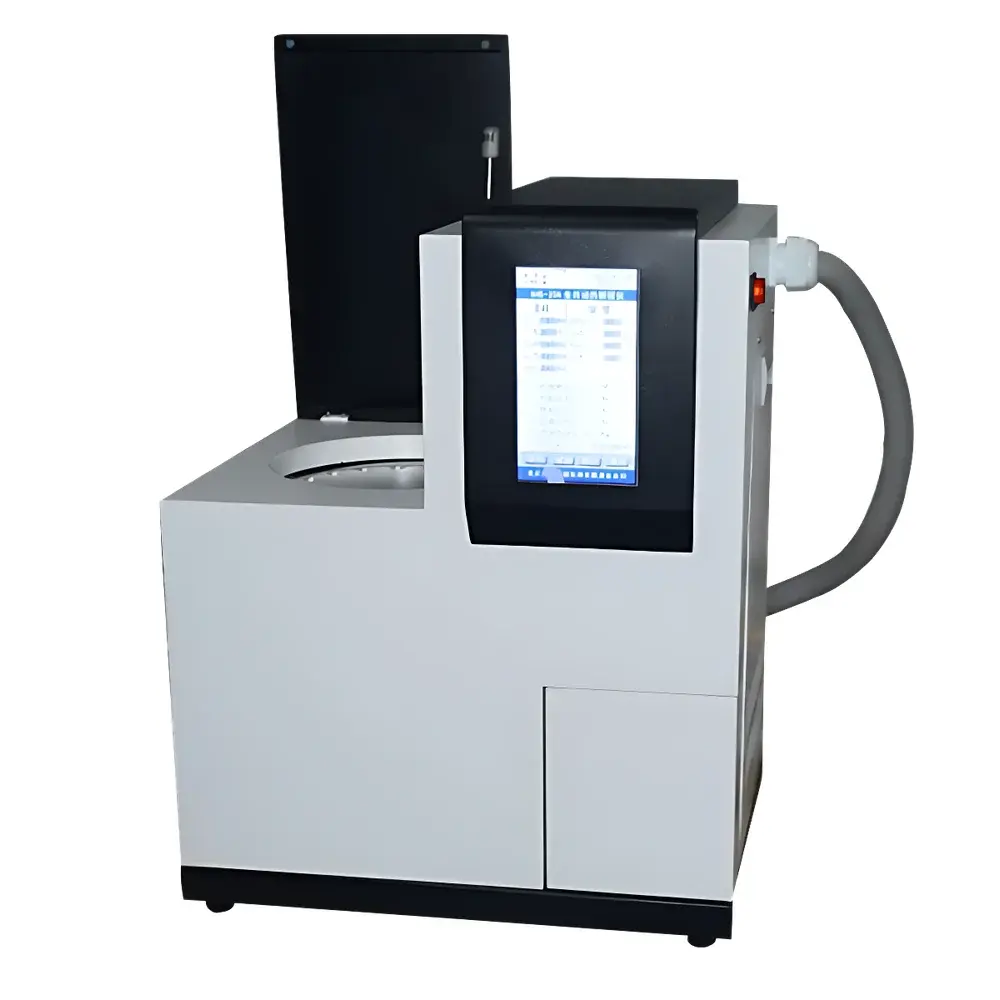
Beifen Sanpu AT-DS-20A Fully Automated Two-Stage Thermal Desorber
| Brand | Beifen Sanpu |
|---|---|
| Model | AT-DS-20A |
| Origin | Beijing, China |
| Manufacturer Type | Direct Manufacturer |
| Instrument Type | Two-Stage Thermal Desorber |
| Primary Desorption Temperature Range | Ambient to 400 °C |
| Secondary Desorption Temperature Range | 100–400 °C |
| Cold Trap Temperature Range | Down to −35 °C |
| Desorption Recovery Rate | >90% |
| Sample Capacity | 20 tubes |
Overview
The Beifen Sanpu AT-DS-20A is a fully automated two-stage thermal desorber engineered for precise, reproducible pre-concentration of volatile and semi-volatile organic compounds (VOCs and SVOCs) from sorbent tubes prior to gas chromatographic analysis. It operates on the principle of sequential thermal desorption: first-stage desorption releases analytes from the sorbent matrix into a heated transfer line; second-stage desorption focuses and re-injects the analyte band onto a cryogenically cooled trap (cold trap), followed by rapid flash desorption into the GC inlet. This architecture minimizes breakthrough, improves sensitivity, and ensures quantitative recovery across complex environmental, occupational health, and indoor air quality matrices. Designed for unattended operation in regulated laboratories, the AT-DS-20A integrates robust temperature control, inert flow pathways, and programmable method storage—making it suitable for routine compliance monitoring per EPA Method TO-17, ISO 16017-1, and ASTM D6196.
Key Features
- Two-stage desorption architecture with independent, PID-controlled heating zones for primary desorption (ambient to 400 °C) and secondary desorption (100–400 °C)
- Cryogenic cold trap capable of reaching −35 °C, enabling sharp band focusing and enhanced detection limits
- 20-position auto-sampler carousel with tube identification support and positional error detection
- Inert stainless-steel and SilcoNert®-treated flow paths to prevent adsorption or catalytic degradation of reactive analytes
- Integrated mass flow control and pressure regulation for consistent carrier gas delivery during desorption and transfer
- Comprehensive self-diagnostics, including temperature sensor validation, valve actuation verification, and leak detection routines
Sample Compatibility & Compliance
The AT-DS-20A accepts standard 6-mm OD stainless steel or glass sorbent tubes (e.g., Tenax TA, Carbopack B/C, Carboxen 1000), compatible with both single- and multi-bed configurations. It supports direct coupling to all major GC and GC-MS systems via standard 1/8″ or 1/16″ fittings. The instrument meets essential design and performance criteria referenced in EPA Method TO-17 (Determination of Volatile Organic Compounds in Ambient Air Using Active Sampling Onto Sorbent Tubes), ISO 16017-1 (Indoor, ambient and workplace air — Sampling and analysis of volatile organic compounds using sorbent tubes), and ASTM D6196 (Standard Practice for Selecting Generic Sampling and Analysis Methods for Volatile Organic Compounds). Its firmware supports audit-trail-enabled method execution and event logging, aligning with GLP and GMP documentation requirements where traceability is mandated.
Software & Data Management
Controlled via Windows-based Beifen Sanpu Thermal Desorption Workstation software, the AT-DS-20A enables full method development—including ramp rates, hold times, trap cooling/heating profiles, and GC trigger synchronization. All methods are stored with user-defined metadata (operator ID, sample ID, date/time stamp). Software enforces electronic signatures and maintains immutable audit trails compliant with FDA 21 CFR Part 11 when configured with network authentication and role-based access control. Raw desorption event logs—including actual vs. setpoint temperatures, valve timing, and pressure transients—are exportable in CSV format for QA/QC review and LIMS integration.
Applications
- Environmental monitoring: VOC profiling in ambient air, landfill emissions, and stack testing
- Occupational hygiene: Workplace exposure assessment per OSHA and NIOSH sampling protocols
- Indoor air quality (IAQ): Formaldehyde, benzene, toluene, and xylene (BTX) quantification in building materials and HVAC systems
- Product safety testing: Residual solvents in pharmaceutical packaging, polymers, and consumer goods
- Method development labs: Optimization of desorption parameters for novel sorbent media or emerging contaminants
FAQ
What maintenance intervals are recommended for optimal performance?
Daily: Visual inspection of tube ports and purge gas lines; weekly: internal dust removal using dry nitrogen; quarterly: cold trap cleaning and calibration verification against NIST-traceable standards.
Can the AT-DS-20A be integrated into an existing LIMS environment?
Yes—via configurable CSV output and optional OPC UA interface for real-time status polling and event-driven data ingestion.
Is the instrument compliant with ISO/IEC 17025 requirements for accredited testing laboratories?
The hardware design, calibration traceability (to NIST), and software audit trail functionality support ISO/IEC 17025:2017 Clause 6.4 (Equipment) and Clause 7.7 (Ensuring validity of results) when implemented with documented SOPs and periodic verification.
Does the system support method transfer between different GC platforms?
Yes—the workstation software exports method parameters in vendor-neutral format; GC-specific injection timing and oven ramp settings are maintained separately within the GC control software.
How is carryover minimized during high-concentration sample analysis?
Through programmable bake-out cycles post-desorption, inert flow path design, and automatic cold trap regeneration with helium or nitrogen purge between runs.
Related Products





