
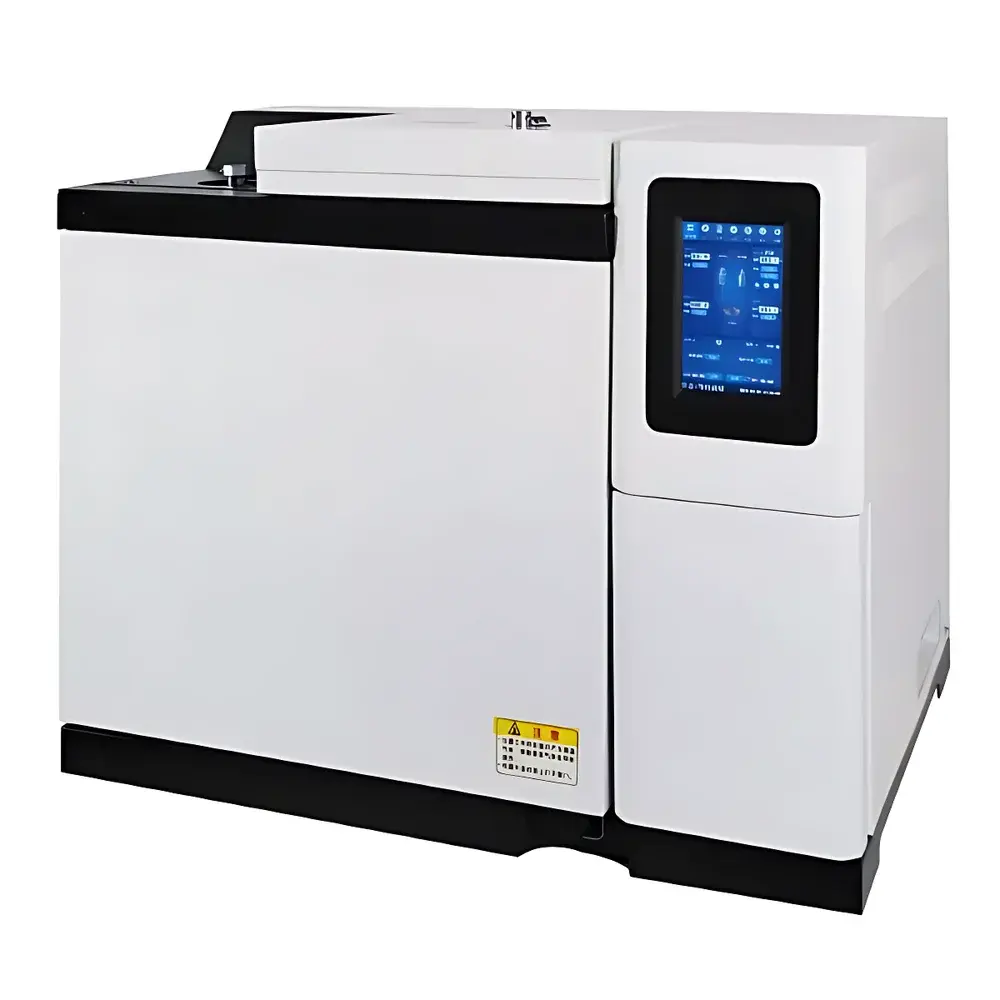
Beifen Sanpu G12C-9860 Laboratory Gas Chromatograph for Fatty Acid Methyl Ester (FAME) Analysis in Food Matrices
| Brand | Beifen Sanpu |
|---|---|
| Origin | Beijing, China |
| Manufacturer Type | Direct Manufacturer |
| Instrument Type | Laboratory Gas Chromatograph |
| Application Field | Food Industry-Specific Fatty Acid Profiling |
| Compliance | GB/T 17376–2008 & GB/T 17377–2008 |
| Detector | FID with Auto-Ignition |
| Column Compatibility | FFAP Capillary Column (30 m × 0.32 mm) |
| Temperature Control | 10-zone, ±0.1–0.2 °C accuracy, up to 450 °C |
| Programmed Heating | 16-step, 0.1–40 °C/min ramp rate |
| Data System | Built-in GC control and acquisition software with valve timing control |
Overview
The Beifen Sanpu G12C-9860 is a purpose-engineered laboratory gas chromatograph optimized for the quantitative determination of fatty acid methyl esters (FAMEs) — specifically oleic acid (C18:1), linoleic acid (C18:2), and α-linolenic acid (C18:3) — in food-grade oils, edible fats, and processed food matrices. It operates on the principle of capillary gas chromatography coupled with flame ionization detection (GC-FID), leveraging the high resolution and reproducibility of polar FFAP stationary phases to separate structurally similar unsaturated fatty acids. Unlike classical wet-chemical methods (e.g., iodine value or saponification value), which lack compound specificity, or reversed-phase HPLC approaches requiring derivatization and pure reference standards, this system implements standardized transesterification per GB/T 17376–2008 followed by direct FAME separation and quantification via external standard calibration or area normalization — exploiting the near-identical FID response factors across C16–C22 saturated and unsaturated methyl esters. The instrument satisfies full regulatory alignment with GB/T 17377–2008 for routine quality control in food manufacturing, R&D laboratories, and third-party testing facilities operating under GLP-compliant workflows.
Key Features
- Integrated 5-inch capacitive touchscreen interface with real-time chromatogram visualization, method storage, and one-touch auto-ignition sequence for FID.
- 10-zone independent temperature control system with ±0.1 °C stability over 30–450 °C range; programmable 16-step heating ramps (0.1–40 °C/min) and precise cooling via stepper-motor-driven rear door.
- Dual inlet capability (split/splitless capillary injector + optional valve-based injection) supporting simultaneous analysis of multiple sample types without hardware reconfiguration.
- FID detector engineered for trace-level sensitivity: detection limit ≤5×10⁻¹² g/s (n-hexadecane in iso-octane), baseline noise ≤5×10⁻¹⁴ A, drift ≤1×10⁻¹³ A/30 min, linear dynamic range ≥106.
- Gas delivery architecture featuring dual-stage mechanical pressure/flow regulation with digital diaphragm valves; integrated low-pressure cutoff (<0.1 MPa) to prevent column damage during carrier gas depletion.
- Built-in GC control software enabling bidirectional communication: automated oven/valve/detector parameter adjustment, peak integration, calibration curve generation, and audit-trail-ready data export compliant with 21 CFR Part 11 requirements when deployed on validated IT infrastructure.
Sample Compatibility & Compliance
The G12C-9860 accommodates liquid samples pre-derivatized into FAMEs using KOH/methanol transesterification — a procedure fully aligned with GB/T 17376–2008. Compatible matrices include vegetable oils (soybean, sunflower, olive), animal fats (lard, tallow), dairy products (butterfat), baked goods, infant formula, and fortified beverages. No solid-phase extraction or cleanup is required prior to injection when sample preparation adheres to standard protocols. The system meets national metrological verification criteria for food safety testing laboratories and supports ISO/IEC 17025 accreditation documentation through traceable calibration records, retention time locking, and system suitability test (SST) reporting. All hardware and firmware design elements conform to IEC 61010-1 safety standards for laboratory electrical equipment.
Software & Data Management
The embedded GC control platform provides native support for method development, sequence scheduling, and post-run processing without third-party dependencies. Users define injection parameters, temperature gradients, detector settings, and valve timing events directly on the instrument’s interface. Quantitative workflows include external standard calibration (with multi-point curves), area normalization, and internal standard correction (e.g., using tridecanoic acid methyl ester). Raw data files (.dat) are structured in vendor-neutral ASCII format, enabling import into LIMS environments or statistical analysis tools such as JMP or R. Audit trails record all user actions, method modifications, and instrument status changes with timestamps and operator IDs. When deployed on networked Windows systems under controlled access policies, the software supports electronic signatures and electronic record retention per FDA 21 CFR Part 11 Annex 11 guidelines.
Applications
- Quantitative profiling of omega-3 (α-linolenic), omega-6 (linoleic), and monounsaturated (oleic) fatty acids in functional foods and dietary supplements.
- Authenticity verification of premium oils (e.g., detecting adulteration of extra virgin olive oil with lower-cost seed oils).
- Stability monitoring of fried foods and snack products during shelf-life studies via oxidation-induced shifts in unsaturated:saturated FAME ratios.
- Regulatory compliance testing for mandatory nutrition labeling (e.g., EU Regulation No. 1169/2011, US FDA 21 CFR 101.9) requiring precise fatty acid composition disclosure.
- Process optimization in lipid hydrogenation, interesterification, and enzymatic modification where real-time FAME tracking informs catalyst performance and reaction endpoint determination.
FAQ
Does the G12C-9860 support ASTM D6584 or AOAC 996.06 methods?
Yes — the instrument’s temperature programming flexibility, FID linearity, and FFAP column compatibility enable full adherence to both ASTM D6584 (for biodiesel FAME analysis) and AOAC 996.06 (for total fat and fatty acid composition in foods), provided sample preparation follows method-specified derivatization protocols.
Can the system be upgraded to include an autosampler or headspace unit?
Absolutely — the chassis includes mechanical and electrical interfaces for integration with third-party liquid autosamplers (e.g., CTC PAL, Gerstel MPS) and commercial headspace samplers (e.g., Shimadzu HS-20, Thermo TriPlus RSH), retaining full software synchronization via TTL/RS-232 handshake signals.
Is method transfer possible from other GC platforms?
Yes — retention time locking (RTL) functionality ensures consistent elution order across instruments. Migration from Agilent 7890, Thermo ISQ, or Shimadzu GC-2010 systems requires only minor adjustments to flow rate and ramp rates due to identical column dimensions and detector physics.
What maintenance intervals are recommended for long-term FAME analysis reliability?
We recommend quarterly FID nozzle cleaning, biannual column trimming (10–20 cm), and annual replacement of septa, O-rings, and gas filters. GC oven insulation integrity and detector baseline stability should be verified weekly using blank injections and certified FAME reference mixtures.
Related Products





