
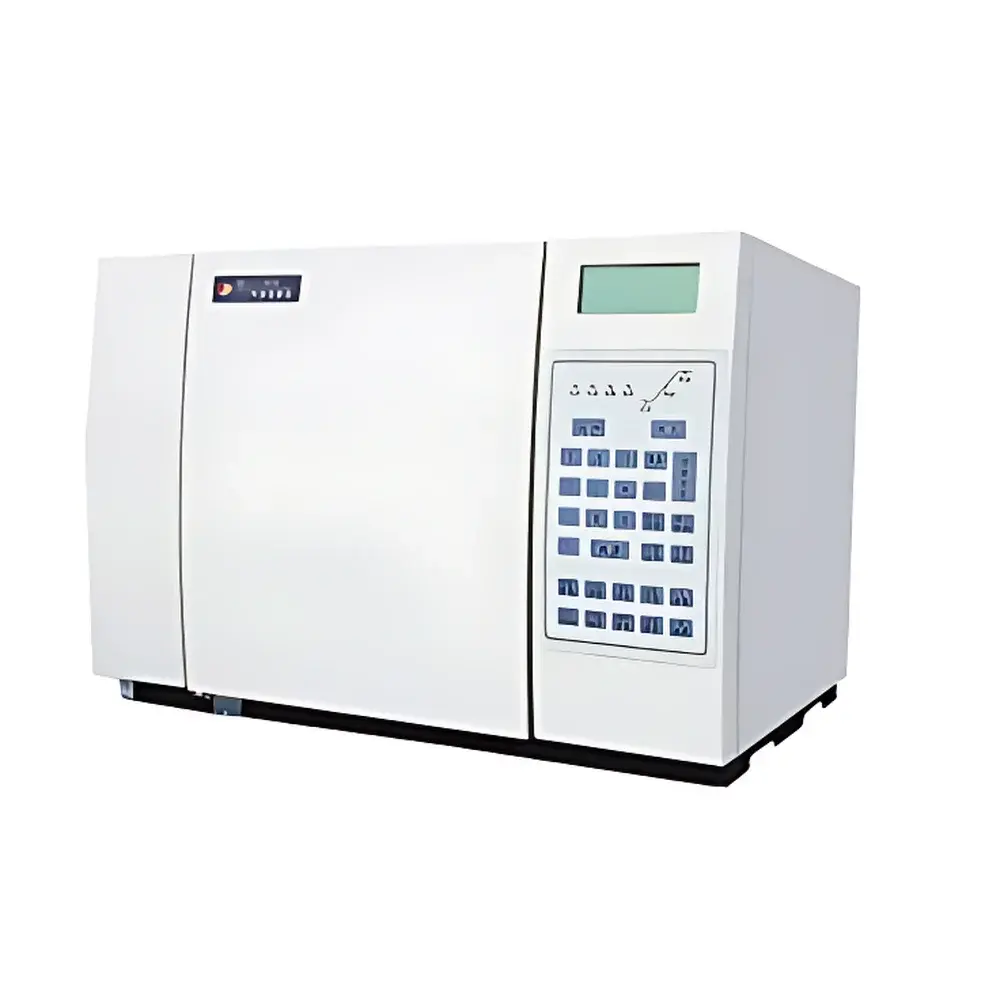
Beifen Sanpu GC-2010 Laboratory Gas Chromatograph for Acetylene Analysis in Liquid Oxygen
| Brand | Beifen Sanpu |
|---|---|
| Origin | Beijing, China |
| Manufacturer Type | Direct Manufacturer |
| Product Category | Domestic |
| Model | GC-2010 |
| Instrument Type | Laboratory Gas Chromatograph |
| Temperature Control Range | 5 °C above ambient to 400 °C |
| Max. Oven Ramp Rate | 40 °C/min |
| Cooling Rate | 320 °C/min (with intelligent back-door system) |
| Carrier Gas Flow Range & Control | 0–856 mL/min |
| Carrier Gas Pressure Range & Control | 0–621 psi |
| Injector Max. Operating Temperature | 420 °C |
| Injector Pressure Setting Range | 0–532 psi |
| Total Injector Flow Setting Range | 0–452 mL/min |
| Detection System | FID with optimized hydrocarbon response |
| Column Configuration | 50 m × 0.53 mm ID × 0.25 µm PLOT capillary column |
Overview
The Beifen Sanpu GC-2010 Laboratory Gas Chromatograph is specifically engineered for trace-level acetylene (C₂H₂) quantification in liquid oxygen (LOX) streams within air separation units (ASUs). Acetylene accumulation in cryogenic LOX is a well-documented safety hazard—its low solubility and high energy of decomposition can trigger spontaneous detonation under pressure and temperature gradients typical in main condensers. Regulatory guidelines—including those from the Chinese National Standard GB/T 20729–2006 and industrial best practices aligned with ISO 8573-1 (compressed air purity) and IEC 61511 (functional safety for process instrumentation)—mandate continuous monitoring of acetylene at sub-ppm levels (<0.1 ppm) and total hydrocarbons (<100 ppm). The GC-2010 meets this requirement through a validated enrichment-based gas chromatographic method that enables direct injection of vaporized LOX samples onto a high-resolution PLOT column, followed by flame ionization detection (FID) with enhanced sensitivity for C₁–C₄ unsaturated hydrocarbons. Its thermal architecture supports rapid, reproducible cryo-focused injection and precise temperature programming critical for resolving acetylene from co-eluting ethylene and methane peaks.
Key Features
- Eight-stage linear programmable temperature ramping (0.1–40 °C/min), enabling sharp peak resolution of volatile hydrocarbons in complex cryogenic matrices.
- Intelligent variable-frequency back-door cooling system achieving near-ambient oven temperatures (<35 °C) in ≤320 seconds—essential for baseline stability during repeated LOX sample runs.
- Dual independent injector ports: one optimized for large-bore PLOT columns (50 m × 0.53 mm), the other configurable for split/splitless or cold-on-column injection protocols.
- FID detector with digital zero adjustment, eliminating mechanical potentiometer drift and ensuring long-term baseline reproducibility (<0.5 pA RMS noise over 24 h).
- Triple gas control architecture supporting simultaneous H₂ (fuel), synthetic air (oxidant), and high-purity N₂ (carrier) delivery with real-time pressure/flow feedback loops.
- Microprocessor-controlled auto-ignition and fault diagnostics—including TCD filament protection, carrier gas failure alerts, and overtemperature cutoffs with bilingual (English/Chinese) event logging.
- Full compliance with GLP data integrity requirements: audit-trail-enabled software, electronic signatures, and 21 CFR Part 11–compatible user access controls available via optional ChromaLink™ Data Station.
Sample Compatibility & Compliance
The GC-2010 is validated for gaseous-phase analysis of vaporized liquid oxygen samples pre-treated using standardized cryogenic enrichment traps (per ASTM D7622–19 Annex A1). It accommodates direct injection of LOX headspace gases following controlled phase transition in stainless-steel sampling loops maintained at −183 °C. The system complies with ISO/IEC 17025:2017 requirements for testing laboratories, and its analytical method has been cross-verified against reference standards traceable to NIST SRM 1860a (hydrocarbon gas mixtures). All hardware components—including the BF-300E hydrogen generator and BF-2L zero-air compressor—meet CE and RoHS directives. Routine operation satisfies ASME B31.1 power piping safety codes applicable to ASU auxiliary instrumentation.
Software & Data Management
ChromaLink™ Data Station (v4.2+) provides full method development, sequence control, peak integration, and calibration curve generation—including multi-point external standardization with internal normalization for acetylene relative response factor (RRF) correction. Raw data files (.CDF) are stored with embedded metadata (operator ID, instrument serial, environmental conditions, calibration history). Audit trails record all parameter modifications, integration edits, and report exports with timestamped user attribution. Optional 21 CFR Part 11 modules support electronic signature workflows, role-based permissions, and secure database archiving compliant with FDA expectations for regulated QC environments.
Applications
- Real-time acetylene surveillance in main condenser LOX sumps of industrial air separation plants.
- Quantitative profiling of C₁–C₄ hydrocarbons (methane, ethane, ethylene, acetylene, propane, isobutane) in cryogenic oxygen streams per GB/T 20729–2006 and SH/T 0248–2006.
- Verification of molecular sieve performance in air purification systems by tracking breakthrough hydrocarbons.
- Supporting root-cause analysis during ASU operational anomalies—including oil carryover events (via concurrent FID/TCD dual detection mode).
- Method transfer and validation support for ISO/IEC 17025-accredited laboratories in petrochemical, refinery, and industrial gas production sectors.
FAQ
What minimum acetylene concentration can this system reliably quantify in liquid oxygen?
The validated method achieves a limit of quantitation (LOQ) of 0.03 ppm acetylene in LOX matrix when coupled with cryogenic pre-concentration and 50 m PLOT column separation.
Is the GC-2010 compatible with existing ASU safety monitoring infrastructure?
Yes—the instrument outputs analog 4–20 mA signals and Modbus TCP/IP for integration into DCS/SCADA platforms used in modern ASUs.
Does the system meet regulatory requirements for pharmaceutical-grade oxygen manufacturing?
While primarily deployed in industrial gas applications, the GC-2010’s hardware and optional software modules satisfy USP and EP 2.5.27 specifications for hydrocarbon impurity testing in medicinal oxygen when operated under validated SOPs.
Can the same configuration analyze other hazardous impurities such as CO, CO₂, or N₂O?
With optional TCD or methanizer/FID configurations, the platform supports extended hydrocarbon and permanent gas analysis; method development services are included with purchase.
What maintenance intervals are recommended for routine LOX monitoring operations?
Injector liner replacement every 200 injections; column bake-out weekly at 320 °C for 2 hours; FID jet cleaning monthly; full system leak-check and flow calibration quarterly.






