
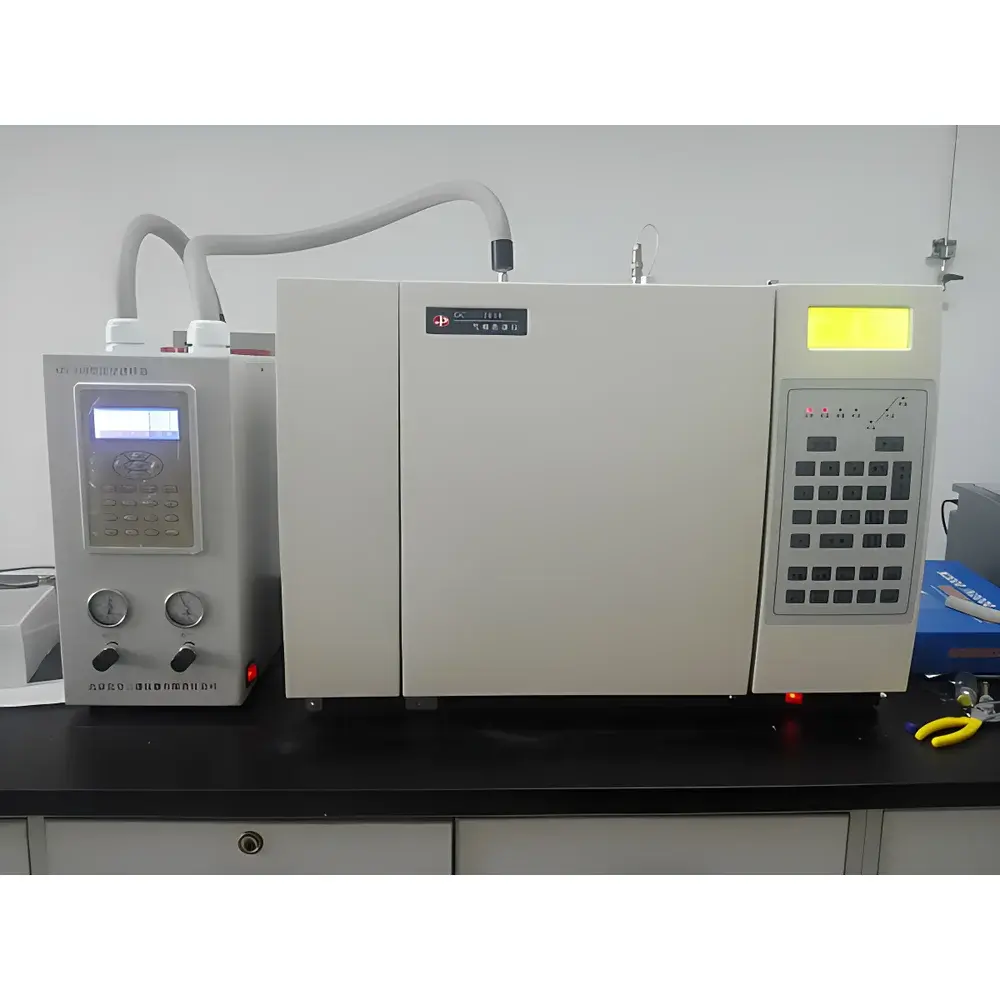
Beifen Sanpu GC-2010 Laboratory Gas Chromatograph for Ethanol Quantification in Tincture of Iodine per Chinese Pharmacopoeia 2015 Edition, Volume IV
| Brand | Beifen Sanpu |
|---|---|
| Origin | Beijing, China |
| Manufacturer Type | Manufacturer |
| Instrument Type | Laboratory Gas Chromatograph |
| Application Field | Pharmaceutical Analysis |
| Oven Temperature Range | Ambient to 400°C |
| Ramp Rate | 0.1–40°C/min |
| Cool-down Rate | 400°C to 50°C in ≤6 min |
| Carrier Gas Flow Range & Control | 0–1200 mL/min |
| Carrier Gas Pressure Range & Control | 0–800 kPa |
| Injector Maximum Temperature | 400°C |
| Injector Pressure Setting Range | 0–800 kPa |
| Injector Total Flow Setting Range | 0–1200 mL/min |
Overview
The Beifen Sanpu GC-2010 is a dedicated laboratory gas chromatograph engineered for precise, reproducible quantification of ethanol in iodine tincture formulations, fully compliant with the methodology stipulated in the Chinese Pharmacopoeia (2015 Edition, Volume IV), General Chapter 0711 “Determination of Ethanol Content” and General Chapter 0521 “Gas Chromatography”. This system implements headspace-gas chromatography (HS-GC) with flame ionization detection (FID) to determine ethanol concentration (v/v % at 20°C) in aqueous-alcoholic pharmaceutical preparations where ethanol serves both as a solubilizing vehicle for iodine and as an active antimicrobial agent. The instrument operates on the principle of volatile compound partitioning between liquid phase and headspace vapor, followed by separation on a capillary column and quantitative detection via FID—ensuring high selectivity, linearity, and robustness under regulated pharmaceutical testing conditions.
Key Features
- Programmable temperature-controlled oven with precise ramping (0.1–40°C/min) and rapid cool-down (400°C → 50°C in ≤6 min), enabling strict adherence to pharmacopoeial temperature gradients: 40°C (2 min) → 65°C (3°C/min) → 200°C (25°C/min, hold 10 min).
- Dual independent pressure/flow control modules for carrier gas (N₂, H₂, or air), supporting both constant-pressure and constant-flow modes across a wide operational range (0–800 kPa; 0–1200 mL/min).
- High-temperature injector (up to 400°C) compatible with split injection (1:1 split ratio) and optimized for headspace vial transfer, minimizing carryover and thermal degradation of volatile analytes.
- FID detector with stable baseline performance (≤0.05 pA drift over 30 min), operating at 220°C to ensure complete combustion and linear response over 10⁶ dynamic range.
- Integrated hardware interface for AHS-610 automated headspace sampler, enabling programmable equilibration (85°C, 20 min), pressurized vial transfer, and precise loop injection—critical for meeting USP and ChP repeatability requirements (RSD ≤2.0% for correction factor determination).
Sample Compatibility & Compliance
The GC-2010 system is validated for analysis of iodine tincture and related ethanol-containing topical antiseptics, including veterinary-grade formulations. It supports both capillary column (30 m × 0.53 mm × 3.00 µm, 6% cyanopropylphenyl–94% dimethylpolysiloxane) and packed column configurations per ChP 0711 Method I and II. System suitability criteria—including theoretical plate count ≥10,000 (ethanol peak), resolution >2.0 between ethanol and internal standard (n-propanol), and absence of interfering peaks at the n-propanol retention time—are routinely verifiable using N2000 chromatography workstation. The configuration meets essential regulatory expectations for GLP-compliant laboratories, including traceable calibration records, audit-ready sequence logs, and secure user access controls aligned with FDA 21 CFR Part 11 principles when paired with validated software protocols.
Software & Data Management
The included N2000 chromatography data system (CDS) provides full method development, acquisition, integration, and reporting capabilities. It supports dual-column validation workflows, automatic correction factor calculation from replicate injections, and direct export of quantitative results (v/v % ethanol) with uncertainty estimation. All raw data files are timestamped and digitally signed; audit trails record operator actions, parameter changes, and reprocessing events. Integration with LIMS is facilitated via ASCII and CSV export formats. For regulated environments, optional 21 CFR Part 11 compliance packages include electronic signatures, role-based permissions, and immutable archive functionality—ensuring data integrity throughout the analytical lifecycle.
Applications
- Quantitative ethanol assay in iodine tincture (ChP 2015 Vol. IV, 0711) and other alcoholic antiseptic solutions (e.g., tincture of chlorhexidine, compound tincture of benzoin).
- Residual solvent analysis in pharmaceutical excipients and finished dosage forms per ICH Q3C guidelines.
- Stability-indicating assays for ethanol loss monitoring during accelerated storage studies.
- Quality control release testing of veterinary disinfectants where ethanol concentration directly impacts microbiological efficacy.
- Method transfer support for laboratories transitioning from distillation-based assays to chromatographic reference methods, as mandated by ChP footnote: “Where discrepancies arise between distillation and GC results, the GC result shall prevail.”
FAQ
Which column specifications satisfy ChP 0711 Method I requirements?
A 30 m × 0.53 mm × 3.00 µm capillary column coated with 6% cyanopropylphenyl–94% dimethylpolysiloxane is recommended for optimal resolution and efficiency (N ≥10,000).
Is the GC-2010 compatible with both manual and automated headspace sampling?
Yes—the system supports manual syringe injection of headspace gas and integrates seamlessly with the AHS-610 autosampler for unattended, temperature- and time-controlled equilibration and injection.
What internal standard is specified in ChP 0711, and why is it required?
n-Propanol is mandated as the internal standard to compensate for variability in headspace equilibrium, injection volume, and detector response—ensuring accuracy and precision across sample batches.
Does the system meet minimum resolution and theoretical plate requirements for pharmacopoeial validation?
When operated under prescribed conditions (oven program, detector settings, column dimensions), the GC-2010 consistently achieves resolution >2.0 between ethanol and n-propanol and theoretical plate counts ≥10,000 for ethanol—fulfilling ChP 0711 system suitability criteria.
Can this configuration be used for other residual solvent analyses beyond ethanol?
Yes—by modifying the temperature program, column selection, and internal standard, the platform supports multi-analyte residual solvent profiling per ICH Q3C, including methanol, acetone, dichloromethane, and ethyl acetate.






