
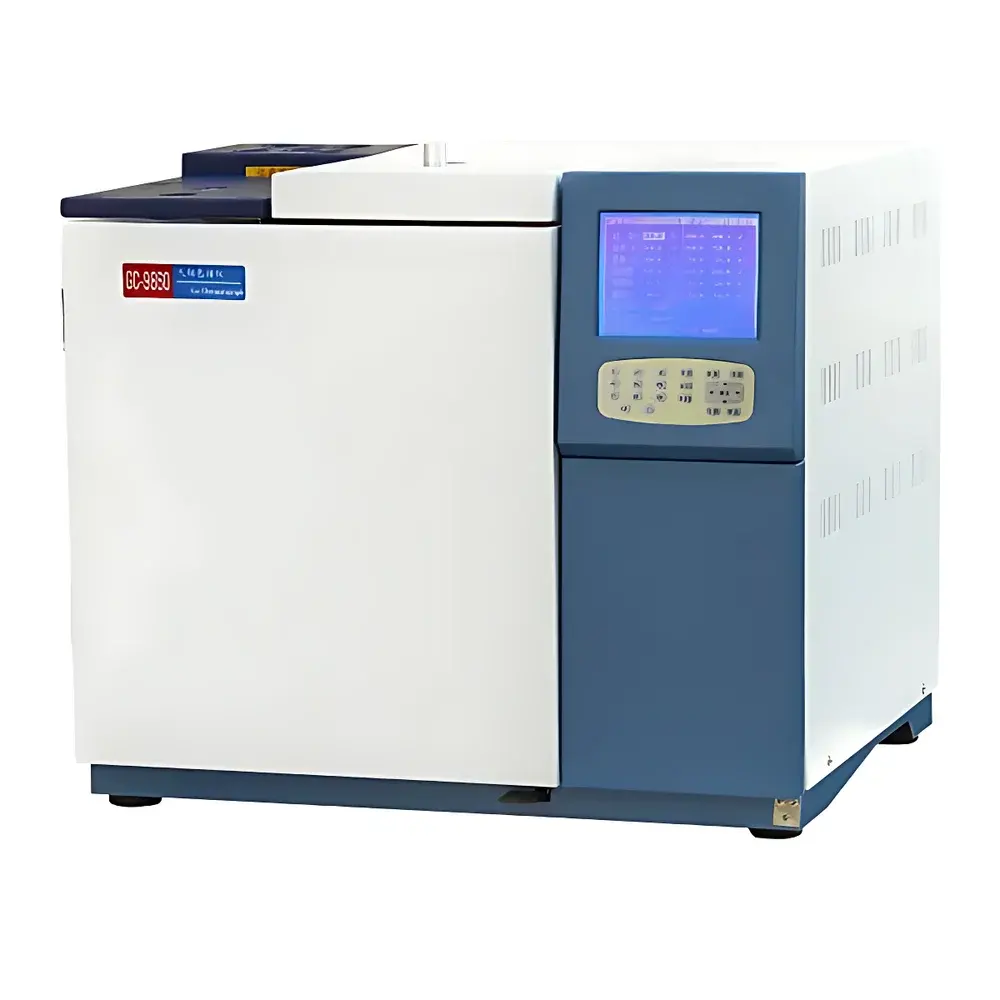
Beifen Sanpu GC-9860-FID Gas Chromatograph for Methanol Analysis in Baijiu
| Brand | Beifen Sanpu |
|---|---|
| Model | GC-9860-FID |
| Instrument Type | Laboratory Gas Chromatograph |
| Application Field | Alcoholic Beverage Chromatography |
| Oven Temperature Range | 450 °C |
| Oven Ramp Rate | 0–40 °C/min |
| Oven Cool-down Time | ~8 min |
| Carrier Gas Flow Control Range | 0–1200 mL/min |
| Carrier Gas Pressure Control Range | 0–1000 kPa |
| Injector Max Temp | 450 °C |
| Injector Pressure Setting Range | 0–1000 kPa |
| Injector Total Flow Setting Range | 0–1200 mL/min |
Overview
The Beifen Sanpu GC-9860-FID Gas Chromatograph is a dedicated laboratory-scale gas chromatographic system engineered for precise, reproducible quantification of methanol in traditional Chinese distilled spirits (baijiu) and other alcoholic beverages. It operates on the principle of capillary gas chromatography coupled with flame ionization detection (FID), enabling selective separation and sensitive detection of volatile organic compounds based on differential partitioning between a mobile phase (high-purity carrier gas) and a stationary phase (polyethylene glycol–coated fused-silica capillary column). The instrument complies with GB 5009.266–2016, the official Chinese national standard for methanol determination in food, and supports full method validation under GLP-aligned laboratory practices. Its thermal architecture—featuring an eight-stage programmable temperature ramp, precise oven temperature control (±0.1 °C), and rapid cool-down (~8 min from 450 °C to 50 °C)—ensures high-throughput analysis without compromising retention time stability or peak shape fidelity.
Key Features
- High-stability FID detector with linear dynamic range >107 and low noise (<0.03 pA RMS), optimized for trace-level methanol quantification in complex ethanol matrices.
- Dual independent temperature zones: programmable oven (450 °C max, 0–40 °C/min ramp) and heated split/splitless injector (450 °C max), both with real-time PID control and digital pressure/flow regulation.
- Integrated carrier gas control system supporting N2, H2, or He with electronic pressure control (EPC) across 0–1000 kPa and mass flow control (MFC) across 0–1200 mL/min.
- Capillary-ready configuration with standard 60 m PEG-based fused-silica column (0.25 mm ID, 0.25 μm film thickness), validated for baseline resolution of methanol, ethanol, and internal standard (tert-amyl alcohol).
- Robust hardware architecture designed for continuous operation in QC laboratories: corrosion-resistant gas pathways, sealed detector chamber, and modular electronics with firmware-upgradable architecture.
Sample Compatibility & Compliance
The GC-9860-FID is validated for direct injection of derivatized and non-derivatized aqueous-ethanolic extracts from baijiu, huangjiu, distilled spirits, and flavored liquors following distillation-based sample cleanup per GB 5009.266–2016. It accommodates 1.0 μL split injections (20:1 ratio) and supports internal standard calibration using tert-amyl alcohol (CAS 75-85-4), ensuring matrix-matched compensation for injection variability and ethanol-induced suppression effects. The system meets essential regulatory requirements for food safety testing laboratories, including alignment with ISO/IEC 17025:2017 analytical method validation criteria (specificity, linearity, LOD/LOQ, precision, recovery), and supports audit-ready documentation for FDA 21 CFR Part 11–compliant data integrity when paired with validated chromatography data systems (CDS).
Software & Data Management
The instrument is operated via Beifen Sanpu’s certified chromatography workstation software, compliant with GxP data handling principles. The software provides full instrument control, automated sequence execution, peak integration with customizable baselines and retention time windows, and report generation in PDF and CSV formats. Audit trail functionality logs all user actions—including method edits, integration parameter changes, and result reprocessing—with timestamped, non-erasable records. Calibration curves are stored with metadata (date, analyst, standard lot numbers, R2 values), and raw data files (.cdf or .raw) retain full spectral and timing information for retrospective re-evaluation. Export options support LIMS integration via ASTM E1381-compliant file transfer protocols.
Applications
This system delivers reliable methanol quantification across diverse alcoholic beverage matrices where regulatory compliance and batch release testing are critical. Primary applications include routine QC screening of baijiu production batches, verification of distillation efficiency in artisanal spirit facilities, and forensic analysis of adulterated or illegally distilled products. Method performance characteristics—LOD 7.5 mg/L and LOQ 25 mg/L—meet statutory thresholds set by China’s National Health Commission and align with international benchmarks for methanol in potable alcohol (e.g., WHO guidelines, EU Regulation (EC) No 110/2008). Additional validated uses include simultaneous determination of higher alcohols (propanol, isobutanol, amyl alcohols) and esters when paired with appropriate column chemistries and gradient methods.
FAQ
What regulatory standard does this method comply with?
GB 5009.266–2016, “Determination of Methanol in Foods”, issued by the Standardization Administration of China.
Is the 60 m PEG column included with the system?
Yes—the system ships with one 60 m polyethylene glycol (PEG)-phase fused-silica capillary column (0.25 mm ID, 0.25 μm film thickness), pre-conditioned and verified for methanol/ethanol separation.
Can the GC-9860-FID be used for other volatile analytes beyond methanol?
Yes; with column and method reconfiguration, it supports analysis of congeners, fusel oils, ethyl carbamate, and residual solvents in accordance with AOAC, USP , and ISO 17025–validated procedures.
What gas supply requirements are necessary for FID operation?
Hydrogen (≥99.999% purity), compressed air (oil-free, dew point ≤ –40 °C), and carrier gas (N2, H2, or He); all supported via integrated EPC/MFC modules or external gas generators.
Does the system support 21 CFR Part 11 compliance?
The hardware and firmware support Part 11–aligned workflows when deployed with validated third-party CDS software featuring electronic signatures, role-based access control, and immutable audit trails.
Related Products





