
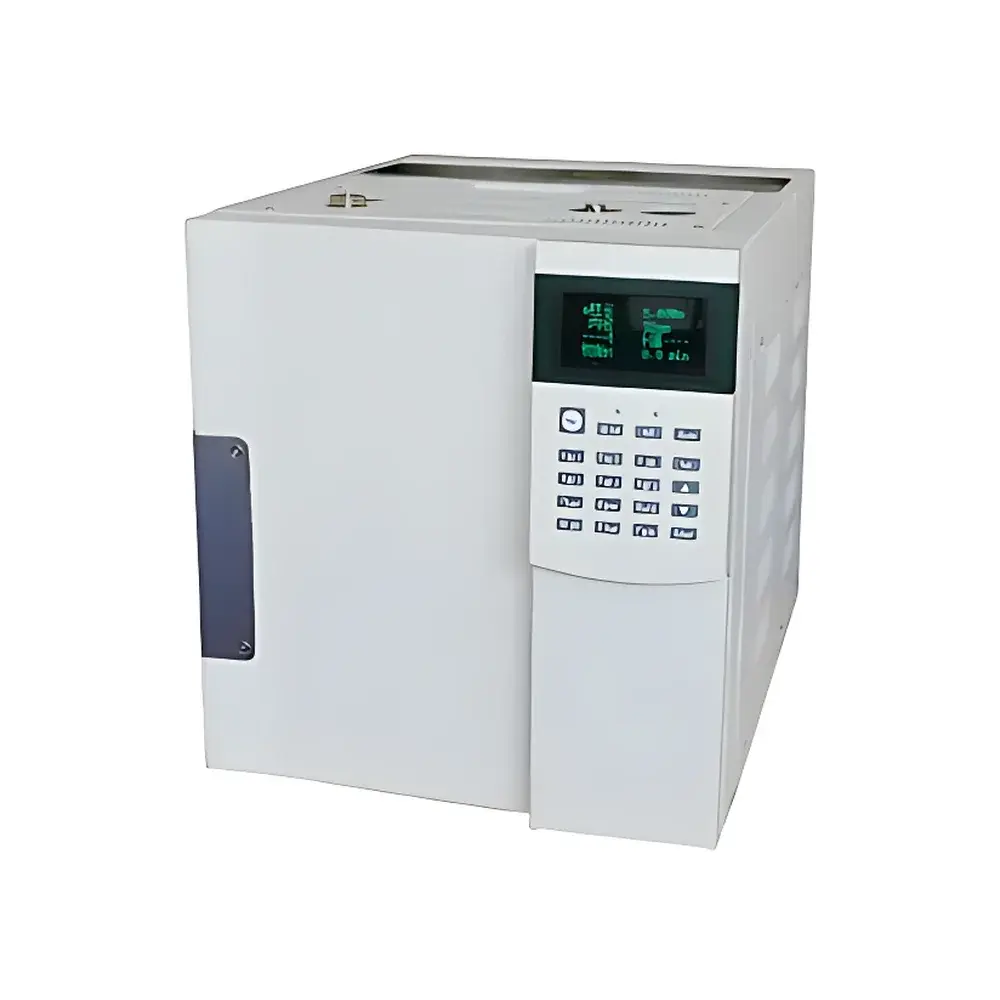
Beifen Sanpu GC-9860-W-A Networked Gas Chromatograph with FID and Integrated Headspace Analysis Capability for Methanol Quantification in Perfumes
| Key | Brand: Beifen Sanpu |
|---|---|
| Origin | Beijing, China |
| Manufacturer Type | Direct Manufacturer |
| Instrument Type | Laboratory Gas Chromatograph |
| Application Field | Pharmaceutical & Cosmetic Quality Control |
| Max Oven Temperature | 450 °C |
| Heating Rate | 0.1–80 °C/min |
| Cooling Rate | 40 °C/min |
| Carrier Gas Flow Range | 0–1200 sccm |
| Carrier Gas Pressure Range | 0–0.4 MPa |
| Injector Max Temp | 450 °C |
| Injector Pressure Set Range | 0–0.4 MPa |
| Injector Total Flow Set Range | 0–1200 sccm |
Overview
The Beifen Sanpu GC-9860-W-A is a network-enabled, research-grade gas chromatograph engineered for precise, reproducible headspace analysis of volatile organic compounds—specifically methanol—in complex, non-volatile matrices such as perfumes, fragranced cosmetics, and aerosol sprays. It operates on the principle of static headspace gas chromatography coupled with flame ionization detection (FID), enabling quantitative determination without solvent extraction or derivatization. The method complies with GB 7917.4–1987, the Chinese National Standard for Chemical Testing of Cosmetics, which mandates methanol quantification at trace levels (≤0.2% v/v) due to its neurotoxic and systemic health hazards upon dermal or inhalational exposure. The system integrates a thermally stabilized oven, EPC-controlled carrier and detector gases, and a high-sensitivity FID with linear dynamic range ≥10⁶, ensuring compliance-ready performance under GLP and ISO/IEC 17025 laboratory frameworks.
Key Features
- Full electronic pressure and flow control (EPC/EFC) across six independently programmable temperature zones—including oven, injector(s), and detector(s)—with pressure resolution ±0.01 kPa and flow resolution ±0.01 sccm.
- Vacuum fluorescent display (VFD) interface supporting real-time parameter monitoring, method recall, and remote diagnostics via embedded Ethernet (IEEE 802.3).
- High-speed thermal management: 0.1–80 °C/min ramp rate and 40 °C/min cooling rate, enabling rapid cycle times for high-throughput perfume QC labs.
- Automatic fault protection: integrated gas leak detection, auto-shutdown during pressure deviation, and sequential EPC-initiated startup/shutdown sequences for unattended overnight operation.
- Dual-detector compatibility: configurable with FID (detection limit ≤3×10⁻¹² g/s), TCD, ECD, FPD, or NPD—supporting multi-analyte validation protocols per ICH Q2(R2) guidelines.
- Modular inlet architecture: supports split/splitless capillary injection, packed-column analysis, and direct coupling to third-party or Beifen Sanpu AHS-20A 20-position automated headspace samplers.
Sample Compatibility & Compliance
The GC-9860-W-A is validated for aqueous-organic emulsions and ethanol-based fragrance formulations where methanol coexists with high-boiling terpenes, aldehydes, and musks. Its inert flow path—from heated transfer line (up to 200 °C) through GDX-201 porous polymer PLOT column—to FID ensures minimal adsorption and peak tailing. Method robustness meets ASTM D3699 (for alcohol content in consumer products) and aligns with FDA’s guidance on residual solvents in topical products (ICH Q3C). All data acquisition and audit trails comply with 21 CFR Part 11 requirements when used with compliant chromatography data systems (CDS), including full electronic signature support, user access controls, and immutable raw-data archiving.
Software & Data Management
Instrument control and data processing are executed via optional Beifen Sanpu ChromaLink CDS v3.x or third-party platforms (e.g., OpenLab CDS, Chromeleon) through standard TCP/IP communication. The system logs all method parameters, calibration events, and sequence execution metadata with time-stamped, user-attributed entries. Audit trail functionality records operator actions, method modifications, and result reprocessing—fully traceable for regulatory inspections. Raw chromatograms are stored in open-format .cdf files compatible with LIMS integration and statistical process control (SPC) dashboards.
Applications
- Quantitative methanol assay in alcoholic perfumes, eau de toilettes, and hair sprays per GB 7917.4–1987 and EU Cosmetics Regulation (EC) No 1223/2009 Annex II restrictions.
- Residual solvent profiling in pharmaceutical excipients and nasal spray formulations using headspace-GC/FID.
- Stability-indicating assays tracking methanol generation from ester hydrolysis during accelerated shelf-life studies.
- Raw material screening of denatured ethanol batches for clandestine methanol adulteration.
- Method transfer between QC labs using standardized EPC methods, minimizing retention time drift across instruments.
FAQ
What is the minimum detectable concentration of methanol in perfume using this system?
Detection limits depend on sample volume, headspace vial size, and equilibrium conditions—but typical LOQ is 10–50 ppm (v/v) under optimized 50 °C/15 min equilibration with 1 mL sample in 20 mL vials.
Can the GC-9860-W-A be operated remotely for 24/7 unattended analysis?
Yes. Its embedded Ethernet interface, automatic ignition, EPC-driven startup/shutdown, and hardware-level fault recovery enable secure remote scheduling and monitoring via LAN or VPN.
Is GDX-201 the only column supported for methanol analysis?
No. While GDX-201 delivers optimal resolution for low-MW alcohols in ethanol-rich matrices, alternative columns—including DB-ALC1, HP-INNOWAX, or Rtx-Volatiles—are method-qualified for expanded analyte panels.
Does the system meet ISO/IEC 17025 calibration traceability requirements?
All temperature and pressure sensors are factory-calibrated against NIST-traceable standards; users may perform in-house verification using certified reference materials (e.g., NIST SRM 1696 methanol-in-ethanol standards).
How is data integrity ensured during long-term deployment in regulated environments?
The instrument generates immutable audit logs, supports role-based access control, and retains full raw-data history—including baseline corrections and integration events—with digital signatures compliant with ALCOA+ principles.




