
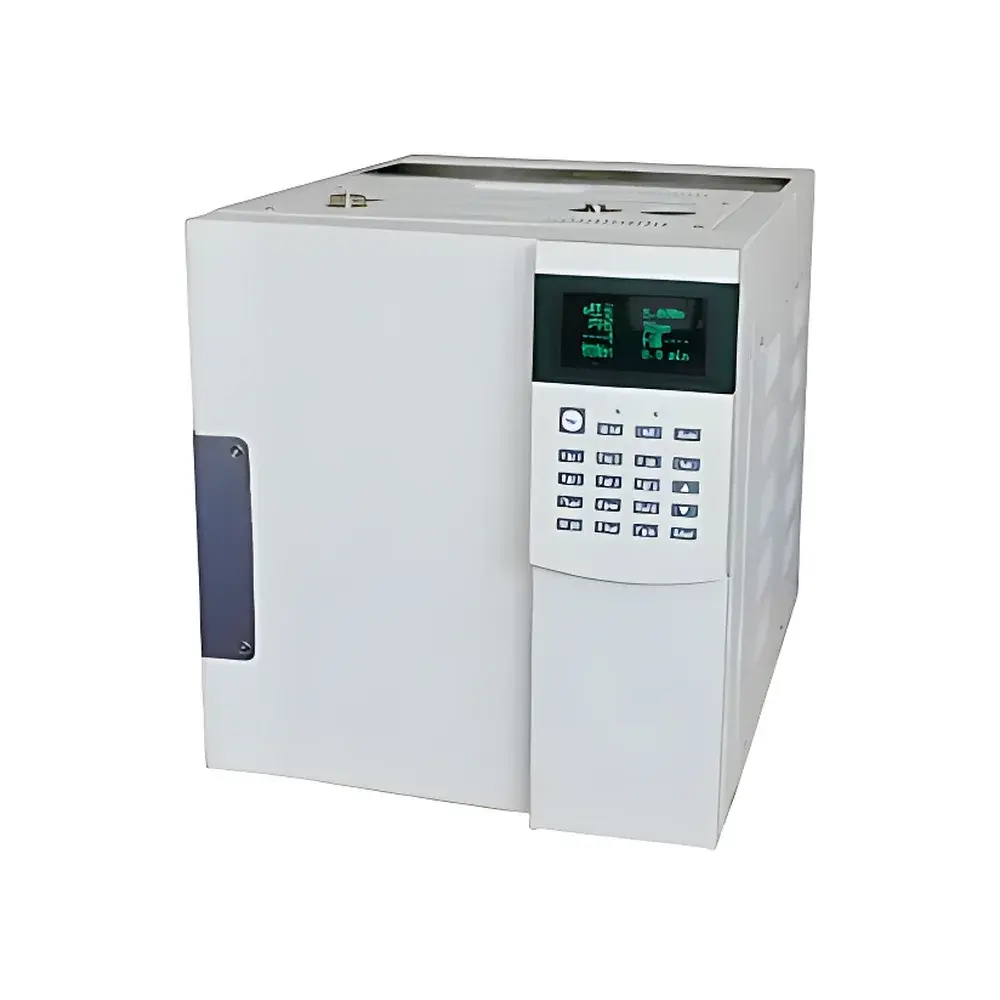
Beifen Sanpu GC-9860-W Networked Gas Chromatograph for Hexane Solvent Residue (No. 6 Solvent) and Fatty Acid Profile Analysis in Edible Oils
| Brand | Beifen Sanpu |
|---|---|
| Origin | Beijing, China |
| Manufacturer Type | Direct Manufacturer |
| Instrument Type | Laboratory Gas Chromatograph |
| Application Field | Food Industry-Specific |
| Temperature Control Range | Up to 450 °C |
| Maximum Ramp Rate | 50 °C/min |
| Cooling Rate | 40 °C/min |
| Carrier Gas Flow Range & Control | 0–1200 sccm |
| Carrier Gas Pressure Range & Control | 0–0.4 MPa |
| Injector Max Operating Temperature | 450 °C |
| Injector Pressure Setting Range | 0–0.4 MPa |
| Total Injector Flow Setting Range | 0–1200 sccm |
Overview
The Beifen Sanpu GC-9860-W is a purpose-engineered networked gas chromatograph designed for regulatory-compliant quantification of residual hexane (commonly referred to as “No. 6 solvent”) and fatty acid composition profiling in edible oils produced via solvent extraction. This instrument implements capillary gas chromatography with flame ionization detection (GC-FID), optimized specifically for the analysis of C5–C7 aliphatic hydrocarbons—including n-hexane, 2-methylpentane, 3-methylpentane, and cyclohexane—that constitute industrial-grade No. 6 solvent. The method aligns with national food safety standards in China (e.g., GB 5009.262–2016) and supports international equivalency assessments under ISO 5508 (Animal and vegetable fats and oils — Determination of residual solvents) and AOAC Official Method 992.15. Its core architecture integrates electronic pressure control (EPC), vacuum fluorescent display (VFD) interface, and IEEE 802.3 Ethernet connectivity—enabling traceable, auditable, and remotely operable analysis workflows essential for food quality control laboratories operating under GLP or HACCP frameworks.
Key Features
- 6-zone independent temperature control with precision of ±0.1 °C across a range of ambient +4 °C to 450 °C, supporting complex multi-step oven programs (up to 16 ramp stages)
- High-speed thermal management: programmable ramp rates up to 80 °C/min and rapid cooling at 40 °C/min for cycle time reduction without compromising column integrity
- Fully integrated EPC/EFC system for carrier gases (N2, H2, He, Ar, air), offering dual-mode operation (constant flow or constant pressure) with pressure resolution of 0.01 kPa and flow resolution of 0.01 sccm
- Dual-detector capability: factory-configured FID with detection limit ≤3×10⁻¹² g/s (n-hexadecane), plus optional TCD, ECD, FPD, or NPD modules for expanded analyte coverage
- Capillary inlet system compatible with split/splitless injection and auto-sampler integration; injector maximum temperature rated to 450 °C with pressure and total flow digital setpoints
- Self-diagnostic gas path logic: automatic shutdown on pressure anomaly, flame-out detection with auto-reignition, and scheduled gas valve sequencing during startup/shutdown
Sample Compatibility & Compliance
The GC-9860-W is validated for direct analysis of crude and refined edible oils—including soybean, rapeseed, peanut, and cottonseed oils—following standardized sample preparation per GB/T 5009.37 and ISO 12966-2. It accommodates headspace vial analysis (with optional autosampler), liquid-phase injection of oil extracts, and derivatized fatty acid methyl ester (FAME) preparations. All hardware and firmware comply with electromagnetic compatibility (EMC) directive IEC 61326-1 and safety standard IEC 61010-1. Data acquisition meets FDA 21 CFR Part 11 requirements when paired with compliant chromatography data systems (CDS), supporting electronic signatures, audit trails, and role-based access control.
Software & Data Management
Control and data handling are performed via embedded web-server interface accessible through any standard browser over local area network or secure VPN. Real-time monitoring includes live chromatogram streaming, detector status telemetry, and EPC parameter logging at 100 ms intervals. Raw data files conform to ASTM E1947-compliant .CDF format, ensuring interoperability with third-party CDS platforms including OpenLab CDS, Chromeleon, and Empower. Sequence methods support automatic calibration curve generation (linear, quadratic, or weighted), peak integration using tangent skim or valley-to-valley algorithms, and reporting templates aligned with ISO/IEC 17025 clause 7.8. Audit trail records capture user actions, method modifications, and instrument state changes with timestamp and operator ID.
Applications
- Quantitative determination of residual No. 6 solvent in solvent-extracted edible oils at levels down to 0.1 mg/kg (LOQ), meeting China’s national limit of 10 mg/kg (GB 2716–2018)
- Fatty acid methyl ester (FAME) profiling for authenticity verification, adulteration screening, and nutritional labeling compliance (e.g., saturated vs. unsaturated fat ratios)
- Stability assessment via oxidation marker detection (e.g., hexanal, pentanal) in stored oils using optional FPD or ECD configurations
- Multi-residue screening of volatile organic contaminants—including benzene, toluene, and chlorinated hydrocarbons—in refined oil batches
- Method transfer and validation support for contract testing laboratories serving ISO/IEC 17025-accredited food safety programs
FAQ
What is the primary regulatory standard this instrument supports for hexane residue testing?
It is fully compatible with GB 5009.262–2016 (“National Food Safety Standard – Determination of Residual Solvents in Foods”) and supports method adaptation for ISO 5508 and AOAC 992.15.
Can the GC-9860-W be integrated into an existing LIMS environment?
Yes—via its native HTTP/HTTPS API and ASTM E1947-compliant data export, it interfaces directly with major LIMS platforms using RESTful protocols or file-based ingestion.
Is helium required as carrier gas, or can nitrogen be used without performance loss?
Both gases are supported; nitrogen is commonly used for cost-effective routine analysis of No. 6 solvent, while helium provides superior resolution for complex FAME mixtures.
Does the system include validation documentation for GxP environments?
Factory-installed IQ/OQ documentation is provided; PQ protocols must be developed per site-specific SOPs and qualified against reference standards traceable to NIST or CNAS-certified materials.
What maintenance intervals are recommended for the FID and EPC modules?
FID jet cleaning every 200 injections; EPC sensor calibration annually or after 5000 pressure cycles—both tracked automatically within the instrument’s service log.
Related Products






