
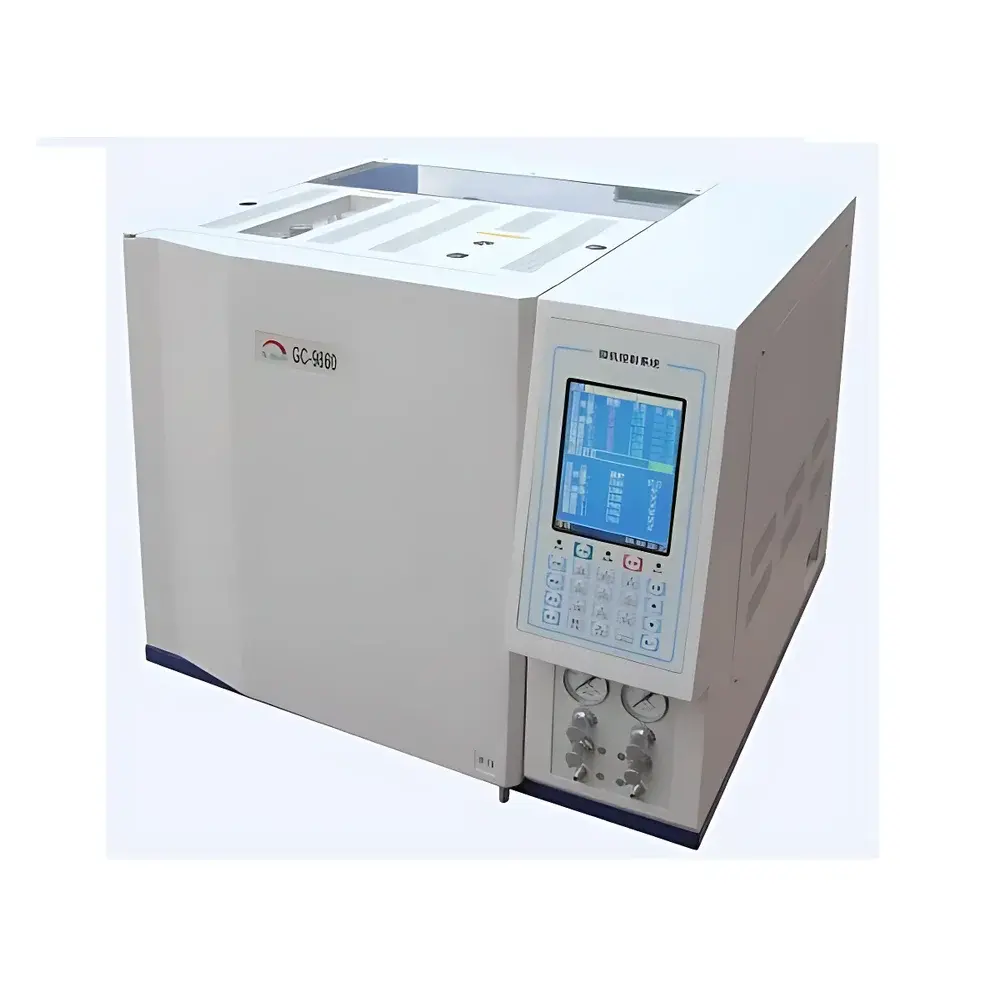
Beifen Sanpu GC-9860A Networked Gas Chromatograph for Indoor Air Analysis (BTEX & TVOC)
| Key | Brand: Beifen Sanpu |
|---|---|
| Origin | Beijing, China |
| Manufacturer Type | Direct Manufacturer |
| Instrument Type | Laboratory Gas Chromatograph |
| Application Field | Environmental Monitoring |
| Temperature Control Range | Ambient to 400 °C |
| Maximum Ramp Rate | 39 °C/min |
| Cooling Rate | 50 °C/min |
| Carrier Gas Flow Range & Control | 0–1200 mL/min (Electronic Flow Control) |
| Carrier Gas Pressure Range & Control | 0–970 kPa (Electronic Pressure Control) |
| Injector Max Temp | 450 °C |
| Injector Pressure Setting Range | 0–970 kPa |
| Injector Total Flow Setting Range | 0–1200 mL/min |
Overview
The Beifen Sanpu GC-9860A is a network-enabled laboratory gas chromatograph engineered for precise, compliant, and high-throughput analysis of volatile organic compounds (VOCs) in indoor air matrices—specifically targeting benzene, toluene, ethylbenzene, xylenes (BTEX), and total volatile organic compounds (TVOC). Built upon a robust dual-column oven architecture with six independently programmable temperature zones, the system operates on the fundamental principle of gas-phase separation: analytes are volatilized, carried through a capillary column by a precisely regulated carrier gas (N2, H2, He, or Ar), and differentially retained based on polarity, molecular weight, and interaction with the stationary phase. Detection is performed via interchangeable, factory-calibrated detectors—including FID, TCD, ECD, FPD, and NPD—enabling method flexibility across regulatory-compliant protocols such as EPA TO-17, ISO 16000-6, and GB/T 18883–2022. Its embedded Ethernet interface (IEEE 802.3) supports remote instrument control, real-time status monitoring, and centralized data aggregation in multi-lab environments—critical for environmental testing laboratories operating under GLP or ISO/IEC 17025 quality systems.
Key Features
- Network-Integrated Architecture: Native Ethernet connectivity enables secure remote operation, firmware updates, and audit-ready event logging without third-party middleware.
- Advanced Electronic Pressure & Flow Control (EPC/EFC): Six-channel digital pneumatic control with three operational modes (constant flow, constant pressure, split ratio) ensures retention time stability <±0.02 min over 24 h and minimizes run-to-run variability.
- High-Fidelity Thermal Management: Oven temperature range from ambient +8 °C to 450 °C (±0.1 °C accuracy); 16-step programmable ramping at rates up to 39 °C/min; rapid cooling at ≥50 °C/min for cycle time reduction.
- Modular Detector Support: Simultaneous installation of up to three detectors (e.g., FID for hydrocarbons, ECD for halogenated VOCs); each detector features independent temperature zoning and digital signal processing.
- Intuitive Human-Machine Interface: 5.7-inch color LCD touchscreen with multilingual UI (English default), graphical temperature profile visualization, and one-click method recall.
- Regulatory-Ready Hardware Design: All critical parameters—including injector pressure, column flow, detector voltage, and oven setpoints—are digitally recorded with timestamped metadata, satisfying FDA 21 CFR Part 11 requirements for electronic records and signatures when paired with compliant LIMS integration.
Sample Compatibility & Compliance
The GC-9860A is validated for direct injection of thermally stable VOCs from sorbent tubes (e.g., Tenax TA, Carbopack B/C), thermal desorption units (TDU), and automated headspace samplers. It accommodates both packed and fused-silica capillary columns (0.1–0.53 mm ID), supporting ASTM D5197, ISO 16017-1, and China’s HJ 583–2010 standard methods for indoor air BTEX quantification. The system meets electromagnetic compatibility (EMC) Class B per IEC 61326-1 and conforms to electrical safety standards IEC 61010-1. When operated with certified reference materials and documented calibration curves (e.g., NIST-traceable BTEX mixtures), it delivers measurement uncertainty <5% RSD for concentrations ≥0.5 µg/m³—fully aligned with WHO indoor air quality guidelines and EU Directive 2004/101/EC.
Software & Data Management
Control and data acquisition are managed via Beifen Sanpu ChromaLink™ GC Workstation (v3.2+), a Windows-based application compliant with 21 CFR Part 11 Annex 11 requirements. The software provides full audit trail functionality—including user login history, parameter change logs, raw data integrity checks (SHA-256 hash), and electronic signature workflows. Peak integration follows AIA/ANDI format standards, enabling seamless export to LIMS platforms (e.g., LabWare, Thermo Fisher SampleManager) or statistical analysis tools (e.g., JMP, Minitab). Method templates for EPA TO-17 and GB/T 18883–2022 are preloaded, including calibrated retention indices, internal standard correction tables, and reporting modules that auto-generate ISO 17025-compliant certificates of analysis (CoA).
Applications
- Quantitative determination of BTEX and C6–C16 aliphatic/aromatic VOCs in residential, commercial, and industrial indoor air samples.
- Compliance monitoring for LEED IEQ credit 3.2 (Indoor Air Quality Assessment) and WELL Building Standard v2 Feature A03.
- Source identification and emission profiling of building materials, adhesives, paints, and cleaning agents per ISO 16000-9.
- Validation of HVAC filtration efficiency and IAQ remediation interventions.
- Supporting occupational exposure assessments in accordance with OSHA 29 CFR 1910.1200 (HCS) and ACGIH TLV® thresholds.
FAQ
Does the GC-9860A support unattended overnight analysis?
Yes—the instrument supports scheduled runs, automatic shutdown sequences, and real-time email/SMS alerts via integrated network protocols. Up to 99 methods can be queued with independent temperature and detector settings.
Is the system compatible with third-party thermal desorbers?
Yes—standardized 1/8″ and 1/4″ column fittings and TTL-level external event triggers enable plug-and-play integration with Markes UNITY, Gerstel MPS, or Teledyne CDS systems.
What detector configurations are recommended for TVOC screening per ISO 16000-6?
A dual-detector setup (FID + ECD) is recommended: FID for total hydrocarbon response and ECD for chlorinated/fluorinated VOCs; both detectors operate simultaneously with independent data streams.
Can raw chromatographic data be exported in open formats?
Yes—ChromaLink™ exports .CDF (NetCDF), .CSV, and .AXD files with full metadata (instrument parameters, calibration history, operator ID), ensuring long-term archival integrity and cross-platform interoperability.
Is on-site training and method validation support available?
Beifen Sanpu provides factory-certified application specialists for on-site IQ/OQ/PQ execution, SOP development, and method transfer assistance—including participation in interlaboratory comparison studies.
Related Products




