
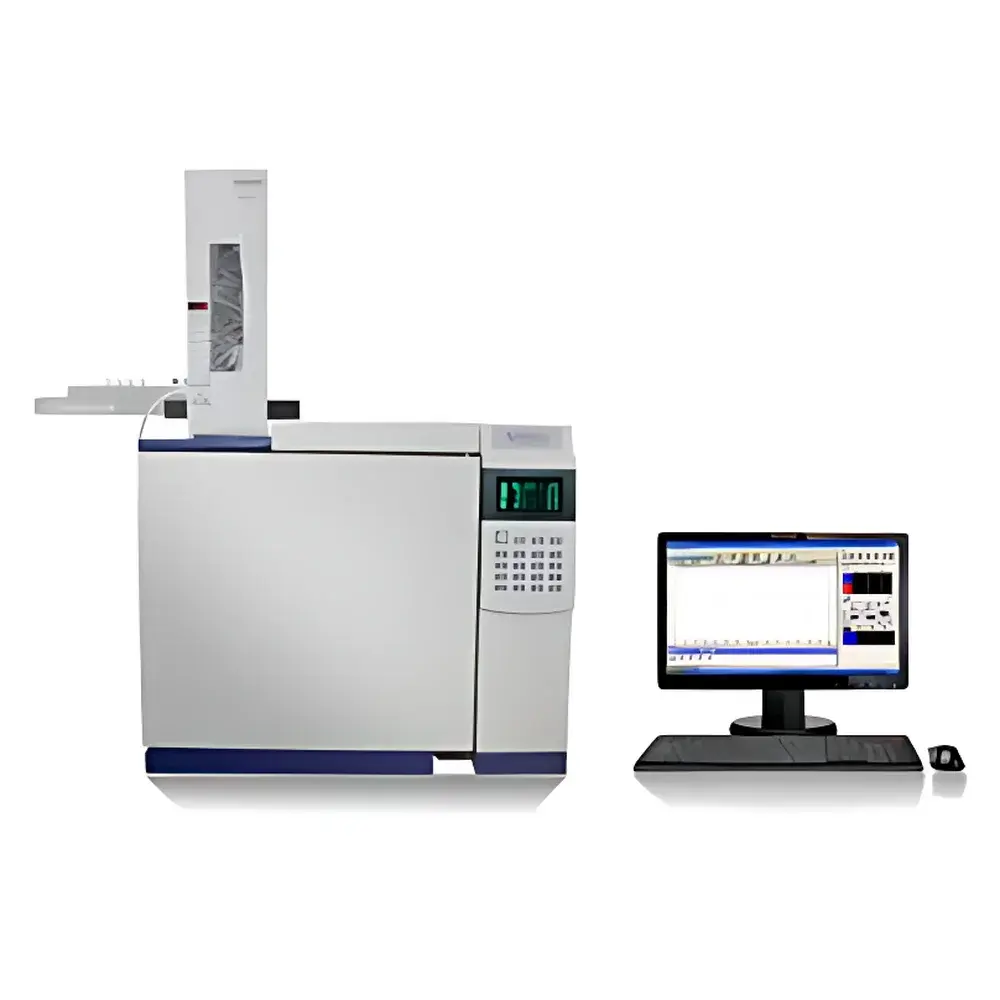
Beifen Sanpu GC9860-IV High-End Online Gas Chromatograph
| Brand | Beifen Sanpu |
|---|---|
| Origin | Beijing, China |
| Manufacturer Type | Direct Manufacturer |
| Instrument Type | Online Gas Chromatograph |
| Model | GC9860-IV |
| Temperature Control Range | 4 °C to 450 °C |
| Oven Ramp Rate | 0.1–39 °C/min |
| Cooling Rate | ~6 min (450 °C → 50 °C) |
| Carrier Gas Flow Range | 0–1200 mL/min |
| Carrier Gas Pressure Control Accuracy | ±0.05 kPa |
| Injector Maximum Temperature | 450 °C |
| Injector Pressure Setting Range | ±0.05 kPa |
| Total Injector Flow Setting Range | 0–1200 mL/min |
| Temperature Zones | 6 independent zones |
| Temperature Increment | 1 °C |
| Temperature Stability | ±0.1 °C |
| Programmed Temperature Steps | 16 |
| External Events | 8 channels |
| Auxiliary Outputs | 4 channels |
| Supported Inlet Types | Packed column, capillary column, 6-port gas valve, headspace auto-sampler |
| Detector Capacity | Up to 3 simultaneous detectors |
| Compatible Detectors | FID, TCD, ECD, FPD, NPD |
| Gas Control Mode | Full Electronic Pressure Control (EPC) |
| EPC Operating Modes | Constant Flow, Constant Pressure |
| Supported Carrier Gases | N₂, H₂, Air, He, Ar |
Overview
The Beifen Sanpu GC9860-IV High-End Online Gas Chromatograph is an industrial-grade, network-enabled analytical platform engineered for continuous, unattended operation in process monitoring, environmental compliance, and quality control laboratories. Built upon a fully modular architecture and compliant with modern chromatographic automation standards, the system implements precise gas-phase separation via capillary or packed column chromatography, coupled with high-fidelity detection across multiple selectivity profiles. Its core design integrates real-time Ethernet-based remote supervision, full electronic pneumatic control (EPC), and multi-zone temperature programming—enabling reproducible retention time alignment, robust baseline stability, and trace-level quantification in complex matrices. The instrument is purpose-built for integration into plant-wide data infrastructure, supporting both routine offline analysis and long-term online surveillance of volatile organic compounds (VOCs), permanent gases, hydrocarbons, and halogenated species.
Key Features
- Full EPC/EFC (Electronic Pressure/Flow Control) system eliminating mechanical valves and analog pressure gauges—ensuring ±0.05 kPa pressure accuracy and repeatable flow delivery across all carrier gases (N₂, H₂, He, Ar, air).
- Six independently programmable temperature zones with ±0.1 °C thermal stability, 16-step oven ramp capability, and rapid cooling (<6 min from 450 °C to 50 °C) for high-throughput cycle times.
- 10/100M adaptive Ethernet interface with embedded TCP/IP stack—enabling secure remote access, bidirectional instrument control, and audit-ready data streaming over LAN/WAN without third-party gateways.
- NETChrom™ workstation supporting up to 253 concurrent GC systems, featuring full instrument reverse control, automated calibration curve generation, peak integration per USP/EP guidelines, and native Modbus/TCP server for seamless DCS/SCADA integration.
- Vacuum fluorescent display (VFD) with dual-language UI (English/Chinese), intuitive menu navigation, and context-sensitive soft keys—optimized for glove-compatible operation in industrial control rooms.
- Modular detector bay accommodating up to three simultaneous detectors (FID, TCD, ECD, FPD, NPD) with hot-swappable electronics and independent temperature zoning for optimal sensitivity and cross-talk suppression.
- Preconfigured timing sequences for unattended online sampling—including scheduled auto-start, valve actuation triggers, and event-driven data logging synchronized with external PLC signals (8 digital inputs, 4 relay outputs).
Sample Compatibility & Compliance
The GC9860-IV supports diverse sample introduction methods: split/splitless capillary injection, packed column analysis, 6-port gas sampling valves, and headspace autosampling (with optional interface). It complies with ASTM D1945, D1946, D3588, ISO 6142, ISO 8573-5, and EPA Method 8260/8021 for VOC analysis. All firmware and NETChrom™ software modules are designed to meet GLP/GMP documentation requirements, including electronic signature support, user-access level management, and 21 CFR Part 11-compliant audit trails. Data integrity is preserved through write-once file storage, automatic backup to network shares, and timestamped method versioning.
Software & Data Management
NETChrom™ provides a validated, single-platform environment for acquisition, processing, reporting, and system diagnostics. It features embedded peak deconvolution algorithms, retention time locking (RTL), and customizable report templates exportable to PDF, CSV, and LIMS-compatible XML. Raw data files adhere to ANDI/NetCDF format for cross-platform compatibility. The integrated Modbus/TCP server enables real-time transmission of quantitative results (e.g., ppmv concentrations, area counts) directly into distributed control systems—eliminating manual transcription and reducing operator error. Remote firmware updates and diagnostic telemetry are supported via HTTPS-secured connections.
Applications
This system is deployed in petrochemical refineries for hydrocarbon speciation (C₁–C₁₂), semiconductor fabs for ultra-trace moisture and oxygen impurity monitoring, pharmaceutical manufacturing for residual solvent testing (ICH Q2(R2)), municipal water treatment plants for chlorinated byproduct tracking, and environmental labs conducting landfill gas or ambient air VOC profiling. Its online configuration—with optional heated transfer lines, pressure-regulated sample loops, and explosion-proof enclosures—meets Class I, Division 1 hazardous area requirements when configured per ATEX/IECEx specifications.
FAQ
Does the GC9860-IV support FDA 21 CFR Part 11 compliance?
Yes—NETChrom™ includes role-based access control, electronic signatures, immutable audit logs, and data integrity safeguards aligned with Part 11 Annex 11 expectations.
Can it operate without a PC connected locally?
Yes—the instrument runs autonomously with onboard method storage and scheduled analysis; PC connectivity is required only for configuration, reporting, or remote oversight.
What is the maximum number of detectors that can be active simultaneously?
Up to three detectors may be installed and operated concurrently, each with dedicated power, temperature, and signal conditioning circuits.
Is helium-free operation supported?
Yes—EPC firmware supports nitrogen, hydrogen, and argon as alternative carriers; hydrogen carrier enables faster analysis and enhanced FID sensitivity without compromising safety when used with leak-tight manifolds.
How is calibration traceability maintained?
Instrument-specific calibration certificates are generated per ISO/IEC 17025 workflows; retention time and response factor drift are tracked automatically and flagged if exceeding user-defined thresholds.





