
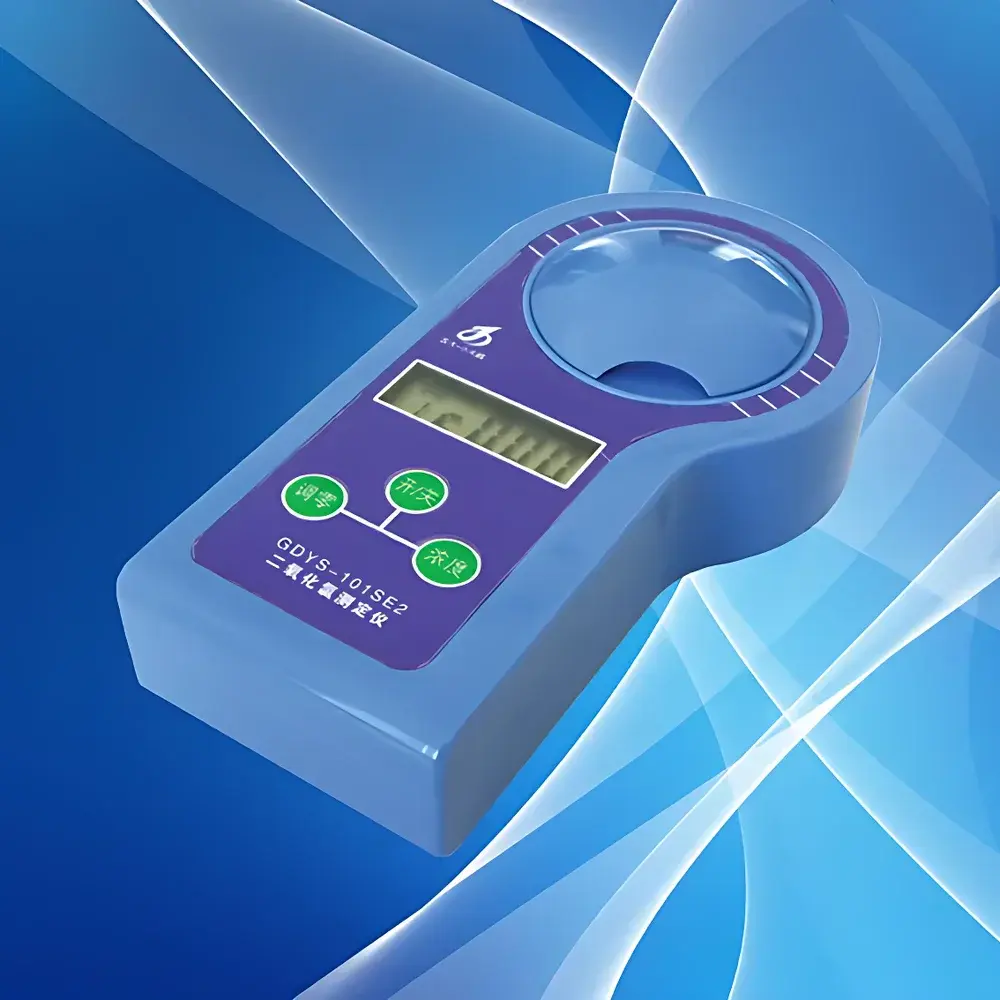
Beifen Sanpu GDYS-101SE2 Chlorine Dioxide (ClO₂) Photometric Analyzer
| Brand | Beifen Sanpu |
|---|---|
| Origin | Beijing, China |
| Manufacturer Type | Direct Manufacturer |
| Product Origin | Domestic (China) |
| Model | GDYS-101SE2 |
| Application | Field and Laboratory Quantitative Determination of Chlorine Dioxide in Water Samples |
| Light Source | 520 nm LED |
| Optical Stability | ±0.005 Abs/20 min |
| Detection Limit | 0.02 mg/L |
| Measurement Range | 0.00–3.00 mg/L |
| Measurement Time | 1 minute |
| Accuracy | ±5% |
| Power Supply | DC 9 V battery |
| Auto Power-Off | After 30 minutes idle |
| Battery Status Indicator | Integrated low-battery diagnostic circuit |
| Compliance | GB/T 5750.11–2006 (Standard Method for Examination of Disinfectants in Drinking Water) |
Overview
The Beifen Sanpu GDYS-101SE2 Chlorine Dioxide (ClO₂) Photometric Analyzer is a compact, field-deployable photometric instrument engineered for rapid, on-site quantification of chlorine dioxide concentration in aqueous matrices. It operates on the standardized N,N-diethyl-p-phenylenediamine (DPD) colorimetric method—fully aligned with GB/T 5750.11–2006, the Chinese national standard for disinfectant analysis in drinking water. Unlike conventional spectrophotometers requiring external calibration standards and complex optical alignment, the GDYS-101SE2 integrates a pre-programmed calibration curve into its firmware, enabling direct concentration readout without manual standard preparation. Its optical architecture employs a monolithic solid-state design: a single 520 nm light-emitting diode functions simultaneously as both excitation source and spectral filter, eliminating moving parts, diffraction gratings, or slit-based monochromators. This integrated light-source–detector–cuvette assembly ensures mechanical robustness under transport vibration and humidity fluctuations—critical for mobile environmental monitoring and emergency response applications.
Key Features
- Integrated DPD-based photometry compliant with GB/T 5750.11–2006 for ClO₂ determination in potable water, surface water, and treated effluents.
- Pre-loaded calibration curve eliminates need for daily standard solution preparation; reduces operator dependency and analytical variability.
- Monolithic optical path: 520 nm LED serves dual role as light source and wavelength selector—no alignment required, no optical drift from thermal expansion or mechanical shock.
- Fixed-pathlength cuvette holder with integrated photodiode sensor; zero-moving-parts construction enhances long-term stability and field reliability.
- Pulse-driven LED operation extends effective source lifetime to ≥100,000 hours—minimizing maintenance intervals and recalibration frequency.
- Low-power architecture: Operates exclusively on a single 9 V alkaline battery; automatic shutdown after 30 minutes of inactivity; real-time battery voltage monitoring with audible/visual low-power alert.
- Compact footprint (185 × 105 × 65 mm) and lightweight design (<450 g) support handheld use in field surveys, wastewater treatment plants, and municipal water quality labs.
Sample Compatibility & Compliance
The GDYS-101SE2 is validated for direct analysis of clear, low-turbidity aqueous samples including distilled water, drinking water, tap water, and ambient surface water. Sample pretreatment is limited to filtration (≤0.45 µm) if particulate interference is suspected; no acidification, distillation, or derivatization is required. The instrument meets metrological requirements specified in GB/T 5750.11–2006 for ClO₂ detection in regulatory compliance testing. While not certified to ISO/IEC 17025 or EPA Method 300.1, its performance characteristics—including ±5% accuracy across 0.02–3.00 mg/L and repeatability ≤±0.005 Abs/20 min—are consistent with routine QA/QC protocols for non-accredited environmental screening laboratories. Data output conforms to GLP documentation practices when paired with manual logbook entry; instrument memory does not support audit trails or electronic signatures per FDA 21 CFR Part 11.
Software & Data Management
The GDYS-101SE2 operates via embedded firmware with no external software dependency. Concentration results are displayed numerically on a high-contrast LCD screen (three-digit resolution, mg/L units). No USB, Bluetooth, or data export capability is provided; all measurements require manual transcription. Firmware includes built-in self-diagnostics: automatic zero-check at startup, continuous battery voltage monitoring, and optical path integrity verification during measurement cycle. Calibration curve parameters are factory-programmed and non-user-editable—ensuring method fidelity but precluding custom curve development. For laboratories requiring digital data capture, integration with external logging systems must be performed manually using standardized reporting templates aligned with ISO 17025 Clause 7.7 (results reporting).
Applications
- Routine monitoring of chlorine dioxide residual in municipal drinking water distribution systems.
- Validation of ClO₂ dosing efficacy in point-of-use disinfection units and packaged water production lines.
- Field assessment of disinfectant decay kinetics in surface water bodies post-treatment.
- Emergency response testing during waterborne outbreak investigations where rapid ClO₂ verification supports public health decision-making.
- Educational use in environmental science laboratories for teaching standardized colorimetric methods and water quality parameter interrelationships.
FAQ
Does the GDYS-101SE2 require daily calibration with standard solutions?
No—its internal calibration curve is fixed and traceable to GB/T 5750.11–2006 reference values; only zero-point verification using deionized water is required before each measurement session.
Can the instrument measure chlorine dioxide in turbid or colored water samples?
Turbidity >5 NTU or strong background absorbance near 520 nm may interfere; filtration through a 0.45 µm membrane is recommended prior to analysis.
Is the reagent kit compatible with other photometers?
The DPD reagent formulation and packaging are optimized for the GDYS-101SE2’s reaction kinetics and optical path length; cross-platform use is not validated and may compromise accuracy.
What is the shelf life of the included reagent kit?
Unopened reagent packets retain stability for 18 months when stored at 2–8 °C; once opened, use within 30 days under desiccated conditions.
Does the instrument support GLP-compliant electronic record keeping?
No—it lacks timestamped memory, user authentication, or electronic signature functionality; manual recording remains the sole compliant data capture method.




