
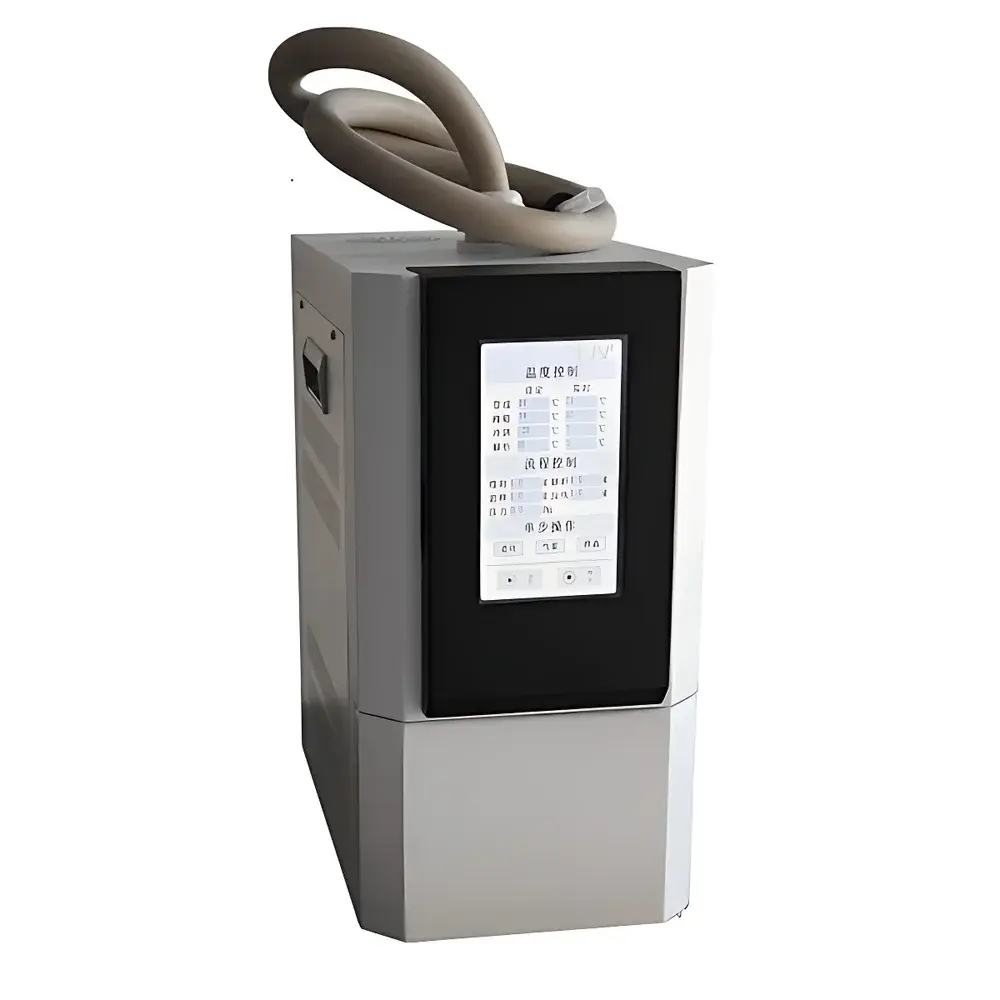
Beifen Sanpu HP-6900N Automated Cryo-Focused Atmospheric Thermal Desorber
| Brand | Beifen Sanpu |
|---|---|
| Origin | Beijing, China |
| Manufacturer Type | Direct Manufacturer |
| Model | HP-6900N |
| Instrument Type | Dual-Stage Thermal Desorber |
| Desorption Temperature Range | Room Temperature to 350°C (1°C increments) |
| Cold Trap Temperature Range | −35°C to Room Temperature (1°C increments) |
| Valve & Transfer Line Temperature Range | Room Temperature to 220°C (1°C increments) |
| Temperature Control Accuracy | < ±0.5°C |
| Adsorption Flow Rate | 0–300 mL/min (adjustable) |
| Desorption/Injection/Backflush Time Range | 0.01–999 min |
| Backflush Flow Rate | 0–160 mL/min (adjustable) |
| Dimensions | 400 × 220 × 420 mm |
| Power Consumption | ~300 W |
| Weight | ~20 kg |
Overview
The Beifen Sanpu HP-6900N Automated Cryo-Focused Atmospheric Thermal Desorber is a precision-engineered sample introduction system designed for trace-level volatile organic compound (VOC) and sulfur-containing compound analysis in ambient air matrices. It operates on the principle of cryogenic preconcentration followed by rapid thermal desorption—enabling quantitative transfer of analytes from large-volume air samples onto capillary GC columns with minimal loss or degradation. The instrument implements a dual-stage thermal desorption architecture: ambient air is drawn through an inert sorbent tube where target compounds are adsorbed at controlled flow rates; the tube is then cooled to −35°C using solid-state Peltier refrigeration, concentrating analytes into a narrow band within the cold trap; finally, the trap is rapidly heated (>2000°C/min ramp rate) to release the focused analyte plug into the GC inlet. This process delivers high sensitivity (sub-ppt detection limits), excellent reproducibility (RSD < 3% for replicate analyses), and compatibility with both single- and multi-bed sorbent tubes per ASTM D6196 and ISO 16017-1 protocols.
Key Features
- Four independently programmable temperature zones: cold trap (−35°C to RT), desorption oven (RT to 350°C), valve manifold (RT to 220°C), and transfer line (RT to 220°C), each with ±0.5°C accuracy and <1°C thermal gradient uniformity
- Integrated mass-flow-controlled sampling with real-time volumetric calculation—supports user-defined sampling duration and flow rate (0–300 mL/min) for precise volume calibration
- Automated backflush functionality for both transfer line and valve system (0.01–999 min duration, 0–160 mL/min flow), eliminating carryover between samples
- Electropolished, silanized stainless-steel gas pathways and fused-silica-lined transfer lines ensure minimal analyte adsorption or catalytic degradation
- 7-inch industrial-grade touchscreen HMI with full Chinese/English bilingual interface, supporting one-touch method launch and real-time monitoring of temperature profiles, elapsed time, and system status
- Hardware-level synchronization with GC and GC/MS systems—including TTL-triggered oven start, data acquisition initiation, and event logging via RS232/Ethernet interfaces
- Onboard liquid standard calibration capability with programmable syringe pump integration for direct vapor-phase spiking and response factor determination
Sample Compatibility & Compliance
The HP-6900N supports standard 1/4″ OD stainless-steel or quartz sorbent tubes (e.g., Tenax TA, Carbopack B/C, Carboxen 1000) and is fully compatible with EPA TO-17, ASTM D6196-22, ISO 16017-1:2022, and GB/T 14678-93 methodologies for ambient air VOC and malodorous compound analysis. Its inert flow path and low-bleed design meet GLP/GMP requirements for regulated environmental laboratories. All thermal and timing parameters are audit-trail enabled and exportable in CSV format—supporting compliance with FDA 21 CFR Part 11 when paired with validated LIMS or chromatography data systems (CDS). The instrument conforms to IEC 61010-1 safety standards for laboratory electrical equipment and CE marking requirements for EMC and low-voltage directives.
Software & Data Management
Instrument control and method development are performed either locally via the embedded touchscreen interface or remotely via Windows-based PC software (compatible with Windows 10/11, 64-bit). The software provides full parameter scripting—including multi-step temperature ramps, flow modulation, timed valve actuation, and conditional logic for adaptive run sequences. All method files are digitally signed and version-controlled; runtime logs record timestamped events (e.g., trap cooldown initiation, desorption trigger, GC sync pulse) with microsecond resolution. Raw parameter sets and calibration reports can be exported in PDF or XML formats for inclusion in analytical validation packages. Audit trail functionality includes user login tracking, parameter change history, and electronic signature support for IQ/OQ/PQ documentation.
Applications
The HP-6900N is routinely deployed in environmental monitoring labs for regulatory compliance testing of ambient air near industrial facilities, landfills, and wastewater treatment plants—particularly for odorant species including hydrogen sulfide, methyl mercaptan, dimethyl sulfide, and dimethyl disulfide per GB/T 14678-93. It is also used in indoor air quality (IAQ) studies targeting formaldehyde, benzene, toluene, and xylenes (BTX); in occupational health assessments for workplace exposure limit (WEL) verification; and in method development for emerging contaminants such as halogenated VOCs and oxygenated compounds. Its robust design supports unattended overnight operation across 96-sample batches when integrated with robotic autosamplers.
FAQ
What sorbent tubes are compatible with the HP-6900N?
Standard 1/4″ OD stainless-steel or quartz tubes packed with Tenax TA, Carbopack B/C, Carboxen 1000, or custom multi-bed configurations—fully compliant with EPA TO-17 specifications.
Does the instrument support automated calibration with liquid standards?
Yes—integrated liquid standard injection mode enables direct vapor-phase spiking via programmable syringe pump for linear range verification and response factor generation.
Can the HP-6900N be operated without a connected GC system?
Yes—the unit functions autonomously for tube conditioning, blank runs, and method validation; GC synchronization is optional and configurable via hardware trigger or software handshake.
Is remote diagnostics and firmware update supported?
Firmware updates are performed via USB drive or network upload; remote desktop-assisted troubleshooting is available under service contract terms.
What maintenance intervals are recommended for routine operation?
Cold trap cleaning every 200 runs; valve seal inspection every 500 runs; annual calibration verification using NIST-traceable reference standards and certified flow meters.






