
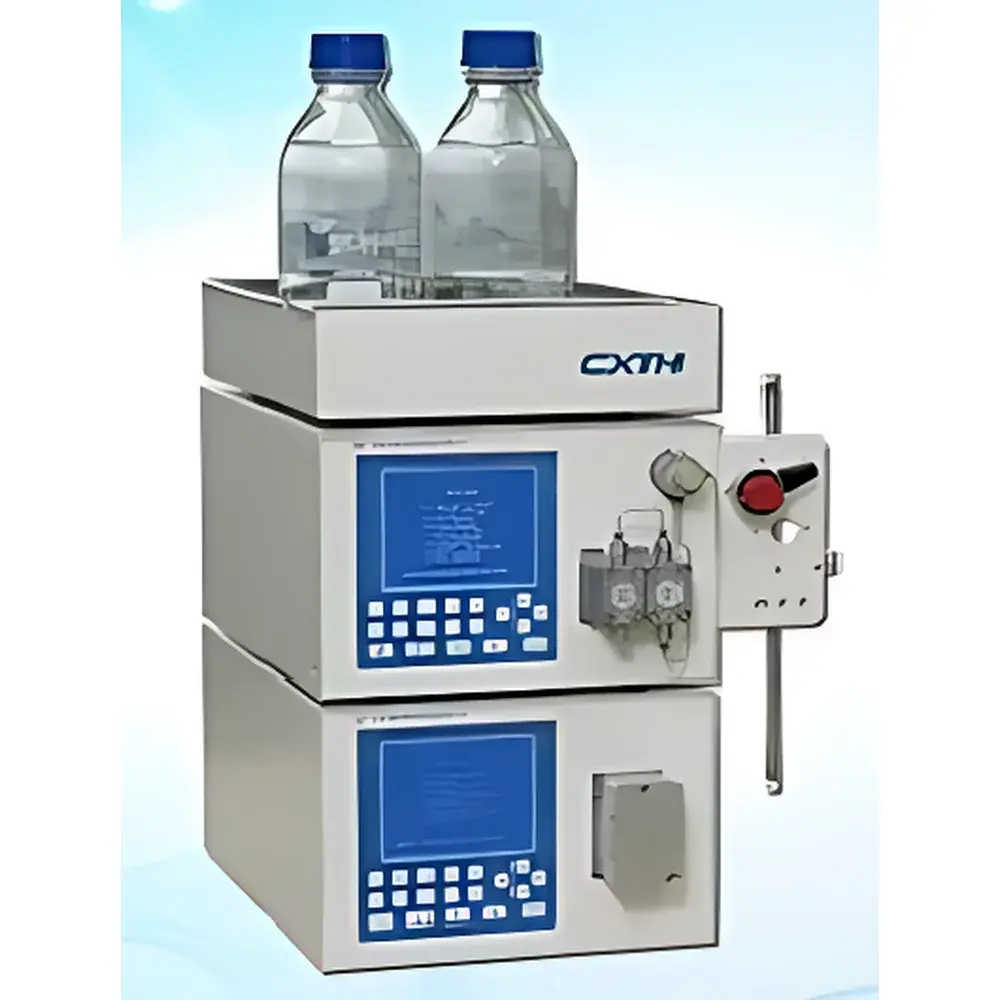
Beifen Sanpu LC-3000 High-Performance Liquid Chromatograph
| Brand | Beifen Sanpu |
|---|---|
| Model | LC-3000 |
| Pump Type | Dual-plunger reciprocating high-pressure solvent delivery system |
| Detector | UV-Vis (190–700 nm) with deuterium/tungsten lamp source |
| Flow Rate Range (Analytical) | 0.001–9.999 mL/min |
| Flow Precision | RSD ≤ 0.5% at 1 mL/min |
| Flow Repeatability | RSD ≤ 0.1% at 1 mL/min |
| Max Pressure (Analytical, stainless steel) | 42 MPa |
| Max Pressure (Analytical, PEEK) | 30 MPa |
| Baseline Noise | ≤1.5 × 10⁻⁵ AU/h (254 nm, MeOH/H₂O 80/20, 1 mL/min) |
| Baseline Drift | ≤4 × 10⁻⁴ AU/h (254 nm, MeOH/H₂O 80/20, 1 mL/min) |
| Wavelength Accuracy | ±2 nm |
| Wavelength Repeatability | 0.4 nm |
| Data Interface | RS-232 serial control + direct analog/digital signal output to PC |
| Software | GLP-compliant intelligent remote-control chromatography workstation with audit trail capability |
| System Architecture | Modular, field-upgradable from isocratic to binary or quaternary gradient configuration |
| Biocompatibility Option | PEEK pump heads and fluidic path components available |
| Dimensions (Pump/Detector) | 398 × 149 × 267 mm |
| Weight | 10 kg per module |
| Power | 220 V ±10%, 50 Hz, 40 W |
Overview
The Beifen Sanpu LC-3000 High-Performance Liquid Chromatograph is a modular, microprocessor-controlled analytical platform engineered for precision, reproducibility, and long-term operational stability in regulated and research laboratory environments. Built upon the fundamental principles of reversed-phase liquid chromatography (RPLC), the system separates analytes based on differential partitioning between a polar mobile phase and a non-polar stationary phase—typically C18-bonded silica—under controlled pressure, flow, and detection conditions. Its architecture integrates a dual-plunger reciprocating high-pressure pump (P3000), a variable-wavelength UV-Vis detector (UV3000), a manually actuated 7725i-type injection valve with 20 µL loop, and a GLP-compliant chromatography data system (CDS) capable of full instrument parameter control, method development, peak integration, and electronic record retention. Designed for compliance with international quality frameworks, the LC-3000 supports method validation protocols aligned with ICH Q2(R2), USP , and ISO/IEC 17025 requirements for analytical instrument qualification.
Key Features
- Modular gradient scalability: Configurable as isocratic, binary high-pressure, or quaternary low-pressure gradient systems via firmware update and hardware addition—no chassis replacement required.
- Biocompatible fluidic path options: Optional PEEK pump heads and flow cells eliminate metal ion leaching, enabling reliable analysis of sensitive biomolecules (e.g., peptides, oligonucleotides, monoclonal antibodies) without catalytic degradation or adsorption artifacts.
- Intelligent pump diagnostics: Automatic post-run column wash function activates when buffer or corrosive solvents are detected in the mobile phase sequence—reducing seal wear and extending service intervals.
- Dual-mode operation: Independent front-panel control (with 320×240 backlit LCD) and PC-based remote control via RS-232 ensure operational continuity during software updates or network maintenance windows.
- High-fidelity signal transmission: Direct analog (±0.1/±1.0/±10 V) and digital output paths minimize signal attenuation and electromagnetic interference—critical for low-concentration quantitation and multi-detector synchronization.
- GLP-ready data integrity: The intelligent workstation logs lamp usage hours, lamp ignition cycles, calibration events, user logins, and method version history with immutable timestamps—fully traceable for FDA 21 CFR Part 11 and EU Annex 11 compliance assessments.
Sample Compatibility & Compliance
The LC-3000 accommodates a broad range of sample matrices—including pharmaceutical actives, environmental contaminants, food additives, natural product extracts, and clinical biofluids—when paired with appropriate column chemistries (C18, phenyl-hexyl, HILIC, or ion-exchange). All wetted components comply with USP Class VI biocompatibility standards. System qualification follows ASTM E2656-20 (Standard Guide for Validation of Liquid Chromatography Systems) and includes documented installation qualification (IQ), operational qualification (OQ), and performance qualification (PQ) protocols. Routine maintenance logs, pressure calibration certificates, and wavelength accuracy verification reports are generated automatically and stored within the secure CDS repository.
Software & Data Management
The intelligent remote-control workstation provides ISO 27001-aligned data security, role-based access control (RBAC), and configurable audit trails meeting FDA 21 CFR Part 11 requirements for electronic signatures and record retention. Raw data files (.raw) are stored in vendor-neutral formats compatible with third-party processing tools (e.g., OpenChrom, Chromeleon). Batch processing supports automated calibration curve generation (linear, quadratic, weighted), limit-of-detection (LOD)/limit-of-quantitation (LOQ) calculation per ICH guidelines, and system suitability testing (SST) with pass/fail thresholds for tailing factor, resolution, and %RSD of retention time. Data backups are scheduled to network-attached storage (NAS) with SHA-256 hash verification.
Applications
- Pharmaceutical QC/QA: Assay of active pharmaceutical ingredients (APIs), related substances testing per ICH Q3B, and dissolution profile analysis.
- Environmental monitoring: Quantification of PAHs, organochlorine pesticides, and perfluoroalkyl substances (PFAS) in water and soil extracts.
- Food safety: Detection of mycotoxins (aflatoxin B1, ochratoxin A), artificial sweeteners, and preservatives in complex food matrices.
- Academic research: Method development for chiral separations, metabolomics profiling, and stability-indicating assays under forced degradation conditions.
- Bioanalytical support: Peptide mapping of recombinant proteins, residual host-cell protein (HCP) analysis, and oligonucleotide purity assessment using ion-pairing RPLC.
FAQ
Is the LC-3000 compliant with 21 CFR Part 11 for electronic records and signatures?
Yes—the intelligent workstation includes electronic signature workflows, audit trail logging, and user authentication mechanisms validated against FDA guidance for computerized systems in GxP environments.
Can the system be upgraded from isocratic to gradient operation after purchase?
Yes—binary or quaternary gradient capability is enabled through optional pump modules and firmware licensing; no mechanical retrofitting of the base chassis is required.
What materials are used in contact with the mobile phase to ensure compatibility with acidic or basic buffers?
Stainless steel pump heads are standard; PEEK-head variants are available for enhanced corrosion resistance and reduced metal leaching in pH 1–12 applications.
Does the UV3000 detector support wavelength scanning for spectral library matching?
Yes—it offers programmable stop-flow scanning with user-defined start/end wavelengths and step increments, supporting peak purity analysis and spectral deconvolution.
How is system suitability verified during routine operation?
The software executes automated SST sequences including plate count, tailing factor, resolution between critical pairs, and %RSD of replicate injections—all reported with configurable acceptance criteria.
Related Products






