
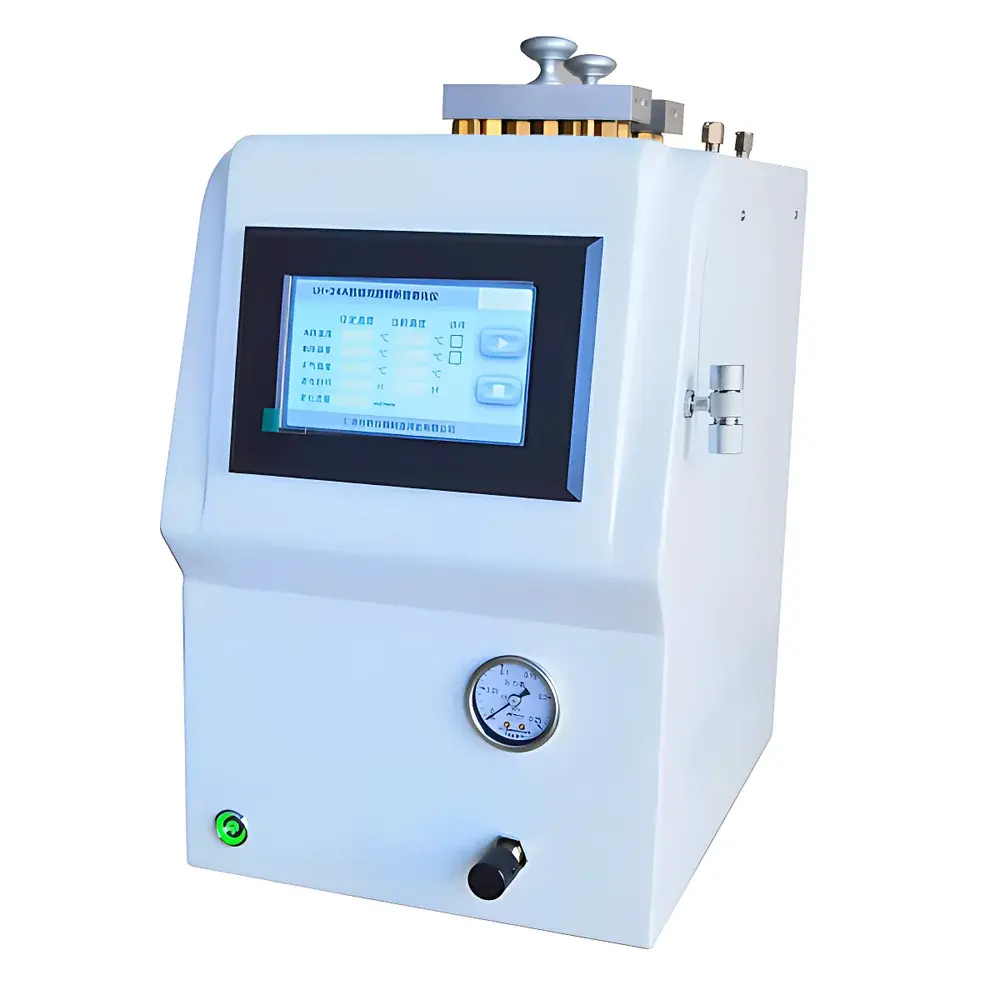
Beifen Sanpu LH-24B Intelligent Adsorption Tube Aging Instrument
| Brand | Beifen Sanpu |
|---|---|
| Origin | Beijing, China |
| Manufacturer Type | Direct Manufacturer |
| Model | LH-24B |
| Temperature Control Range | Ambient to 400 °C |
| Gas Flow Rate | 0–1000 mL/min |
| Tube Capacity | 24 tubes |
| Power Supply | 220 VAC, 50 Hz |
| Power Consumption | <200 VA |
| Temperature Accuracy | ±1 °C |
| Maximum Aging Duration | >999 h |
| Simulated Sampling Time | 0–99 min |
| Tube Dimensions (Standard) | Ø6 mm × ≥110 mm or 1/4″ OD × ≥3.5″ |
| Dimensions (H×W×D) | 350 × 230 × 330 mm |
| Net Weight | ~12 kg |
Overview
The Beifen Sanpu LH-24B Intelligent Adsorption Tube Aging Instrument is a dedicated thermal conditioning system engineered for the precise and reproducible preparation of sorbent-packed sampling tubes prior to thermal desorption–gas chromatography (TD–GC) analysis. It operates on the principle of controlled convective heating under inert gas purge—enabling removal of residual volatiles, moisture, and contaminants from adsorbent beds (e.g., Tenax TA, Carbopack B/C, Carboxen, or custom blends) without degrading sorbent integrity. Designed specifically for laboratories performing volatile organic compound (VOC) and semi-volatile organic compound (SVOC) monitoring in air, workplace environments, and building materials, the LH-24B ensures batch consistency, trace-level cleanliness, and compliance with method-driven aging protocols such as EPA Method TO-17, ISO 16017-1, and ASTM D6196. Its dual-zone independent temperature control architecture allows simultaneous conditioning of two distinct tube sets at different setpoints—a critical capability when validating multi-sorbent configurations or cross-comparing tube lots.
Key Features
- 24-position parallel aging capacity with quick-connect, leak-tight tube interfaces—eliminating threaded fittings and reducing operator-induced variability;
- 5-inch high-resolution capacitive touch display with intuitive menu navigation and real-time parameter visualization (temperature, flow, elapsed time, remaining time);
- Dual independent PID-controlled heating zones, each with adjustable ramp rates, soak times, and cooling profiles;
- Programmable aging cycles up to 999 hours, supporting long-duration stabilization of high-capacity or chemically complex sorbents;
- Integrated safety interlocks: over-temperature cutoff (>405 °C), automatic gas shutoff upon completion or cooldown, and audible/visual fault alerts;
- Energy-efficient active cooling system that initiates post-aging and terminates gas flow once target cooldown temperature is reached;
- Optional simulated sampling module for quantitative spiking of certified standards directly onto aged tubes—facilitating recovery calibration and breakthrough validation;
- Compact benchtop footprint (350 × 230 × 330 mm) with robust steel housing and EMI-shielded electronics for stable operation in shared lab environments.
Sample Compatibility & Compliance
The LH-24B accommodates standard 6 mm OD × ≥110 mm or 1/4″ OD × ≥3.5″ stainless steel or quartz-lined adsorption tubes—including those packed with single- or multi-bed sorbents used in regulated VOC monitoring. Its temperature uniformity (±1 °C across all positions) and flow stability (±2% full-scale repeatability) meet the instrumental prerequisites outlined in EPA TO-17 Section 7.2 (Tube Conditioning) and ISO 16017-1 Annex C. The instrument supports GLP-aligned workflow documentation when paired with external audit-trail-capable LIMS or electronic lab notebooks; its deterministic timing logic and non-volatile parameter storage ensure full traceability of aging conditions per tube batch. No firmware or hardware modifications are required to satisfy routine inspection criteria under CNAS-CL01 or CMA accreditation frameworks.
Software & Data Management
While the LH-24B operates autonomously via embedded firmware, it logs all critical process parameters—including start time, setpoint history, actual temperature profiles, gas flow readings, and cycle completion status—to internal flash memory (retention ≥10 years). Data export is supported via USB-C interface in CSV format for integration into laboratory data management systems. All user-modifiable settings are password-protected to prevent accidental configuration changes during routine operation. Firmware updates are delivered via signed binary files to maintain integrity and support future regulatory alignment (e.g., enhanced timestamping for 21 CFR Part 11–compatible environments).
Applications
- Ambient and indoor air quality monitoring (e.g., benzene, toluene, xylenes, formaldehyde, naphthalene);
- Occupational exposure assessment in industrial hygiene surveys (NIOSH Method 1501, OSHA Method 1005);
- Building material emissions testing (VOC screening per ISO 16000-9 and ASTM D5116);
- Calibration standard preparation for TD–GC–MS quantitation workflows;
- Quality assurance of commercial sorbent tubes prior to distribution or in-house use;
- Method development and validation studies requiring statistically robust tube-to-tube reproducibility (n ≥ 24 per run).
FAQ
What tube dimensions and sorbent types are validated for use with the LH-24B?
The instrument is mechanically and thermally optimized for 6 mm OD × ≥110 mm or 1/4″ OD × ≥3.5″ tubes packed with common polymeric (Tenax TA), carbon-based (Carbopack, Carboxen), or silica-based (Silica gel, molecular sieves) sorbents. Custom tube adapters are available upon request.
Does the LH-24B support automated reporting for QA/QC records?
Yes—each aging run generates a timestamped CSV log containing all operational parameters. These files can be imported into Excel, LabWare LIMS, or Empower for audit-ready record retention.
Can the dual-zone control be used to age two different sorbent types simultaneously?
Absolutely. Independent setpoints allow one zone to condition Tenax TA at 320 °C while the other stabilizes Carboxen 1000 at 350 °C—enabling comparative aging studies without cross-contamination risk.
Is the simulated sampling module compatible with certified VOC standard solutions?
Yes. The optional module includes calibrated micro-syringe ports and inert vapor pathways, enabling trace-level (<1 ng) spiking of EPA TO-17 reference standards directly onto conditioned tubes.
What maintenance is required to sustain long-term accuracy?
Annual verification of temperature uniformity (using NIST-traceable probe array) and flowmeter calibration (with bubble meter or mass flow calibrator) is recommended. No consumables or routine part replacements are specified in the operating manual.
Related Products





