
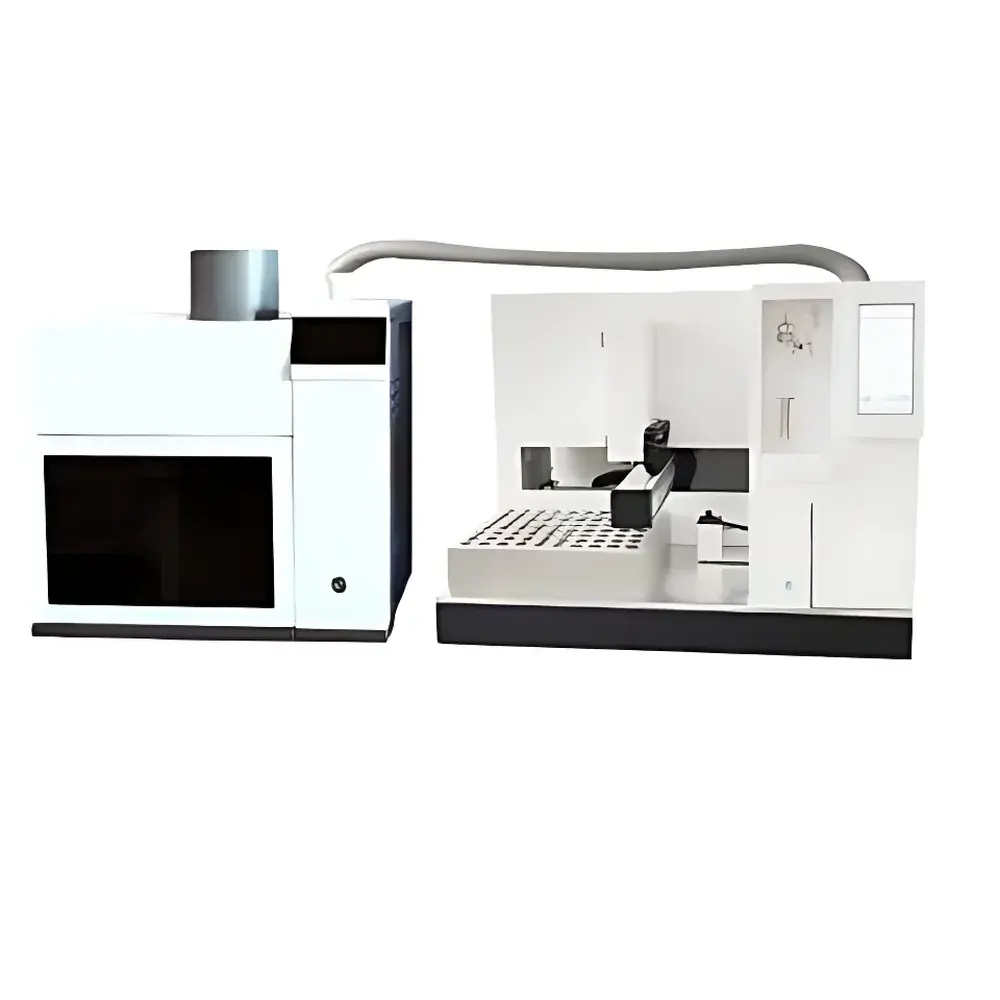
Beifen Sanpu Multi-2025 Alkylmercury Analyzer for Water Quality Analysis
| Brand | Beifen Sanpu |
|---|---|
| Origin | Beijing, China |
| Manufacturer Type | Direct Manufacturer |
| Instrument Type | Laboratory Gas Chromatograph |
| Detection Principle | Purge-and-Trap / Gas Chromatography–Cold Vapor Atomic Fluorescence Spectrometry (GC-CVAFS) |
| Compatible With | Commercial Purge-and-Trap Concentrators |
| GC Column | Modified OV-3 Packed Column |
| Pyrolysis Temperature | Up to 1050 °C |
| Detection Elements | As, Hg, Pb, Se, Sb, Bi, Cd (12 total) |
| Regulatory Compliance | HJ 977–2018, HJ 1269–2022, HJ 1268–2022, SNT 5517–2023 |
| Software | Graphical Interface with Real-Time Status Monitoring, Consumable Lifetime Tracking, Multi-Format Reporting (Word/Excel/PDF) |
| Application Scope | Environmental water, soil, sediment, biological tissues, cosmetics, herbal medicine, feed, and seafood matrices |
Overview
The Beifen Sanpu Multi-2025 Alkylmercury Analyzer is a dedicated laboratory gas chromatograph engineered for trace-level quantification of alkylated mercury species—primarily methylmercury (MeHg) and ethylmercury (EtHg)—in aqueous and solid environmental matrices. It implements the standardized purge-and-trap/gas chromatography–cold vapor atomic fluorescence spectrometry (GC-CVAFS) methodology, as prescribed in Chinese national standard HJ 977–2018 for water and HJ 1269–2022 for soil and sediment. The instrument integrates two functionally coupled modules: a thermally programmable GC separation system with high-temperature pyrolysis capability (up to 1050 °C), and a compact, integrated atomic fluorescence detection unit based on hydride generation and cold vapor atomization. Unlike conventional single-purpose mercury analyzers, the Multi-2025 operates as a dual-mode platform: it performs speciated alkylmercury analysis via GC-CVAFS while retaining full functionality as a multi-element hydride-generation atomic fluorescence spectrometer (HG-AFS) for total elemental determination of As, Hg, Pb, Se, Sb, Bi, Cd, and five additional elements (12 total), per GB/T 223.73–2022 and related metrological validation protocols.
Key Features
- Modular GC-CVAFS architecture compliant with HJ 977–2018 and HJ 1269–2022, enabling validated quantification of MeHg and EtHg at sub-pg/L levels in drinking water, wastewater, and surface water extracts.
- Thermally robust pyrolysis furnace capable of precise temperature control up to 1050 °C, ensuring complete thermal decomposition of alkylmercury species into elemental mercury vapor prior to CVAFS detection.
- Modified OV-3 packed column—selected for superior stability, reproducible retention times, and extended service life (>2000 injections) compared to conventional fused-silica capillary columns under routine environmental lab conditions.
- 3D-printed monolithic reaction module integrating hydride generator, gas–liquid separator, and quartz cell holder; eliminates internal tubing, reduces dead volume by >75%, and minimizes memory effects from mercury adsorption.
- Mercury-inert construction materials—including fluoropolymer-coated stainless steel and fused silica flow paths—certified for negligible Hg retention (<0.1% carryover after 10 ng/mL standard).
- Open-system design supporting interoperability with third-party purge-and-trap concentrators (e.g., Tekmar, OI Analytical, or domestic equivalents), allowing integration into existing laboratory workflows without hardware lock-in.
Sample Compatibility & Compliance
The Multi-2025 accepts liquid samples (aqueous extracts, acid digests, enzymatic hydrolysates) and solid-phase extracts (e.g., from EPA Method 1630 derivatized SPE cartridges). It supports direct injection of 1–5 mL sample volumes into the purge-and-trap interface. Validation data confirm linearity (R² ≥ 0.999) across 0.05–50 ng/L MeHg in ultrapure water matrix, with method detection limits (MDL) of 0.012 ng/L (n = 7, 3σ) under HJ 977–2018 conditions. Instrument performance meets GLP-aligned requirements for audit readiness: full electronic record retention, user-access logging, and calibration history traceability. Software enforces 21 CFR Part 11–compatible electronic signatures for critical actions (method execution, calibration, report approval). All reported methods are fully aligned with ISO/IEC 17025:2017 clause 7.2.2 (method validation) and CNAS-CL01:2018 technical requirements for environmental testing laboratories.
Software & Data Management
The graphical control software provides real-time visualization of instrument status—including GC oven ramp progression, trap desorption timing, quartz cell temperature stabilization, and HG-AFS lamp warm-up cycles. Automated sequence control supports unattended overnight operation for batch processing of up to 48 samples. Consumable lifetime monitoring tracks usage hours for hydride generation reagent pumps, hollow cathode lamps (Hg, As, Se), and quartz UV cells, triggering configurable alerts when thresholds are reached. All analytical data—including raw fluorescence intensity curves, peak integration parameters, calibration curves, and QC check results—are stored in an encrypted SQLite database with immutable timestamps. Reports export natively to Word (.docx), Excel (.xlsx), and PDF formats, with optional inclusion of chromatograms, spectral overlays, and uncertainty budget tables per GUM (JCGM 100:2008) guidelines.
Applications
- Regulatory compliance testing for alkylmercury in municipal drinking water supplies (HJ 977–2018), industrial effluents, and river/lake monitoring programs.
- Speciation analysis of MeHg/EtHg in sediment cores and soil leachates for ecological risk assessment (HJ 1269–2022).
- Total element screening of As, Hg, Se, Sb, and Pb in agricultural products, traditional Chinese medicinal herbs, animal feed, and cosmetic raw materials per GB 2762–2022 and GB/T 5009 series standards.
- Export certification of seafood and marine products per SNT 5517–2023, including automated speciation reporting required by Chinese customs laboratories.
- Method development and reference material characterization in national metrology institutes and accredited environmental testing labs.
FAQ
Does the Multi-2025 require proprietary consumables or vendor-locked purge-and-trap systems?
No. It interfaces with industry-standard 1/8″ OD gas lines and accepts standard trap desorption signals (TTL or analog voltage), enabling compatibility with multiple commercial purge-and-trap platforms.
Can the instrument quantify both methylmercury and ethylmercury separately in a single run?
Yes. Under optimized GC temperature programming (e.g., 60 °C hold → 10 °C/min → 180 °C), MeHg and EtHg elute with baseline resolution (Rs > 1.5) using the modified OV-3 column.
Is the atomic fluorescence detector calibrated for multi-element use beyond mercury?
Yes. The HG-AFS module supports validated methods for As, Se, Sb, Bi, Pb, Cd, Sn, Te, Ge, Zn, Co, and Ni using element-specific hydride generation chemistry and lamp selection.
How is data integrity ensured during long-term deployment in regulated environments?
The software implements audit trail logging (user ID, timestamp, action type, before/after values), electronic signature enforcement for report finalization, and periodic cryptographic hash verification of raw data files.
What maintenance intervals are recommended for the 3D-printed reaction module?
Under normal operation (≤10 samples/day), inspection and ultrasonic cleaning in 5% HNO₃ are recommended every 3 months; replacement is typically required only after ≥12 months or 2500 analyses.






