
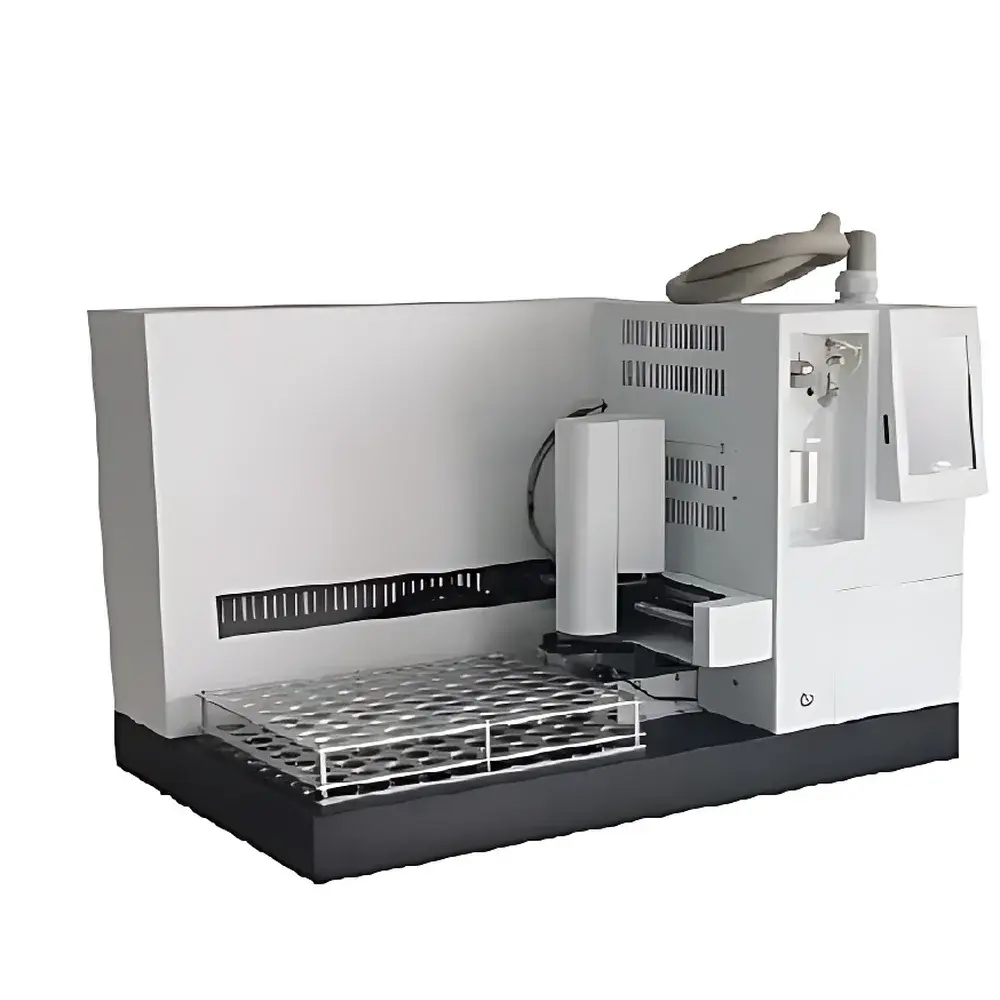
Beifen Sanpu PT-80A Solid-Liquid Integrated Fully Automated Purge and Trap Concentrator
| Brand | Beifen Sanpu |
|---|---|
| Origin | Beijing, China |
| Manufacturer | Beifen Sanpu Instrument Co., Ltd. |
| Model | PT-80A |
| Sample Capacity | 80 positions (40 mL VOA vials) |
| Injection Precision | RSD ≤ 3% |
| Trap Temperature Range | Ambient to 380 °C |
| Cooling | 250 °C → 35 °C in ≤ 90 s |
| Purge Tube Temperature | Ambient to 95 °C |
| Sample Chilling | Ambient only |
| Cold Trap Temperature | −40 °C to ambient (Peltier + air cooling) |
| Desorption Flow Path Heating | Ambient to 220 °C |
| Water Removal Trap | Ambient to 400 °C |
| Purge Flow Rate | 0–150 mL/min |
| Timing Resolution | 0.1 s |
| Max Duration | 100 min |
| Timing Accuracy | < 0.1 s |
| System Pressure Rating | ≤ 0.6 MPa |
| Power Supply | AC 220 V, 50 Hz |
| Power Consumption | 800 W |
| Dimensions | 750 × 500 × 550 mm |
| Weight | ~50 kg |
Overview
The Beifen Sanpu PT-80A Solid-Liquid Integrated Fully Automated Purge and Trap Concentrator is a laboratory-grade sample preparation system engineered for quantitative enrichment and introduction of volatile organic compounds (VOCs) from aqueous and solid matrices into gas chromatography (GC) or gas chromatography–mass spectrometry (GC–MS) systems. Based on the standardized purge-and-trap principle—where inert gas purges VOCs from a heated sample matrix, transports them through a moisture removal stage, and traps them cryogenically or thermally on a sorbent-packed trap—the PT-80A delivers reproducible, low-background preconcentration with minimal analyte loss or degradation. Its dual-mode capability supports both liquid-phase (e.g., drinking water, wastewater) and solid-phase (e.g., soil, sediment, food homogenates) samples without hardware modification, eliminating cross-method reconfiguration delays. The instrument complies with core method requirements defined in U.S. EPA Method 524.2, ASTM D5002, and Chinese environmental standards including HJ 605–2011, HJ 639–2012, and HJ 686–2014.
Key Features
- Fully automated 80-position autosampler compatible with standard 40 mL VOA vials, supporting unattended overnight operation and high-throughput batch analysis.
- Peltier-based cold trap capable of reaching −40 °C (at 20 °C ambient), eliminating reliance on liquid nitrogen while maintaining robust VOC retention across C2–C12 range.
- High-speed thermal desorption module: quartz-lined trap (Φ4 mm × 80 mm × 1 mm) heats at >2000 °C/min and cools from 250 °C to 35 °C within 90 seconds—enabling sharp, narrow-band elution and minimizing peak broadening in GC.
- Integrated water management: a dedicated heated water removal trap (up to 400 °C) positioned upstream of the cold trap reduces water vapor load by >95%, mitigating column contamination, detector saturation, and baseline drift in GC–MS applications.
- Solid-sample handling module: programmable heating (ambient to 95 °C), integrated vortex mixing with 5 mL distilled water addition, and optional steam-assisted purge enhance recovery of semi-volatile and matrix-bound VOCs from soils and sediments.
- Chemically inert fluidic path: PEEK tubing and silanized stainless-steel lines throughout the purge, transfer, and desorption zones minimize adsorption, carryover, and catalytic decomposition.
- Real-time system diagnostics: built-in foam sensor detects foaming during aqueous purging, automatically pausing the sequence to prevent aerosol transport and protect downstream components.
- Heated valve manifold and transfer lines (ambient to 220 °C) eliminate cold spots, ensuring complete analyte transfer and reducing memory effects.
- Two configurable TTL synchronization outputs (1–2 s pulse width) enable precise timing coordination with GC oven start, detector acquisition, and data system triggers.
Sample Compatibility & Compliance
The PT-80A accommodates diverse sample types under standardized regulatory frameworks. For aqueous matrices—including drinking water, groundwater, surface water, and wastewater—it meets performance criteria specified in GB/T 5750.8–2023 (Standard Methods for Examination of Drinking Water) and HJ 639–2012. For solid-phase analysis, it supports HJ 605–2011 (soil and sediment VOCs) and HJ 686–2014 (volatile halogenated hydrocarbons), delivering validated recoveries ≥85% for target compounds such as benzene, chloroform, tetrachloroethylene, and vinyl chloride. All temperature-controlled zones maintain ±0.5 °C stability over full operating ranges, satisfying GLP documentation requirements for trace-level environmental testing laboratories. The system architecture supports audit-ready electronic records when paired with compliant LIMS or chromatography data systems (CDS) that implement 21 CFR Part 11-compliant user authentication and audit trail functionality.
Software & Data Management
Control is executed via Beifen Sanpu’s proprietary Windows-based software, featuring intuitive touchscreen navigation on the instrument’s integrated 10.1″ LCD panel and full remote configuration via Ethernet or USB. Method parameters—including purge time, trap desorption profile, bake-out cycles, and rinse protocols—are stored as encrypted binary files with version timestamps. The software logs all critical events (e.g., temperature deviations, pressure anomalies, valve actuation sequences) with millisecond resolution, generating CSV-formatted diagnostic reports for internal QA review or external accreditation audits. Optional OPC UA integration enables bidirectional communication with third-party CDS platforms (e.g., Thermo Chromeleon, Agilent OpenLab, Waters Empower), allowing method push-down, status polling, and automated run queue synchronization. No cloud connectivity or vendor-hosted services are embedded—ensuring full data sovereignty and compliance with ISO/IEC 27001-aligned IT policies.
Applications
- Regulatory monitoring of VOCs in municipal drinking water per GB 5749–2022 and EPA Safe Drinking Water Act compliance programs.
- Site assessment and remediation verification for chlorinated solvents (e.g., TCE, PCE) in soil and groundwater per HJ 605–2011 and ASTM D6888.
- Food safety screening for residual solvents (e.g., ethyl acetate, hexane) and off-flavor compounds (e.g., geosmin, 2-methylisoborneol) in beverages and dairy products.
- Pharmaceutical excipient testing for residual volatiles per USP <467> Class 2 and Class 3 solvent limits.
- Industrial effluent characterization in petrochemical, semiconductor, and electroplating facilities where low-ppt VOC detection is mandated by local discharge permits.
FAQ
Can the PT-80A be used with GC–MS systems from non-Chinese manufacturers?
Yes. It features universal pneumatic interfaces (1/8″ Swagelok), analog/digital synchronization I/O, and vendor-neutral method export formats compatible with Agilent, Thermo Fisher, Shimadzu, and PerkinElmer GC and GC–MS platforms.
Is liquid nitrogen required for cold trapping?
No. The Peltier–air hybrid cooling system achieves −40 °C without cryogens, reducing operational cost, safety risk, and logistical dependency.
How does the system handle high-moisture samples like wastewater or leachate?
The heated water removal trap (up to 400 °C) actively decomposes and vents water vapor before it reaches the cold trap, preventing ice formation and extending sorbent lifetime.
What maintenance intervals are recommended for routine operation?
Daily: visual inspection of purge tube integrity and septum condition. Weekly: cold trap bake-out at 350 °C for 30 min. Quarterly: replacement of O-rings, PTFE ferrules, and desorption trap liner per manufacturer’s logbook protocol.
Does the software support multi-user access with role-based permissions?
Yes. Administrator, analyst, and reviewer roles can be assigned with granular controls over method editing, sequence execution, report generation, and audit log access—fully aligned with 21 CFR Part 11 Annex 11 expectations.




