
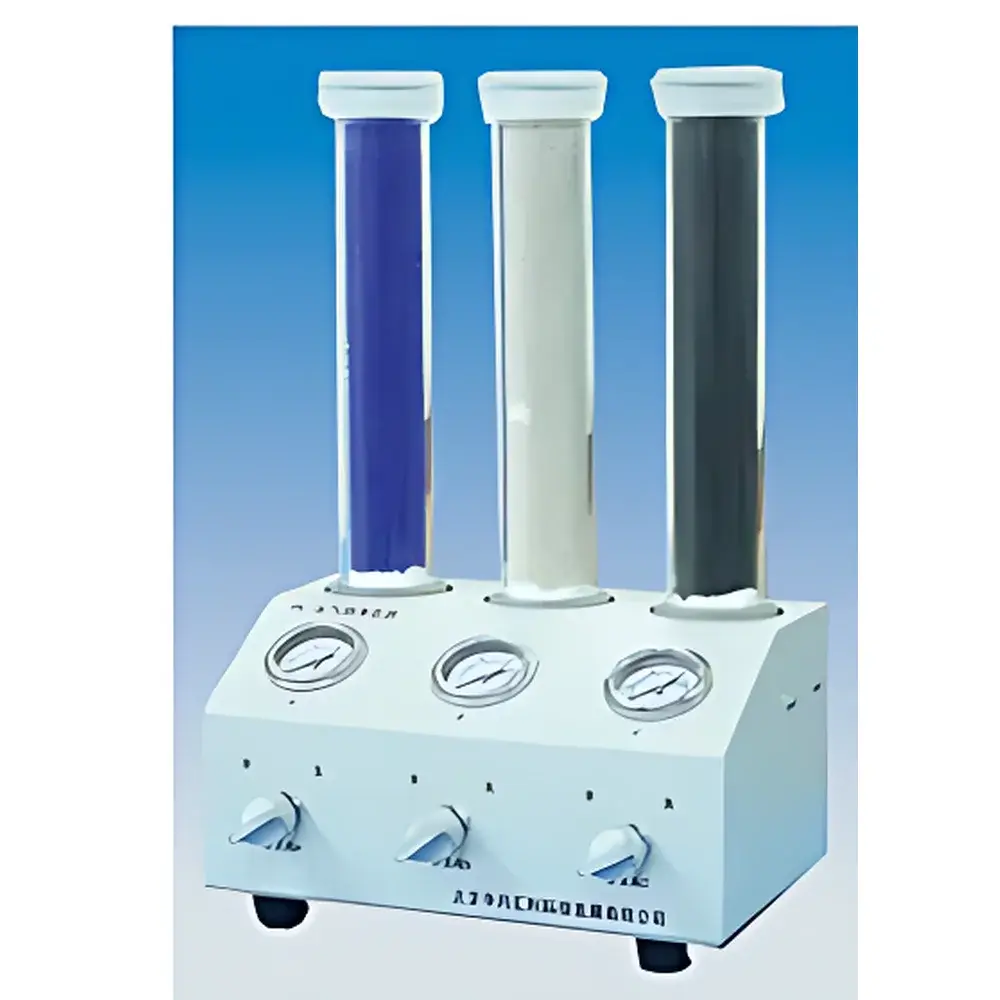
Beifen Sanpu QA-3 Gas Purifier
| Brand | Beifen Sanpu |
|---|---|
| Origin | Beijing, China |
| Manufacturer Type | Manufacturer |
| Country of Origin | Domestic (China) |
| Model | QA-3 |
| Price | USD 180 (approx.) |
| Dew Point | -40°C |
| Output Flow Rate | 0–3 L/min |
| Output Pressure | 0–0.4 MPa |
| Operating Temperature | 10–40°C |
| Relative Humidity Limit | ≤85% (non-condensing, dust-free, non-corrosive environment) |
| Dimensions (L×W×H) | 225 × 170 × 370 mm |
| Weight | 3 kg |
Overview
The Beifen Sanpu QA-3 Gas Purifier is a compact, benchtop-grade gas purification system engineered for reliable support of gas chromatography (GC) and flame photometric detection systems. Designed to deliver high-purity carrier, fuel, and zero-air gases, it employs a dual-stage adsorption architecture based on standardized desiccant and molecular sieve media. The unit operates on the principle of physical adsorption—where moisture, hydrocarbons, oxygen, and trace particulates are selectively removed via surface interaction with activated silica gel (color-indicating) and 4A/13X molecular sieves. This passive, pressure-driven purification process requires no electricity or moving parts, ensuring silent, maintenance-light operation ideal for continuous laboratory service. As an auxiliary gas conditioning device, the QA-3 meets the baseline purity requirements specified in ASTM D6299 (standard practice for laboratory quality control) and supports method validation under ISO/IEC 17025-accredited environments when integrated into GC workflows.
Key Features
- Triple-chamber modular design: Three independent, parallel purification columns—each filled with color-changing silica gel (visual moisture saturation indicator) and high-capacity 4A molecular sieve—enable flexible configuration (series, parallel, or selective bypass).
- Real-time status monitoring: Integrated color-transition indicators allow immediate visual assessment of desiccant exhaustion without instrumentation or downtime.
- Pressure-stable delivery: Regulated output maintains consistent 0–0.4 MPa supply pressure across the full 0–3 L/min flow range, compatible with standard GC pneumatic controllers and FPD air compressors.
- Robust mechanical architecture: Aluminum alloy housing with powder-coated steel base ensures structural integrity, ESD-safe grounding, and resistance to minor chemical exposure in analytical labs.
- Low-footprint footprint: Compact dimensions (225 × 170 × 370 mm) and 3 kg mass facilitate placement beneath fume hoods, inside GC cabinets, or on shared instrument benches without spatial compromise.
- Fail-safe gas path: All internal tubing conforms to ASTM F2217 (ultra-high-purity stainless-steel or PTFE-lined fittings), minimizing leachable organics and metallic contamination.
Sample Compatibility & Compliance
The QA-3 is validated for use with compressed air, nitrogen, hydrogen, and helium supplies feeding gas chromatographs (e.g., Agilent 7890/8890, Thermo ISQ, Shimadzu GC-2030), flame photometric detectors (FPD), and nitrogen-phosphorus detectors (NPD). It complies with general laboratory safety standards per IEC 61010-1 (electrical safety for lab equipment—though electrically passive, its mechanical construction adheres to associated mechanical stress and enclosure requirements). While not certified to ISO 8573-1 Class 1 for compressed air purity, its -40°C dew point output aligns with ISO 8573-1:2010 Class 3.2.2 for humidity and Class 4 for total oil content when used with pre-filtered inlet gas. It supports GLP-compliant documentation protocols when paired with logbook-based change-out tracking of consumables.
Software & Data Management
The QA-3 is a hardware-only, analog purification device with no embedded firmware, digital interface, or data logging capability. Its operational integrity relies on manual verification—users record column replacement dates, inlet pressure readings, and outlet dew point checks (via optional handheld hygrometer) in paper or LIMS-integrated electronic logs. For laboratories operating under FDA 21 CFR Part 11, the unit is classified as “non-configurable ancillary hardware”; audit trails for gas quality are maintained externally via instrument calibration records, preventive maintenance logs, and QC gas certification documents (e.g., NIST-traceable dew point certificates).
Applications
- Carrier gas conditioning for capillary GC analyses requiring low water/oxygen content (e.g., pesticide residue screening, petrochemical hydrocarbon profiling).
- Fuel and oxidant gas polishing for flame-based detectors (FPD, FID, NPD) to prevent baseline drift and detector quenching.
- Zero-air generation for ambient air monitoring calibrations and VOC analyzer zeroing procedures.
- Pre-purification stage upstream of catalytic scrubbers or ozone generators in multi-stage gas cleaning trains.
- Backup purification for centralized lab gas systems during scheduled maintenance or unexpected filter breakthrough events.
FAQ
How often should the silica gel and molecular sieve cartridges be replaced?
Cartridge replacement frequency depends on inlet gas quality and daily usage volume; under typical lab conditions (2 L/min, 8 hrs/day, urban compressed air), expect 3–6 months per set. Visual color shift (blue → pink for silica gel) indicates moisture saturation and necessitates immediate replacement.
Can the QA-3 be used with hydrogen carrier gas?
Yes—the unit is constructed with hydrogen-compatible materials (316 stainless steel fittings, fluorocarbon seals) and poses no ignition risk, as it contains no electrical components or heat sources.
Is the output pressure adjustable?
No—output pressure is determined by upstream supply pressure and regulated passively via internal orifice design; users must install an external pressure regulator if precise downstream pressure control is required.
Does the QA-3 require periodic calibration?
No formal calibration is needed; however, periodic verification of dew point performance using a calibrated chilled-mirror hygrometer (e.g., Michell Opti-Dew) is recommended every 6 months for QC-critical applications.
Can multiple QA-3 units be manifolded for higher flow capacity?
Yes—parallel manifold configurations are supported via standard 1/4″ NPT ports; ensure balanced flow distribution using needle valves to avoid channeling and uneven cartridge loading.
Related Products






