
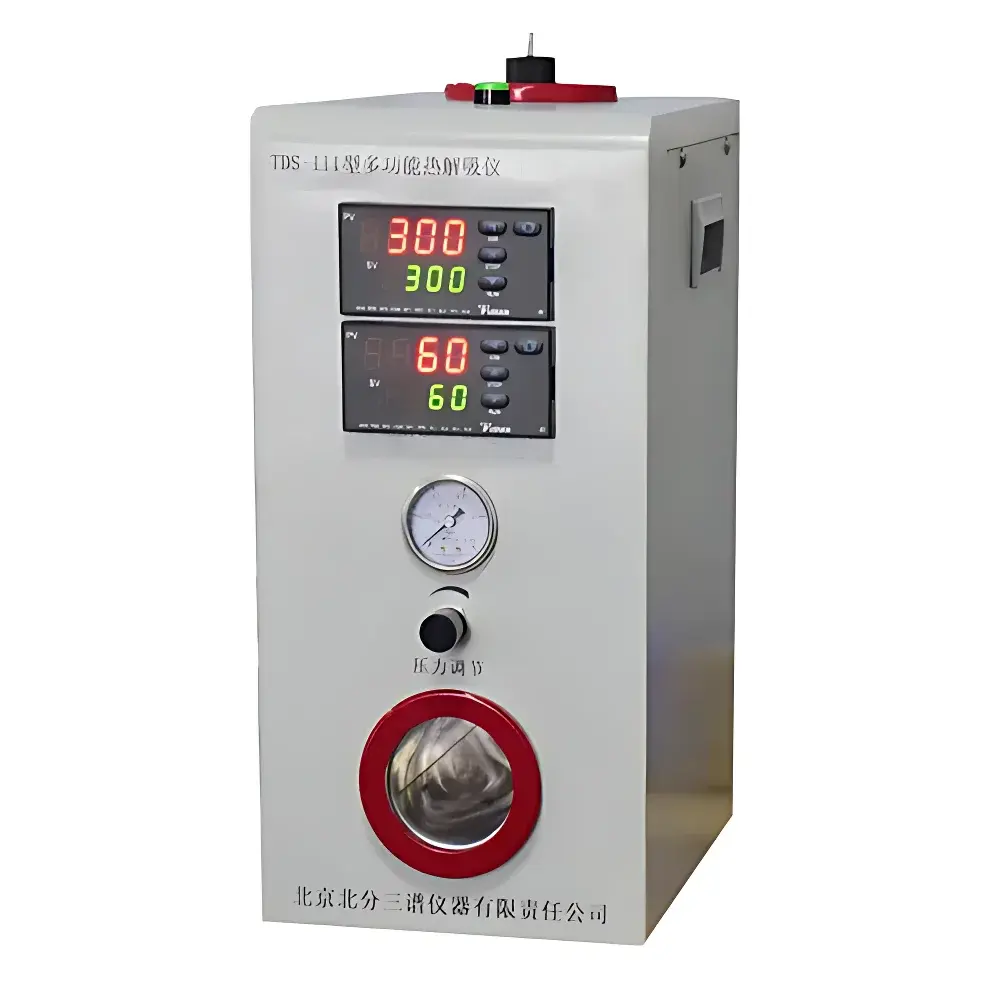
Beifen Sanpu TDS-III Multi-Function Thermal Desorber for Hexafluoropropylene Analysis
| Brand | Beifen Sanpu |
|---|---|
| Origin | Beijing, China |
| Manufacturer Type | Direct Manufacturer |
| Instrument Type | Single-Stage Thermal Desorber |
| Primary Desorption Temperature Range | 50 °C to 380 °C |
| Cold Trap Temperature Range | Down to −30 °C (basic configuration) |
| Desorption Recovery Rate | >80% (compound-dependent) |
| Sample Capacity | 20 adsorption tubes |
| Tube Dimensions | 6 mm OD (¼″), variable length |
| Injection Syringe Compatibility | 100 mL gas-tight glass syringe |
| Heating Precision | ±0.5 °C (both desorption furnace and syringe oven) |
| Flow Control Stability | <0.1% over time |
| Power Consumption | ~500 W |
| Dimensions (H×W×D) | 390 × 170 × 360 mm |
| Weight | ~9 kg |
Overview
The Beifen Sanpu TDS-III Multi-Function Thermal Desorber is a laboratory-grade, single-stage thermal desorption system engineered for quantitative analysis of volatile and semi-volatile organic compounds—including hexafluoropropylene (HFP)—in air samples collected on solid sorbent tubes. It operates on the principle of controlled thermal desorption: analytes adsorbed onto activated carbon or other sorbents are thermally released under inert carrier gas flow (typically nitrogen), concentrated into a large-volume gas-tight syringe (100 mL), and manually injected into a gas chromatograph (GC) equipped with a flame ionization detector (FID). This workflow aligns with standardized methods including GBZ/T 300.77–2017 (“Determination of Tetrafluoroethylene and Hexafluoropropylene in Workplace Air”) and GBZ/T 300.62–2017 (“Determination of Volatile Organic Compounds by Thermal Desorption–Gas Chromatography”). Unlike cryofocused or automated dual-stage systems, the TDS-III emphasizes operational simplicity, reproducible manual injection, and cost-effective compliance for routine occupational hygiene and indoor air quality monitoring.
Key Features
- Integrated dual-zone heating architecture: independent temperature-controlled desorption furnace (50–380 °C) and syringe oven (room temperature to 100 °C), both with ±0.5 °C stability and 1 °C programmable resolution.
- Optimized tube handling: accommodates standard 6 mm OD (¼″) sorbent tubes of variable length; zero-dead-volume connection design minimizes analyte loss and carryover.
- High-recovery desorption: validated recovery >80% for HFP and other fluorinated olefins under method-defined conditions (e.g., 200 °C, 20 mL/min N₂ flow, 100 mL collection volume).
- Multi-application flexibility: supports benzene, TVOC, and broad-spectrum VOC analysis per GB 50325–2006 and ISO 16000-6, enabled by interchangeable sorbent tubes (e.g., activated carbon, Tenax TA, Carbopack B).
- Robust mechanical design: compact footprint (390 × 170 × 360 mm), low power draw (~500 W), and lightweight construction (~9 kg) facilitate benchtop deployment in QC labs, field mobile units, and third-party testing facilities.
Sample Compatibility & Compliance
The TDS-III is compatible with standard 200 mg activated carbon tubes (as specified in GBZ/T 300.77–2017 for HFP) and alternative sorbents used in occupational health sampling (e.g., charcoal for halogenated hydrocarbons, silica gel for polar VOCs). Its performance meets critical requirements for regulatory compliance: consistent desorption efficiency (>80%), precise temperature control (±0.5 °C), and stable carrier gas flow (<0.1% drift). While not inherently compliant with FDA 21 CFR Part 11 or EU Annex 11 due to its manual injection interface, the system supports GLP-aligned documentation when paired with auditable GC data systems (e.g., Shimadzu GC-2010, Agilent 7890B) and traceable calibration records. It satisfies national occupational exposure limit (OEL) verification workflows mandated by Chinese Ministry of Health standards and serves as a validated platform for ISO/IEC 17025-accredited laboratories performing workplace air analysis.
Software & Data Management
The TDS-III operates via front-panel digital controls—no embedded software or PC interface is required. Temperature setpoints, hold times, and gas flow rates are manually configured and recorded in lab notebooks or LIMS-integrated worksheets. This analog control architecture ensures deterministic operation, eliminates firmware update dependencies, and simplifies validation for regulated environments where software qualification burdens are high. Users maintain full traceability through handwritten or electronic logs linking each desorption event to sample ID, tube lot number, calibration date, and GC run identifier. For laboratories requiring electronic audit trails, integration with chromatography data systems (CDS) such as OpenLab CDS or Chromeleon enables synchronized metadata capture—though instrument-level electronic signatures or user access controls are not natively supported.
Applications
Primary applications include: determination of hexafluoropropylene in semiconductor manufacturing exhaust and fluoropolymer production facilities; benzene and total volatile organic compound (TVOC) quantification in residential and office indoor air per GB 50325–2006; and routine screening of aliphatic/aromatic VOCs in occupational hygiene surveys. The system is routinely deployed by third-party environmental testing labs, occupational safety departments, and R&D centers validating sorbent tube performance. Its compatibility with low-cost activated carbon tubes reduces consumable costs for high-throughput monitoring programs, while the 20-tube capacity supports batch processing without intermediate reloading. Method transfer from research-grade GC–MS platforms to routine FID-based QC is straightforward due to identical desorption kinetics and syringe-based injection consistency.
FAQ
What is the difference between thermal desorption and headspace analysis?
Thermal desorption recovers analytes adsorbed onto solid sorbents (e.g., activated carbon tubes) via controlled heating and carrier gas elution, enabling pre-concentration of trace-level volatiles. Headspace analysis equilibrates analytes between liquid/solid matrix and vapor phase above it—suited for higher-concentration samples but lacking the sensitivity and sorbent selectivity of thermal desorption.
Can the TDS-III be used for secondary (cold trap) desorption?
No—the TDS-III is a single-stage desorber. It lacks a cryogenic focusing trap; analytes are transferred directly into a 100 mL syringe for manual injection. Dual-stage systems require separate cold trap modules and automated valving.
Is the TDS-III compatible with EPA Method TO-17?
It supports core TO-17 principles (thermal desorption of sorbent tubes followed by GC analysis) but does not meet full automation or cold trap specifications outlined in the method. It is suitable for laboratories applying modified TO-17 protocols under internal SOPs or national standards like GBZ/T 300.
How is calibration verified for hexafluoropropylene analysis?
Calibration is performed using certified HFP standard gases diluted in clean air across 0–0.20 mg/mL range. A minimum of four concentration points are analyzed; linear regression requires r² ≥ 0.999. System suitability is confirmed daily via recovery checks using spiked blank tubes.
Does the instrument support GLP-compliant operation?
Yes—when operated within documented SOPs, with maintained maintenance logs, temperature calibration certificates (NIST-traceable), and analyst training records, the TDS-III fulfills essential GLP requirements for non-automated instrumentation in environmental and occupational testing.




