
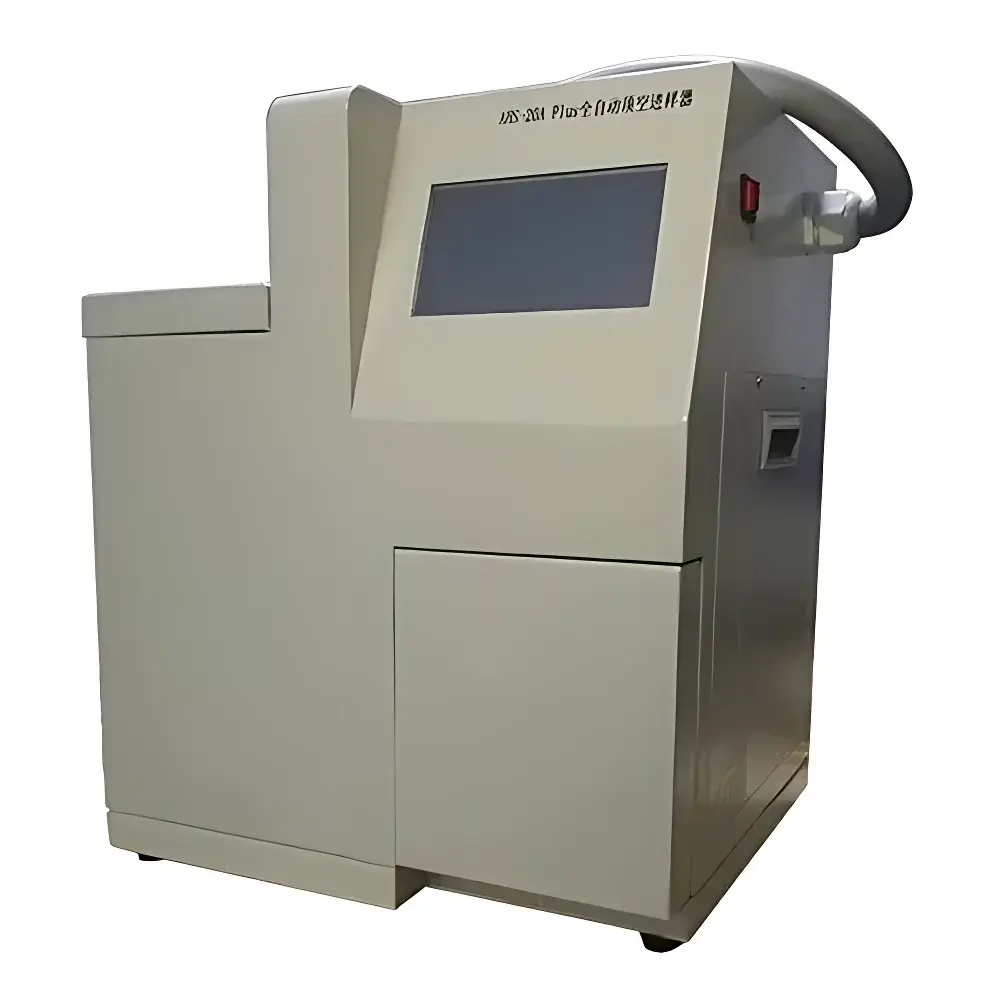
Beifen Sanpu VAHS-20A Plus Fully Automated Headspace Sampler
| [Brand | Beifen Sanpu |
|---|---|
| Origin | Beijing, China |
| Manufacturer Type | Original Equipment Manufacturer (OEM) |
| Country of Manufacture | China |
| Model | VAHS-20A Plus |
| Sample Positions | 20 |
| Sample Vial Capacity | 10 mL or 20 mL (customizable up to 100 mL) |
| Quantitative Loop Volume | 1 mL (optional: 0.5 / 2 / 5 mL) |
| Sample Heating Range | 40–220 °C (extendable to 300 °C) |
| Valve & Transfer Line Heating Range | 40–220 °C (extendable to 300 °C) |
| Temperature Accuracy | ±0.5 °C |
| Temperature Stability | < ±0.5 °C |
| Pressure Control Range | 0–0.25 MPa (continuously adjustable) |
| Pressurization Time | 0–999 s |
| Sampling Time | 0–30 min |
| Injection Time | 0–999 s |
| Bake-out/Flush Time | 0–30 min |
| Minimum Time Resolution | 1 ms |
| Carrier Gas Flow Control | EPC-compatible (optional) |
| RSD | < 1.0% (measured on 100 ppm ethanol in water) |
| Backflush Flow Rate | 0–100 mL/min (adjustable) |
| Interface | USB 2.0 |
| Compliance | ASTM D6866, ISO 11843-2, USP <467>, EPA Method 502.2 / 524.2 / 8260D] |
Overview
The Beifen Sanpu VAHS-20A Plus Fully Automated Headspace Sampler is an engineered solution for precise, reproducible, and unattended volatile organic compound (VOC) analysis in complex liquid and solid matrices. Designed for integration with gas chromatography (GC) systems, it operates on the principle of equilibrium headspace sampling—where analytes partition between a sealed sample vial’s condensed phase and its vapor phase at controlled temperature and pressure. This thermodynamic equilibrium enables quantitative extraction without matrix interference, making it ideal for residual solvent analysis, environmental monitoring, pharmaceutical quality control, and forensic toxicology. The system employs positive-pressure sampling via a high-inertness six-port valve and fused-silica transfer lines housed entirely within a thermally insulated oven, eliminating cold spots and ensuring analyte integrity from vial to GC inlet.
Key Features
- 20-position rotary autosampler with automatic vial recognition and intelligent collision avoidance—detects empty or misaligned positions and skips them without manual intervention.
- Triple-zone independent temperature control: sample incubation block, valve oven, and transfer line—all calibrated to ±0.5 °C stability and configurable up to 300 °C for high-boiling analytes.
- True microsecond-level timing resolution (1 ms minimum step) for pressurization, equilibration, sampling, injection, and purge cycles—enabling method optimization down to sub-second intervals.
- Electronically actuated motion system: no external pneumatic supply required; all positioning, valve switching, and syringe actuation are driven by precision stepper motors for long-term repeatability and safety in regulated labs.
- High-inertness fluidic path: deactived fused-silica quantitative loop (standard 1 mL, optionally 0.5/2/5 mL), PTFE/siliconized septa, and heated stainless-steel transfer tubing minimize adsorption, carryover, and memory effects.
- Integrated self-diagnostics: power-on system check, real-time positional feedback, thermal fault detection, and hardware error logging compliant with GLP audit requirements.
- Flexible operation modes: single-vial multi-injection, single-vial single-injection, and multi-vial sequential injection—programmable per vial to support heterogeneous sample batches.
Sample Compatibility & Compliance
The VAHS-20A Plus accommodates standard 10 mL and 20 mL crimp-top headspace vials (with optional adapters for 50 mL and 100 mL formats), supporting both aqueous and non-aqueous samples—including polymers, soils, biological tissues, and pharmaceutical formulations. Its thermal and pressure control architecture meets critical regulatory benchmarks: USP for residual solvents, ICH Q2(R2) validation guidelines for analytical instrumentation, and EPA Methods 502.2 (halogenated hydrocarbons), 524.2 (purge-and-trap VOCs), and 8260D (volatile organics in solid/liquid waste). All firmware timestamps, parameter logs, and sequence records are time-stamped and exportable for 21 CFR Part 11-compliant data integrity workflows when paired with validated GC data systems.
Software & Data Management
Control is executed via native Windows-based software accessible through USB 2.0 interface—supporting full remote configuration of all thermal, timing, pressure, and sequence parameters. The GUI provides real-time visualization of temperature profiles, valve status, and run progress, with event-triggered synchronization to GC start commands or external TTL signals. Audit trails record every user action, parameter change, and system alarm with immutable timestamps. Raw method files (.hsm) include embedded calibration metadata and are compatible with LIMS integration via CSV/Excel export. Optional EPC (Electronic Pressure Control) module enables closed-loop carrier gas flow regulation during injection—enhancing retention time stability and reducing inter-run variability in multi-method laboratories.
Applications
- Pharmaceutical QC: Residual solvent testing per ICH Q3C guidelines in APIs and excipients.
- Environmental labs: VOC quantification in groundwater, soil extracts, and air canister samples per EPA SW-846 protocols.
- Food & beverage: Ethanol, acetaldehyde, and flavor volatiles profiling in wines, dairy, and fermented products.
- Forensics: Blood alcohol concentration (BAC) and toxicant screening using headspace-GC-FID/MS.
- Polymer manufacturing: Monomer and catalyst residue analysis in PVC, ABS, and PET resins.
- Academic research: Kinetic studies of volatilization rates, partition coefficient determination, and method development for novel matrices.
FAQ
What vial sizes does the VAHS-20A Plus support out of the box?
Standard configuration supports 10 mL and 20 mL crimp-top headspace vials. Custom carriers for 50 mL and 100 mL vials are available upon request.
Can the system be validated for GMP environments?
Yes—the instrument includes password-protected user roles, electronic signatures, full audit trail logging, and 21 CFR Part 11–ready data export features when used with compliant GC software.
Is external gas supply required for operation?
No. All mechanical motion is motor-driven; only carrier gas (helium, nitrogen, or hydrogen) is needed for GC coupling.
How is carryover prevented between injections?
Through programmable high-flow backflush (0–100 mL/min), heated transfer line purging, and inert surface passivation of all wetted components.
Does the system support unattended overnight runs?
Yes—20-vial capacity, auto-recovery after power interruption, and built-in thermal fault shutdown ensure robust 24/7 operation in core lab environments.






