
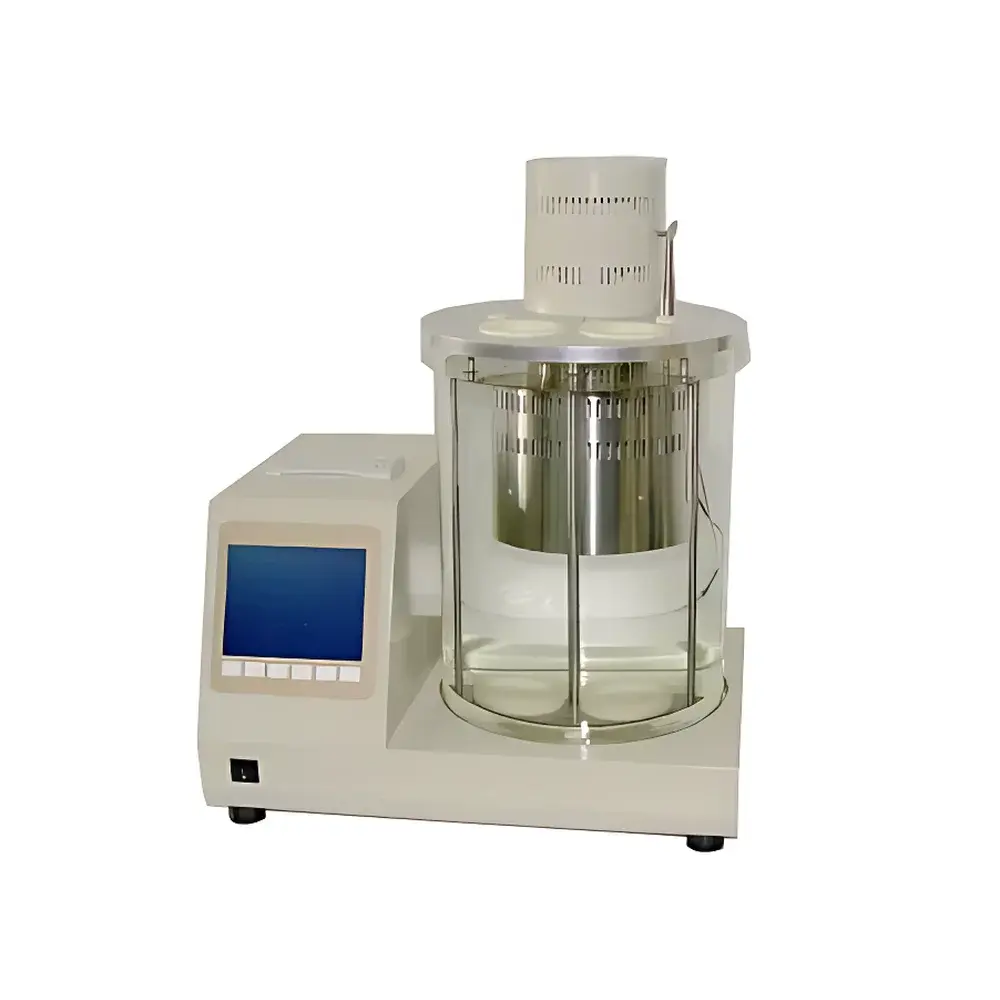
Beifen Sanpu ZFMD102 Petroleum Product Density Analyzer
| Brand | Beifen Sanpu |
|---|---|
| Origin | Hebei, China |
| Manufacturer Type | Direct Manufacturer |
| Country of Origin | China |
| Model | ZFMD102 |
| Pricing | Available Upon Request |
| Temperature Control Range | Ambient to 100 °C |
| Temperature Stability | ±0.1 °C |
| Sample Positions | 2 |
| Power Rating | 1000 W |
| Supply Voltage | AC 220 V ±20%, 50 Hz ±10% |
| Operating Ambient | 0–40 °C, ≤85% RH |
| Dimensions (W×D×H) | 440 × 350 × 550 mm |
| Display | 320 × 240 dot-matrix LCD with capacitive touch keys |
| Interface | RS-232 serial port |
| Thermal Printer | Integrated high-speed thermal printer with offline printing capability |
| Compliance Standard | GB/T 1884–1992 |
Overview
The Beifen Sanpu ZFMD102 Petroleum Product Density Analyzer is a precision laboratory instrument engineered for the gravimetric determination of density in liquid petroleum products and related hydrocarbon-based fluids. It operates in strict accordance with the Chinese national standard GB/T 1884–1992, which specifies the hydrometer method for density measurement at prescribed reference temperatures (typically 15 °C, 20 °C, or 60 °C). This method relies on the buoyancy principle: the depth to which a calibrated glass hydrometer sinks in a static, temperature-equilibrated sample correlates directly with its density. The ZFMD102 automates critical environmental controls—most notably thermal stabilization—enabling reproducible measurements across transparent, low-viscosity liquids (e.g., gasoline, naphtha, kerosene) as well as higher-viscosity samples (e.g., diesel, lubricating oils), provided they are free of suspended solids and entrained air.
Key Features
- Microprocessor-controlled thermal regulation system employing PID auto-tuning algorithm for rapid convergence and sustained stability within ±0.1 °C across the full operating range (ambient to 100 °C).
- Dual independent sample wells permit parallel conditioning of two specimens, improving throughput during routine QC testing or comparative analysis.
- Integrated 320 × 240 pixel monochrome LCD with capacitive touch interface supports intuitive navigation through test setup, real-time temperature monitoring, and result review without external peripherals.
- Built-in thermal line printer delivers immediate hardcopy output of test parameters—including date/time stamp, setpoint temperature, measured density value, and operator ID—supporting GLP-compliant documentation workflows.
- Standard RS-232 serial interface enables bidirectional communication with LIMS or custom data acquisition software; firmware supports ASCII-based command protocols for automated script integration.
- Robust mechanical architecture features corrosion-resistant stainless steel bath housing, insulated heating elements, and precision-machined sample well inserts to minimize thermal gradients and ensure long-term calibration integrity.
Sample Compatibility & Compliance
The ZFMD102 is validated for use with homogeneous, non-volatile, and non-corrosive liquid petroleum products meeting the physical criteria outlined in GB/T 1884–1992. Compatible samples include crude oil fractions, refined fuels, base oils, and certain bio-derived hydrocarbons—provided viscosity remains below 200 mm²/s at measurement temperature and vapor pressure does not exceed 100 kPa. Samples must be pre-filtered (≤5 µm) and degassed prior to immersion to prevent hydrometer float error or meniscus distortion. While GB/T 1884–1992 is the primary referenced standard, results are traceable to SI units (kg/m³) and correlate closely with ISO 3675 and ASTM D1298 methodologies under equivalent test conditions. Instrument design adheres to IEC 61010-1 safety requirements for electrical laboratory equipment.
Software & Data Management
The analyzer operates autonomously via embedded firmware; no host PC is required for basic operation. However, the RS-232 interface supports structured data export in CSV-compatible format, including timestamp, bath temperature, user-defined sample ID, and final density reading (in g/cm³ or kg/m³). Firmware logs retain the last 256 test records with audit trail metadata (start/stop time, temperature deviation history, operator input flags). For regulated environments, optional firmware upgrade packages provide 21 CFR Part 11–compliant electronic signatures, role-based access control, and encrypted data archiving—facilitating FDA, CNAS, or CMA accreditation audits. All exported data files include embedded checksums to verify transmission integrity.
Applications
- Quality control of refinery streams and finished fuels per enterprise specifications aligned with GB/T 1884–1992 and GB/T 1885–1998 (petroleum measurement tables).
- Batch release testing of lubricants and specialty fluids where density serves as a surrogate indicator for base stock composition or additive concentration.
- Research-grade characterization of alternative fuels (e.g., FAME biodiesel blends) to assess blending homogeneity and detect phase separation tendencies.
- Forensic analysis of fuel adulteration by comparing measured density against certified reference materials (CRMs) traceable to NIM (National Institute of Metrology, China).
- Educational laboratories conducting ASTM D1298–style experiments to demonstrate empirical correlations between hydrocarbon class distribution (paraffinic vs. naphthenic vs. aromatic) and bulk density.
FAQ
Does the ZFMD102 support automatic hydrometer reading or require manual interpretation?
No. The ZFMD102 provides precise thermal conditioning only; hydrometer insertion, meniscus reading, and temperature correction remain manual steps per GB/T 1884–1992. It does not integrate optical sensors or image-based analysis.
Can the instrument accommodate ASTM D1298 or ISO 3675 test protocols?
Yes—provided the user follows procedural equivalencies: identical temperature control accuracy (±0.1 °C), calibrated hydrometers meeting ASTM E100 or ISO 3807, and proper sample handling per respective standards. The hardware platform satisfies environmental control requirements common to all three methods.
Is calibration verification traceable to national metrology institutes?
Yes. Temperature sensor calibration is performed using NIST-traceable PRTs (Platinum Resistance Thermometers); density verification employs certified liquid standards from NIM or equivalent NMIs. Certificate of Conformance includes as-found/as-left data.
What maintenance intervals are recommended for long-term accuracy?
Bath fluid (distilled water or silicone oil) should be replaced every 12 months or after 500 operational hours. Thermal sensor drift verification is advised quarterly using a secondary reference thermometer calibrated to ±0.05 °C uncertainty.
Does the RS-232 interface support Modbus RTU or other industrial protocols?
No. Communication is limited to proprietary ASCII command sets documented in the technical manual. Custom driver development is supported via published protocol specification.





