
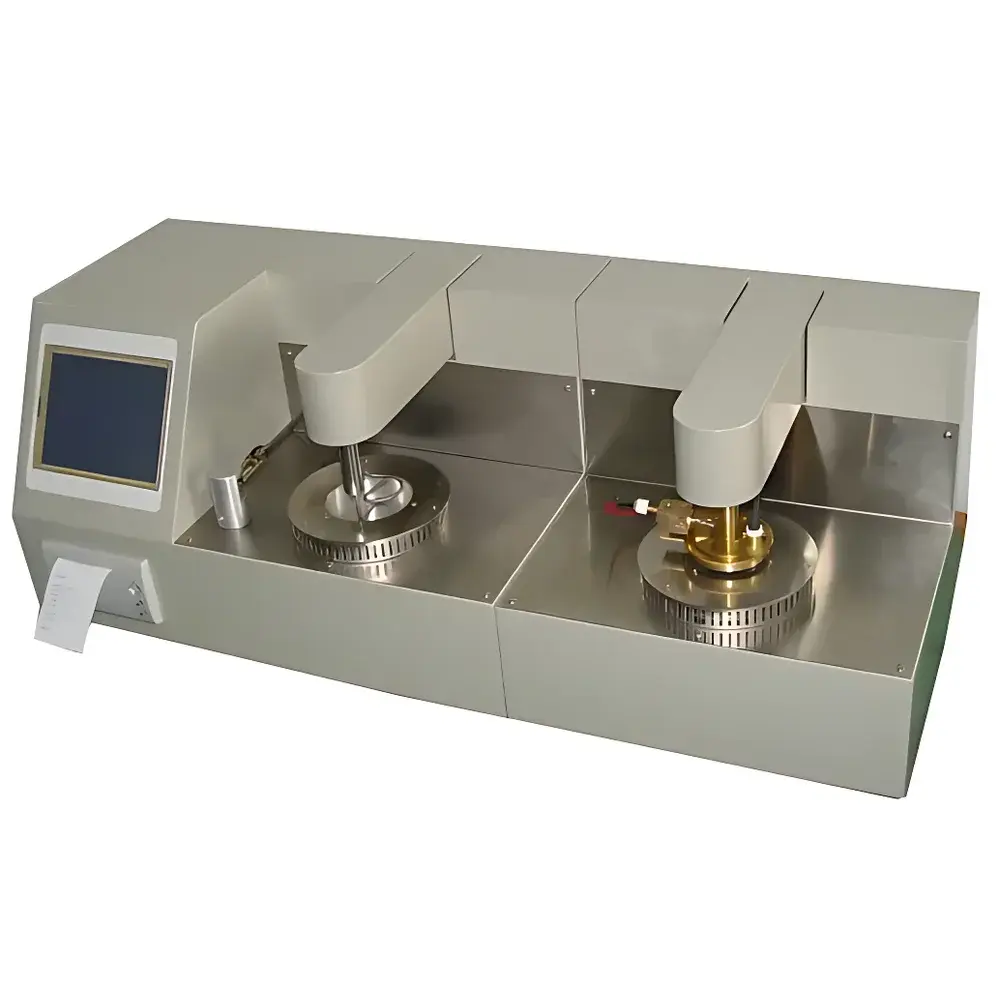
Beifen Sanpu ZFSD300 Fully Automated Flash Point Tester
| Brand | Beifen Sanpu |
|---|---|
| Origin | Hebei, China |
| Manufacturer Type | Direct Manufacturer |
| Model | ZFSD300 |
| Flash Point Measurement Range (Closed Cup) | Ambient to 350 °C |
| Flash Point Measurement Range (Open Cup) | Ambient to 400 °C |
| Accuracy | ±1 °C (≤104 °C), ±2 °C (>104 °C) for closed cup |
| Repeatability | ±2 °C (closed cup), ±3 °C (open cup) |
| Temperature Resolution | 0.1 °C |
| Temperature Sensor | Imported Class A PT100 Platinum Resistance Thermometer |
| Ignition Detection | Thermocouple-based Flash Detection |
| Heating Control | Adaptive PID Algorithm per ASTM/ISO/GB Standards |
| Atmospheric Pressure Compensation | Integrated Digital Barometric Sensor |
| Power Supply | AC 220 V ±20%, 50 Hz ±10% |
| Rated Power | 800 W |
| Dimensions | 720 × 280 × 290 mm |
| Weight | 18 kg |
| Operating Environment | 0–40 °C, ≤90% RH |
| Data Storage | 255 test records with timestamp |
| Display & Interface | Touchscreen with screen-saver function |
| Printing | Built-in high-speed thermal printer (on-line and off-line capable) |
| Multi-furnace Support | Single main unit controls multiple independent test furnaces |
Overview
The Beifen Sanpu ZFSD300 Fully Automated Flash Point Tester is an engineered solution for precise, repeatable, and standards-compliant flash point determination of petroleum products and related hydrocarbon-based liquids. Designed in accordance with fundamental principles of equilibrium flash vaporization and ignition threshold detection, the instrument implements either Cleveland Open Cup (COC) or Pensky-Martens Closed Cup (PMCC) methodologies—fully configurable within a single platform. Its dual-mode capability ensures strict adherence to internationally harmonized test protocols, including ASTM D92 (open cup), ASTM D93 (closed cup), ISO 2719, GB/T 261–2008, GB/T 267–1988, GB/T 3536–2008, and GB/T 1671–2008. The system operates on the principle that flash point is the lowest temperature at which vapors above a heated sample ignite momentarily when exposed to a standardized ignition source under controlled atmospheric conditions. Real-time pressure compensation, adaptive heating control, and thermocouple-based flame detection collectively ensure metrological integrity across wide-ranging sample matrices—from light distillates to heavy fuel oils and lubricants.
Key Features
- Modular multi-furnace architecture: One central control unit synchronously manages up to four independent test furnaces, enabling parallel analysis of heterogeneous samples without cross-contamination or procedural delay.
- Adaptive PID temperature regulation: Dynamically adjusts heating rate to match exact ramp profiles specified by ASTM, ISO, and GB standards—eliminating manual intervention and ensuring protocol fidelity.
- Dual ignition options: Field-selectable electronic spark or gas flame ignition modules, each calibrated to meet energy output requirements defined in ASTM D93 Annex A1 and ISO 2719 Clause 6.3.
- Integrated barometric correction: On-board digital pressure sensor continuously measures ambient atmospheric pressure and applies real-time flash point correction per ASTM D93 Section 10.2.3 and ISO 2719:2016 Annex B.
- Comprehensive fault diagnostics: Self-monitoring circuitry detects thermistor drift, thermocouple open-circuit conditions, heater over-temperature events, and lid actuation failures—halting operation and logging error codes per IEC 61508 SIL1 requirements.
- Regulatory-grade data handling: Timestamped records include operator ID (optional), method ID, ambient pressure, final flash temperature, ignition event confirmation, and raw temperature/time arrays—structured for audit readiness.
- Thermal printer with offline mode: High-resolution thermal printout includes full test metadata, compliance statement, and QR-coded traceability link—retains functionality even during network interruption.
Sample Compatibility & Compliance
The ZFSD300 accommodates a broad spectrum of petroleum-derived materials, including but not limited to gasoline, diesel fuel, kerosene, jet fuel (Jet A-1, JP-8), residual fuel oil (IFO 180, IFO 380), lubricating base oils, transformer oils, and biodiesel blends (B5–B20). It excludes aqueous emulsions, highly volatile solvents below C4 hydrocarbons, and reactive chemicals (e.g., peroxides, nitro compounds) unless validated per ASTM D3278 risk assessment guidelines. All operational firmware and calibration procedures conform to GLP principles as defined in OECD Series on Principles of Good Laboratory Practice (ENV/MC/CHEM(98)17). Instrument validation documentation supports IQ/OQ/PQ execution per FDA 21 CFR Part 11 Annex 11 and EU GMP Annex 11 requirements for regulated laboratories.
Software & Data Management
Embedded firmware (v3.2+) provides full local control via 7-inch capacitive touchscreen with glove-compatible interface and automatic brightness adjustment. Data are stored internally in non-volatile memory with cyclic overwrite protection and optional USB export (CSV/Excel-compatible format). Each record contains ISO 8601 timestamps, method version identifiers, atmospheric pressure readings, and raw temperature vs. time logs sampled at 1 Hz. Audit trail functionality meets ALCOA+ criteria—ensuring Attributable, Legible, Contemporaneous, Original, Accurate, Complete, Consistent, Enduring, and Available data integrity. Optional RS-232 or Ethernet connectivity enables integration into LIMS environments supporting ASTM E1384 and ISO/IEC 17025 Clause 7.7 traceability frameworks.
Applications
Primary deployment domains include refinery quality assurance laboratories (ASTM D93/D92 compliance testing for crude assay and cut-point verification), aviation fuel certification (DEF STAN 91-91, ASTM D1655 Annex A1), power generation facilities (IEC 60296 transformer oil acceptance), rail transport fuel depots (EN 590 cold flow properties correlation), and academic research on alternative fuel volatility behavior. Secondary use cases span regulatory submissions to CNCA (China National Certification and Accreditation Administration), CNAS-accredited testing bodies, and third-party inspection agencies performing API RP 2000 or NFPA 30 hazard classification assessments.
FAQ
Does the ZFSD300 support both manual and automated calibration verification?
Yes—calibration verification is performed using certified reference materials (CRM) traceable to NIM (National Institute of Metrology, China) or NIST SRM 2721. The instrument includes guided calibration check routines compliant with ISO/IEC 17025 Clause 6.4.3.
Can test methods be modified to align with internal SOPs while retaining standard compliance?
Yes—Custom Method Mode allows parameter override (e.g., stirrer speed, ignition interval, ramp rate) within physical and safety boundaries defined by ASTM D93 Section 7.3. All deviations are flagged in report footers and logged separately.
Is remote firmware update supported?
Firmware updates require authenticated USB media loaded with digitally signed binaries issued by Beifen Sanpu’s Quality Assurance Department—no over-the-air (OTA) capability is implemented to preserve cybersecurity posture per IEC 62443-3-3 SL2.
What maintenance intervals are recommended for long-term accuracy?
Quarterly thermocouple verification, biannual cleaning of ignition electrodes and vapor chamber surfaces, and annual full-system metrological recalibration using accredited service providers meeting CNAS CL01:2018 requirements.
How does the instrument handle low-flash-point samples prone to pre-ignition?
Pre-ignition suppression logic activates when rate-of-temperature-rise exceeds 1.5 °C/s prior to expected flash event—automatically pausing heating and initiating cooling cycle per ASTM D93 Annex A2 safeguards.






