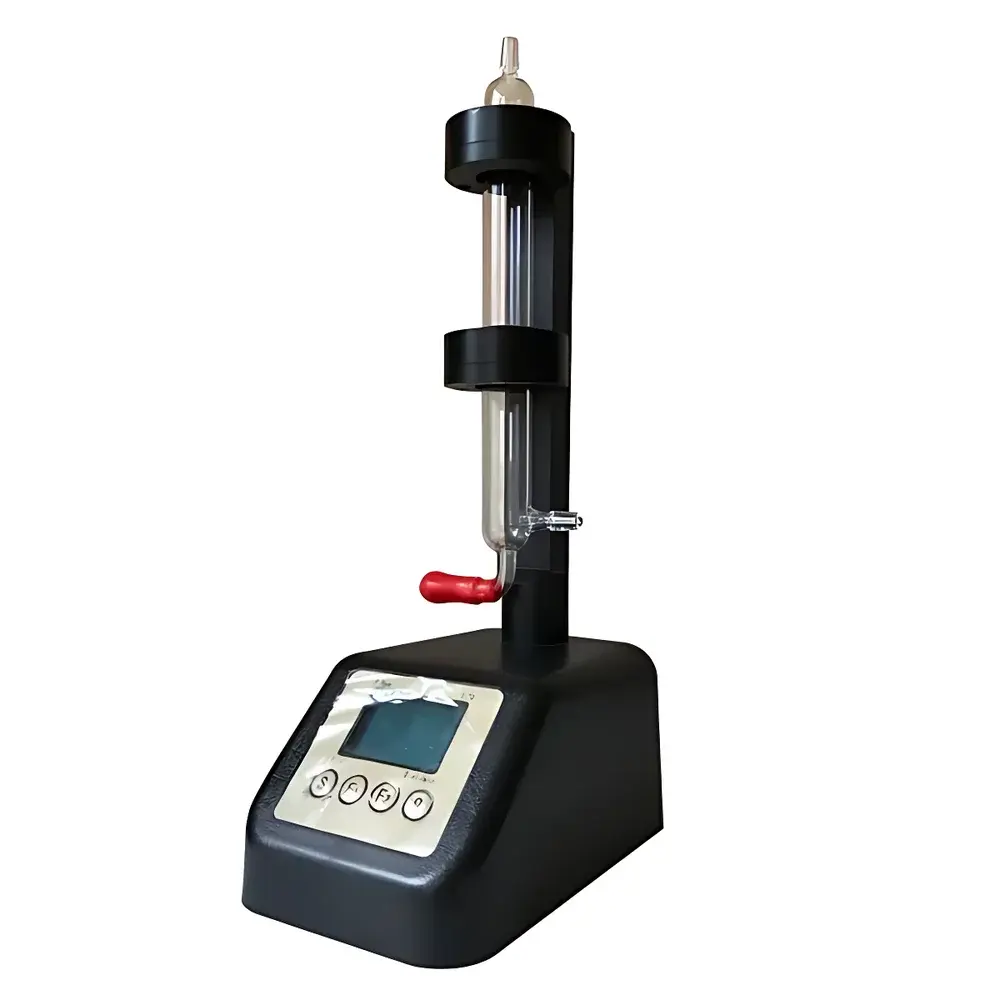
Beifen Sanpu ZM-103A Portable Volumetric Soap Film Flowmeter
| Brand | Beifen Sanpu |
|---|---|
| Origin | Beijing, China |
| Manufacturer Type | Direct Manufacturer |
| Model | ZM-103A |
| Flow Principle | Volumetric (Soap Film) |
| Flow Range | 4–1000 mL/min |
| Temperature Range | −10 °C to 50 °C |
| Pressure Range | 101.3 kPa ±50 kPa |
| Accuracy | ΔQ < ±1% |
| Repeatability | < 0.5% |
| Flow Resolution | 0.1 mL/min |
| Time Resolution | 0.1 s (internal calculation to 0.01 s) |
| Power | Rechargeable 4.8 V battery (standby >24 h |
| External Power | 9 V DC input with integrated trickle charging |
Overview
The Beifen Sanpu ZM-103A Portable Volumetric Soap Film Flowmeter is a precision-calibrated, handheld instrument engineered for traceable volumetric flow measurement of gases in low-to-moderate flow regimes. Operating on the established soap film displacement principle—where a thin, non-evaporative soap film is drawn across a calibrated glass tube by gas flow—the ZM-103A measures elapsed time between two optical sensors to compute volumetric flow rate (mL/min) with high reproducibility. Unlike thermal or differential pressure-based meters, this method provides direct, primary-standard-level traceability without requiring gas-specific calibration factors. Designed specifically for field and laboratory verification of sampling instrumentation, the ZM-103A meets the metrological requirements of JJG 586–2006 “Verification Regulation for Soap Film Flowmeters” and supports compliance-critical workflows in environmental monitoring, occupational health, and analytical instrument qualification.
Key Features
- Integrated microprocessor-controlled system with real-time computation of volume, elapsed time, temperature, pressure, and derived flow rates (both volumetric and mass-corrected)
- Dual optical sensor array with self-diagnostic capability—simultaneously monitors photodiode signal intensity and allows user-adjustable sensitivity via internal potentiometer
- Onboard environmental compensation: automatic correction for ambient temperature (−10 °C to 50 °C) and barometric pressure (101.3 kPa ±50 kPa) per ISO 8573-1 and ASTM D6159 conventions
- High-resolution timing engine with 0.01-second internal resolution and 0.1-second display granularity, ensuring sub-1% uncertainty in time-based volume integration
- Compact monolithic architecture: combined soap film tube, optical path, electronics, and rechargeable power supply in a single lightweight housing (<0.8 kg), optimized for field portability
- Intelligent power management: backlight auto-dimming after 60 seconds of inactivity; full auto-shutdown after 5 minutes; battery status indicator with charging progress feedback
- Dual-power operation: supports continuous use via external 9 V DC input while simultaneously maintaining float charge on the internal 4.8 V Li-ion pack (≥500 charge cycles, >24 h standby)
Sample Compatibility & Compliance
The ZM-103A is validated for use with clean, dry, non-corrosive gases—including air, nitrogen, helium, and synthetic air—at ambient conditions. It is not intended for liquids, vapors, or particulate-laden streams. Its volumetric measurement principle ensures consistent performance across gas species without recalibration, provided operating pressure remains within specification. The instrument conforms to national metrological verification requirements under JJG 586–2006 and supports GLP-compliant documentation when used with external data logging. While not certified to ISO/IEC 17025 itself, its traceable design enables integration into accredited laboratories’ uncertainty budgets for flow calibration tasks. It is routinely deployed in settings requiring adherence to EPA Method IO-4, NIOSH Manual of Analytical Methods (NMAM) Chapter 1000, and OSHA ID-121 protocols for sampler calibration.
Software & Data Management
The ZM-103A operates as a standalone, embedded-system device with no proprietary software dependency. All measurement data—including raw timestamps, sensor states, compensated flow values, and environmental parameters—are displayed in real time on the integrated LCD and retained in volatile memory for immediate review. While it lacks USB or Bluetooth connectivity, its deterministic measurement sequence and built-in repeatability (<0.5%) support manual transcription into LIMS or ELN platforms. For audit readiness, users may record serial-numbered calibration logs referencing ambient conditions and reference standards used—fully compatible with FDA 21 CFR Part 11-aligned documentation practices when paired with controlled procedural SOPs.
Applications
- Calibration and verification of low-flow air samplers (e.g., personal and area monitoring pumps per ISO 13137)
- Field validation of dust and aerosol sampling systems, including cyclones and impactors
- Verification of carrier and auxiliary gas flows in GC systems prior to method transfer or routine maintenance
- Recalibration of rotameters and critical orifice flow controllers used in emission testing setups
- Performance assessment of portable VOC analyzers and photoionization detectors requiring precise sample draw control
- Flow characterization of stack gas probes and dilution samplers in stationary source monitoring
- Teaching and research applications in fluid mechanics and environmental engineering laboratories
FAQ
What gas types can be measured with the ZM-103A?
It is suitable for non-reactive, particle-free gases such as air, nitrogen, argon, helium, and carbon dioxide at ambient temperature and pressure.
Does the instrument require periodic factory recalibration?
No mandatory factory recalibration is specified; however, users are advised to verify sensor alignment and timing accuracy annually using a certified stopwatch and reference volume standard per JJG 586–2006.
Can the ZM-103A measure liquid flow?
No—it is designed exclusively for gaseous media; liquid introduction will damage the optical sensors and soap film tube.
Is pressure compensation applied automatically during measurement?
Yes—barometric pressure input (manual or optional external sensor) is used to correct volume to standard conditions (e.g., 25 °C, 101.325 kPa) in accordance with ISO 10780 and EPA guidance.
How is traceability maintained for regulatory audits?
By documenting instrument serial number, date/time stamp, ambient T/P values, operator ID, and comparison against a higher-tier standard (e.g., bell prover or gravimetric calibrator), users establish an auditable chain of custody per ISO/IEC 17025 Clause 6.5.