
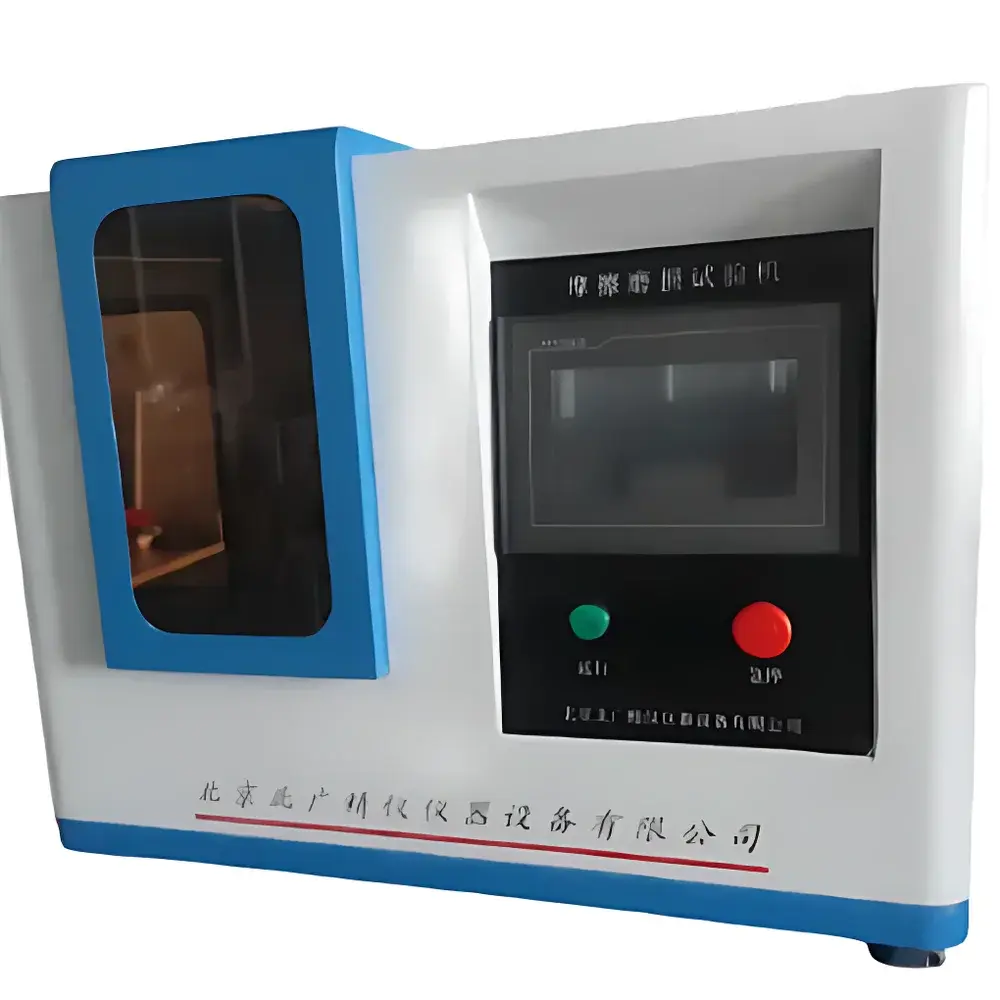
Beiguang Jingyi BGJY-200 Hard Plastic Sliding Friction and Wear Tester
| Brand | Beiguang Jingyi / All Precision Instrument |
|---|---|
| Origin | Beijing, China |
| Manufacturer Type | Direct Manufacturer |
| Product Origin | Domestic (China) |
| Model | BGJY-200 |
| Max Test Load | 2000 N |
| Load Measurement Accuracy | ±2% FS (≥10% FS) |
| Load Repeatability | ≤2% FS (≥10% FS) |
| Friction Torque Range | 0–15 N·m |
| Torque Accuracy | ±3% FS (≥10% FS) |
| Torque Repeatability | ≤3% FS (≥10% FS) |
| Lower Specimen Shaft Speed | 0–400 rpm (infinitely variable) |
| Upper Specimen Shaft Speed | 0–360 rpm |
| Axial Travel of Upper Specimen | ±4 mm |
| Time Control Range | 1 s – 9999 min |
| Revolution Count Range | 1 – 999999 |
| Sample Dimensions | 30 mm × 7 mm × 6 mm |
| Standard Load | 196 N (±0.1%, extendable to 392 N) |
| Counterweight Configuration | One 4 kg + four 1 kg weights |
| Friction Ring | Ø40 × 10 mm, 45# steel, hardened to HRC 40–45, surface roughness Ra ≤ 3.2 µm, concentricity < 0.01 mm |
Overview
The Beiguang Jingyi BGJY-200 Hard Plastic Sliding Friction and Wear Tester is a precision-engineered tribological evaluation system designed specifically for quantitative assessment of sliding friction behavior and wear resistance in rigid thermoplastics, engineering polymers, and reinforced composites. Operating on the principle of controlled reciprocating or rotational sliding contact under defined normal load and kinematic conditions, the instrument conforms to ASTM D3702, ISO 6892-2 (for tribological extensions), and GB/T 3960—2016, the Chinese national standard for plastic friction and wear testing. Its dual-shaft architecture enables independent speed control of upper and lower specimens, supporting both pin-on-disk and block-on-ring configurations. The system integrates a high-stiffness mechanical frame, servo-driven actuation, real-time torque and load transduction, and embedded industrial PC-based process control—eliminating external controllers and minimizing signal latency. Unlike conventional analog testers, the BGJY-200 implements closed-loop PID regulation for load stability and thermal management, ensuring measurement integrity across extended test durations (up to 9999 minutes) and high-cycle counts (up to 999,999 revolutions).
Key Features
- Industrial-grade AC servo motor drive with Japanese origin controller, enabling infinitely variable speed control from 0 to 400 rpm on the lower shaft and 0 to 360 rpm on the upper shaft—optimized for low-speed creep studies and high-speed wear acceleration
- Integrated embedded industrial PC running custom HX control software; all operations—including parameter setup, real-time monitoring, curve plotting (time vs. friction torque, time vs. coefficient of friction), and data export—are executed via a single GUI interface
- Dual-load sensing architecture: high-accuracy load cell (2000 N full scale, ±2% linearity error ≥10% FS) and torque sensor (15 N·m full scale, ±3% linearity error ≥10% FS), both calibrated traceably to national metrological standards
- Modular specimen mounting system accommodating standardized 30 mm × 7 mm × 6 mm rectangular specimens and Ø40 mm × 10 mm hardened steel counterfaces (HRC 40–45, Ra ≤ 3.2 µm), with axial adjustment range of ±4 mm for precise contact alignment
- Programmable test protocols: time-controlled, revolution-controlled, or hybrid termination logic; automatic zeroing sequence with dual-stage stabilization (5-minute stress relaxation post-zeroing) to mitigate viscoelastic drift in polymer substrates
- Thermally isolated oil-bath environment (18–20 L capacity, operating temperature range up to 150 °C), compliant with flash point safety margins (≥40 °C below medium flash point), and equipped with PID-regulated heating and optional water-cooling interlock
Sample Compatibility & Compliance
The BGJY-200 is validated for use with rigid polymeric materials including but not limited to polyamide (PA6, PA66), polyoxymethylene (POM), polycarbonate (PC), polyetheretherketone (PEEK), glass-fiber-reinforced polybutylene terephthalate (PBT-GF), and ultra-high-molecular-weight polyethylene (UHMWPE). It supports comparative wear rate calculation per ISO 8251 and friction coefficient derivation per ASTM D1894 methodology. The system meets essential requirements of ISO/IEC 17025 for test equipment validation, including documented uncertainty budgets for load and torque channels. Optional GLP-compliant audit trail logging (user action timestamps, parameter change history, calibration event records) is available via software configuration. All mechanical components comply with RoHS Directive 2011/65/EU, and electrical safety conforms to IEC 61000-6-3 (EMC) and IEC 61010-1 (safety).
Software & Data Management
The proprietary HX Control Suite provides deterministic real-time acquisition at 100 Hz sampling rate, synchronized logging of load, torque, rotational speed, elapsed time, and revolutions. Raw data is stored in CSV and binary formats with metadata embedding (operator ID, sample ID, test standard, environmental notes). Curve overlays support multi-test comparison; statistical summaries include mean COF, wear volume (calculated from mass loss and density), and standard deviation across replicates. Export modules generate PDF reports compliant with internal QA templates or external regulatory submissions (e.g., FDA 21 CFR Part 11–ready when deployed on validated Windows OS with electronic signature enabled). Audit logs are immutable and timestamped to UTC, satisfying GMP traceability requirements for material qualification dossiers.
Applications
- Development and QC of automotive interior trim components (e.g., gear shift knobs, door handles) requiring low-friction, abrasion-resistant surfaces
- Evaluation of self-lubricating polymer formulations containing PTFE, graphite, or MoS₂ additives
- Accelerated wear life prediction for bearing cages, bushings, and linear guide elements in industrial automation systems
- Comparative screening of surface-modified plastics (plasma-treated, flame-sprayed, or laser-textured) against baseline resins
- Validation of ISO 15307-compliant biopolymer tribological performance for medical device housings and surgical tool components
- Supporting failure analysis investigations where galling, scuffing, or third-body wear mechanisms are suspected
FAQ
What standards does the BGJY-200 directly support?
It is fully aligned with GB/T 3960–2016, ASTM D3702 (for thrust washer configurations), and ISO 6892-2 Annex E (tribological testing extension). Custom protocol scripting allows adaptation to non-standard methods.
Can the system operate unattended for long-duration tests?
Yes—equipped with hardware watchdog timers, thermal cut-off relays, and auto-pause-on-anomaly logic, it supports continuous operation up to 9999 minutes with scheduled shutdown and data auto-save.
Is calibration documentation provided with delivery?
Each unit ships with a factory calibration certificate traceable to CNAS-accredited laboratories, covering load cell, torque sensor, and encoder channels, valid for 12 months under normal use.
How is specimen temperature controlled during testing?
Via thermostatically regulated silicone oil bath with integrated Pt100 RTD feedback, PID-tuned heating, and optional external chiller interface for sub-ambient stabilization.
Does the system support automated wear debris collection for SEM/EDS analysis?
Not natively—but the oil reservoir design permits optional magnetic particle traps and bottom-drain filtration kits (available as accessories) for post-test particulate recovery.





