
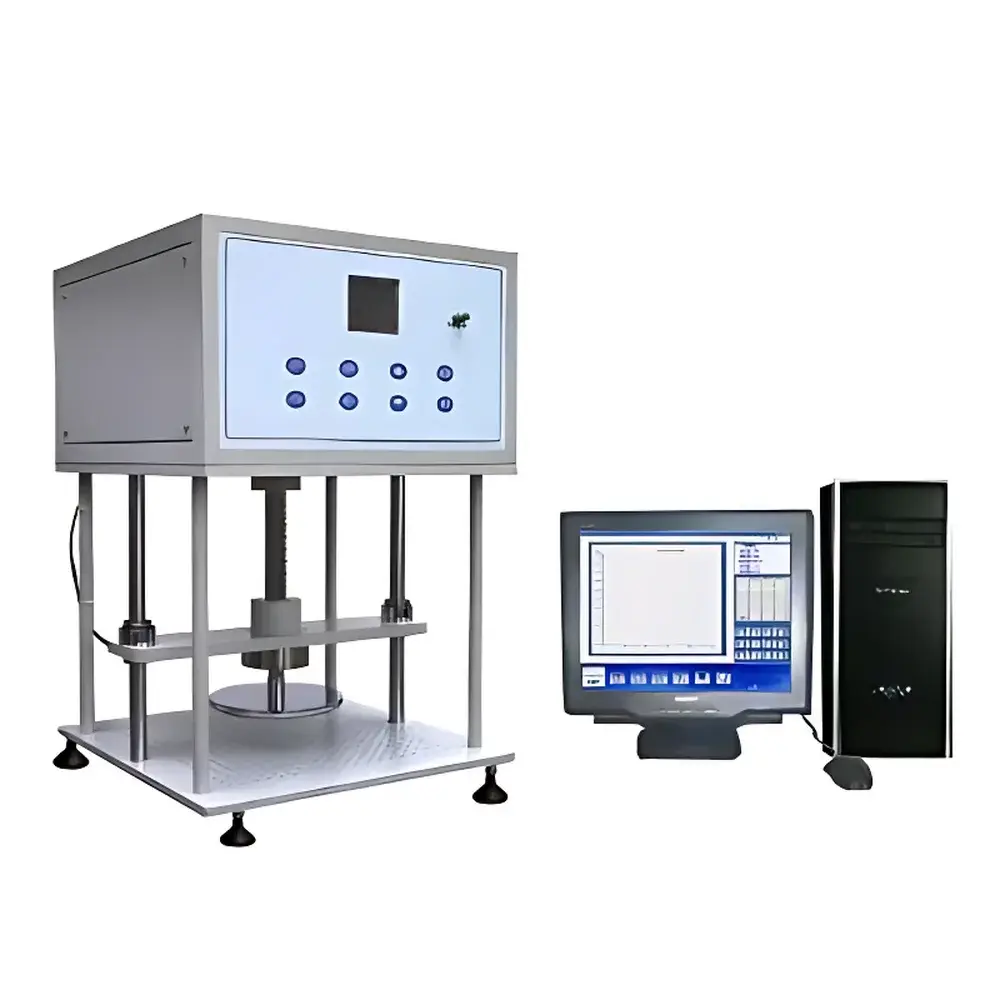
Beiguang Precision HMYX-2000 Foam Indentation Hardness Tester
| Brand | Beiguang Precision Instrument |
|---|---|
| Origin | Beijing, China |
| Manufacturer Type | Direct Manufacturer |
| Model | HMYX-2000 |
| Testing Speed | 100 mm/min |
| Force Range | 0–2000.0 N |
| Force Resolution | 0.25 N |
| Measurement Accuracy | < ±1% FS |
| Compliance Standards | GB/T 10807-2006, GB/T 10802 |
| Load Cell Type | 200 kg S-type load cell |
| Control Interface | PCI-based computer control card |
| Data Output | Real-time force–displacement curve, printable report |
Overview
The Beiguang Precision HMYX-2000 Foam Indentation Hardness Tester is a microprocessor-controlled mechanical testing system engineered for standardized indentation hardness evaluation of flexible polymeric foams—including polyurethane (PU), polyester, and latex-based sponge materials. It operates on the principle of quasi-static uniaxial compression, applying a precisely controlled, vertically oriented force via a rigid circular indenter (typically 200 mm diameter per GB/T 10807-2006) at a constant rate of 100 mm/min. The instrument measures the reaction force required to achieve specified indentation depths—commonly 25%, 40%, and 65% of original sample thickness—as defined in Method A (constant rate), Method B (constant load hold), and Method C (cyclic loading) under Chinese national standards. Designed for laboratory environments requiring traceable, repeatable mechanical characterization, the HMYX-2000 delivers high reproducibility in compliance with quality assurance frameworks including ISO/IEC 17025 and GLP-aligned documentation workflows.
Key Features
- Programmable indentation depth control with pre-set displacement targets (e.g., 25/40/65% deflection) and real-time closed-loop position feedback
- Dual-mode operation: force-controlled and displacement-controlled test protocols, selectable via software interface
- Auto-zeroing function initiated upon test start command to eliminate thermal drift and sensor offset
- Integrated overload protection and dual-limit safety system (electronic programmable limit + mechanical hard stop)
- Automatic return-to-origin post-test sequence, minimizing operator intervention and ensuring consistent starting conditions
- Multi-range load cell auto-ranging: automatic switching between sensitivity ranges to maintain optimal signal-to-noise ratio across full 0–2000 N span
- Real-time dynamic display of force–displacement curves during testing, with adjustable time-base and scaling
- Point-wise curve interrogation: post-test cursor-based extraction of force and displacement values at any coordinate along the recorded trace
Sample Compatibility & Compliance
The HMYX-2000 is validated for use with standard foam specimens measuring 380 mm × 380 mm × 50 mm (L × W × H), as specified in GB/T 10807-2006. It supports both Method A (rate-controlled indentation to target depth) and Method B (load-hold at fixed indentation depth for 30 s), enabling comparative assessment of initial stiffness, creep resistance, and recovery behavior. All hardware components—including the 200 kg S-type load cell, precision linear actuator, and hardened steel indenter plate—meet dimensional and surface finish tolerances outlined in Annex A of GB/T 10807. The system’s measurement uncertainty budget has been verified against NIST-traceable force calibration standards, supporting audit readiness for internal QA, third-party certification, and regulatory submissions under China’s CCC framework.
Software & Data Management
The proprietary Windows-based control software provides full test method configuration, real-time data acquisition (100 Hz sampling), and automated report generation compliant with GB/T 10807 reporting requirements. Raw datasets are stored in CSV and binary formats with embedded metadata (operator ID, timestamp, environmental conditions, calibration certificate ID). Audit trail functionality logs all user actions—including parameter changes, calibration events, and data exports—in accordance with ALCOA+ principles. Exported reports include graphical overlays of multiple test curves, statistical summaries (mean, SD, CV%), and pass/fail flags relative to specification limits. Data files are compatible with external analysis platforms such as MATLAB, Python (Pandas), and JMP for advanced regression modeling or DOE integration.
Applications
This tester serves critical roles in R&D, incoming material inspection, and production line QC for manufacturers of automotive seating foams, furniture cushioning, mattress cores, packaging inserts, and medical support surfaces. Typical use cases include: evaluating batch-to-batch consistency of PU foam formulations; validating curing process parameters (e.g., catalyst concentration, oven dwell time); benchmarking competitor materials; generating technical dossiers for customer qualification (e.g., OEM Tier 1 automotive specifications); and supporting root-cause analysis of field complaints related to perceived softness or collapse. Its ability to replicate standardized indentation sequences ensures comparability across global supply chains where GB/T 10807 alignment is mandated alongside ASTM D3574 or ISO 2439 equivalents.
FAQ
Does the HMYX-2000 comply with international standards beyond GB/T 10807?
Yes—it is mechanically and algorithmically configurable to execute ASTM D3574 Method A (Indentation Force Deflection) and ISO 2439 Type A protocols by adjusting indenter geometry, speed, and dwell timing within software parameters.
Can the system be integrated into a LIMS or MES environment?
It supports OPC UA and TCP/IP communication protocols; custom API endpoints can be enabled for bidirectional data exchange with enterprise systems upon request.
What calibration documentation is provided with shipment?
Each unit ships with a factory calibration certificate traceable to CNAS-accredited reference standards, including force linearity, repeatability, and zero stability verification at three points across the 0–2000 N range.
Is mechanical maintenance required between tests?
No scheduled maintenance is needed for routine operation; however, biannual verification of indenter parallelism and guide rail lubrication is recommended per the user manual’s preventive maintenance schedule.
How is data integrity ensured during long-duration creep tests?
The embedded controller maintains independent clock synchronization and non-volatile memory buffering, preventing data loss during unexpected power interruption or PC disconnection.



