
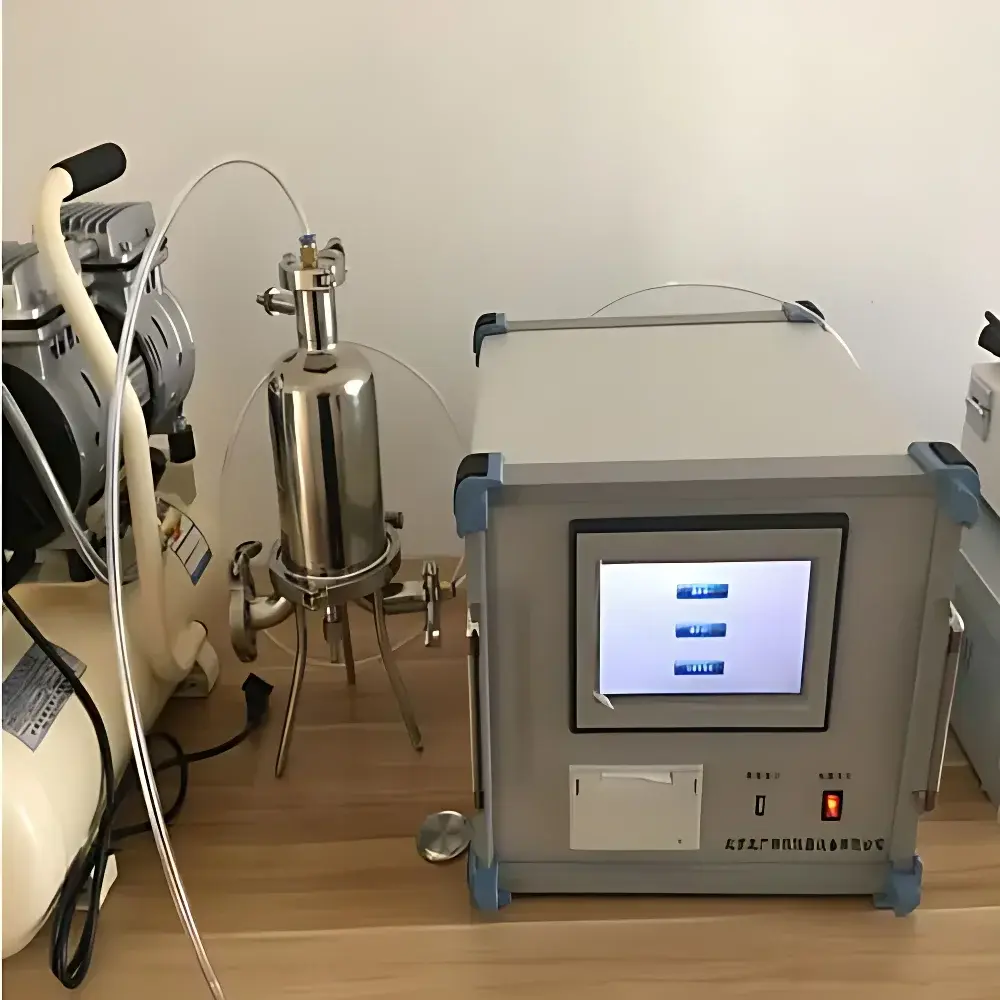
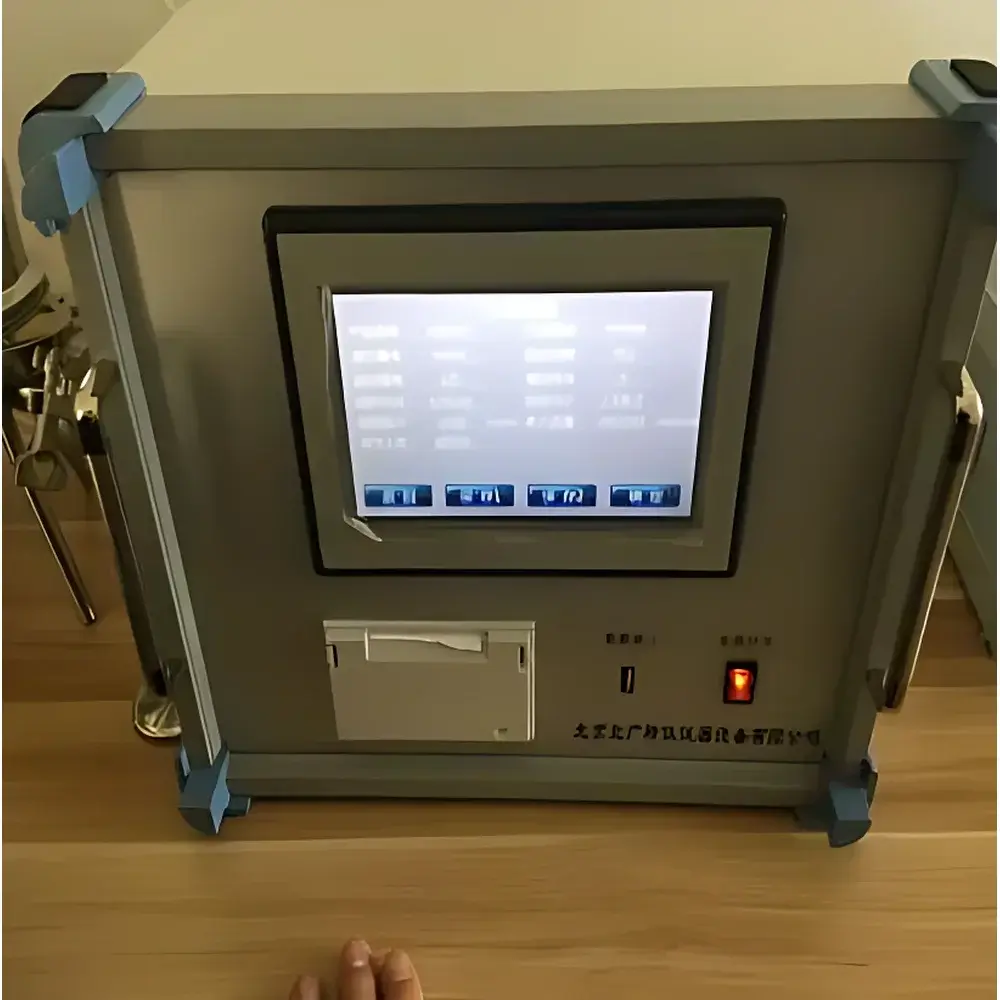
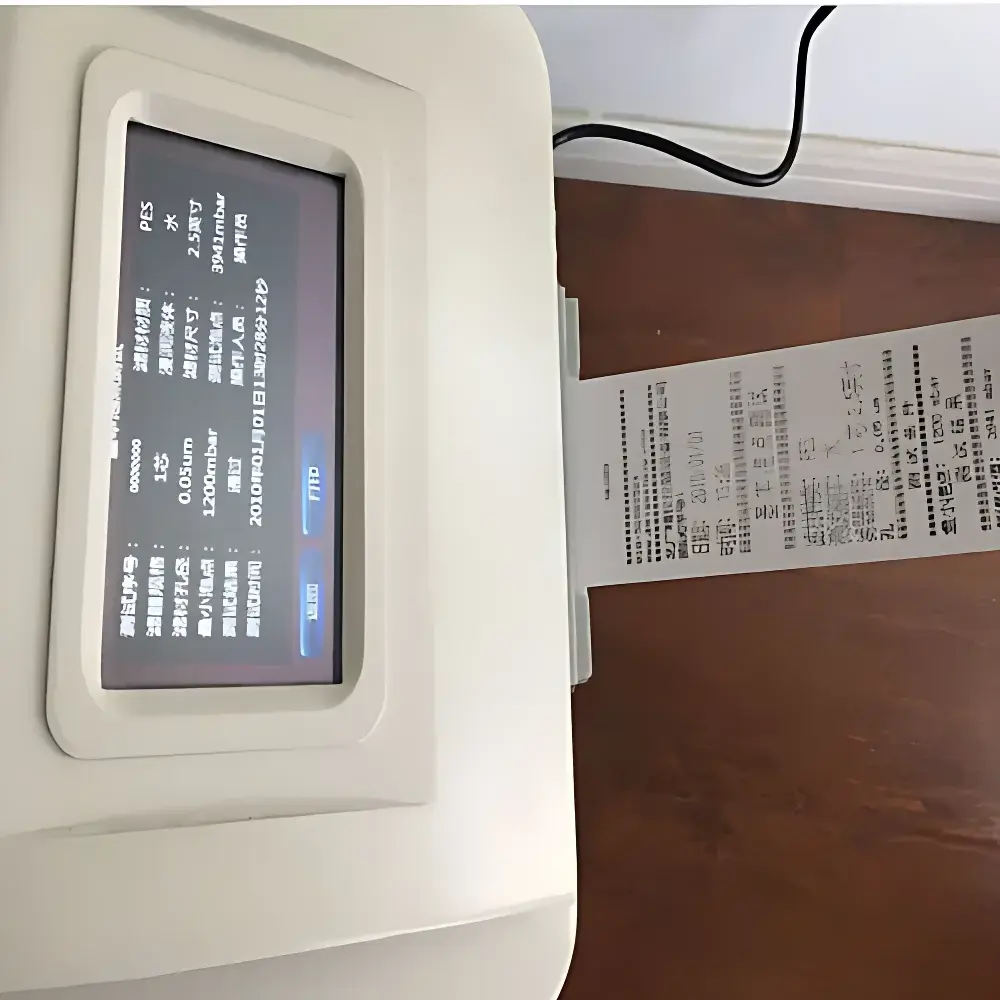
Beijing Guangjing BQS19 Online/Offline Filter Integrity Tester
| Key | Brand: Beijing Guangjing / All Precision Instrument |
|---|---|
| Origin | Beijing, China |
| Manufacturer Type | Manufacturer |
| Country of Origin | Domestic (China) |
| Model | BQS19 |
| Max Operating Pressure | 7999 mbar |
| Minimum Inlet Pressure | 3000 mbar |
| Test Pressure Range | 500–6900 mbar |
| Pressure Sensitivity | ±1.0 mbar |
| Bubble Point Accuracy | ±60 mbar |
| Environmental Operating Range | 0–50 °C, 10–80% RH |
| Basic Bubble Point Test Duration | 2 ± 2 min |
| Diffusion Flow Test Duration | 7 ± 2 min |
| Water Intrusion Test Duration | 7 ± 2 min |
| System Leak Test Duration | 3 ± 1 min |
| Disc Membrane Compatibility | Φ25 mm to Φ300 mm |
| Cartridge Length Range | 2.5″ to 40″ |
| Cartridge Core Count | 1–9 cores |
| Capsule & Mini-Cartridge Support | Yes |
| Air Filter Testing Capability | Yes |
| Display | 5.7″ 32-bit touchscreen |
| Language Options | English / Chinese |
| Data Storage | 32 GB (≥1 million test records) |
| Interface | RS232 / USB / Ethernet (for PC connectivity and remote control) |
| Power Supply | 170–240 V AC, 50/60 Hz, 100 W |
| Dimensions (L×W×H) | 500 × 200 × 180 mm |
| Printing | Thermal printer with bilingual (EN/CN) output of test conditions, results, and real-time curves |
Overview
The Beijing Guangjing BQS19 Online/Offline Filter Integrity Tester is an engineered solution for deterministic, regulatory-compliant integrity verification of hydrophilic and hydrophobic membrane filters used across pharmaceutical, biotechnology, and sterile manufacturing environments. It implements three primary ASTM- and ISO-aligned test methods: Bubble Point (BP), Diffusion Flow (DF), and Water Intrusion (WI), each governed by first-principles fluid dynamics and capillary flow theory. The instrument operates on a pressure decay and gas flow quantification architecture, where pressure stability, volumetric flow measurement, and real-time signal processing are synchronized via a high-resolution digital pressure transducer and mass flow sensor subsystem. Designed for both in-line integration (via optional process interface modules) and off-line benchtop use, the BQS19 meets core functional requirements of USP , ISO 13408-2, and Annex 1 (EU GMP) for filter qualification and routine post-use validation.
Key Features
- Digital Automatic Gas Inlet Control: Replaces legacy mechanical throttling with closed-loop PID-regulated pneumatic actuation—ensuring consistent test performance across variable supply pressure (3000–7999 mbar) and eliminating operator-dependent calibration drift.
- Auto-Exit on Pass: Upon successful completion of BP or DF testing against preconfigured acceptance criteria, the system automatically depressurizes and exits the test sequence—reducing cycle time and minimizing unnecessary exposure of filter media to elevated pressure.
- One-Touch Repeat Testing: Stores full test parameter sets (filter type, dimensions, wetting fluid, pore size, ramp rate, hold time) per test ID; subsequent runs require only a single confirmation input—optimized for repetitive batch release workflows.
- User Role-Based Access Control (RBAC): Three-tier permission structure (Operator, Supervisor, Administrator) with configurable password policies, audit-trail-enabled parameter modification logging, and session timeout—all aligned with FDA 21 CFR Part 11 electronic record requirements.
- Integrated Safety Architecture: Continuous internal pressure monitoring during standby and active phases; automatic venting if residual pressure exceeds 50 mbar; hardware interlocks prevent filter mounting/dismounting under pressure.
- Bilingual Touchscreen Interface: 5.7″ capacitive display with contextual on-screen prompts, step-by-step guided navigation, and dual-language (English/Chinese) menu logic—designed for multilingual cleanroom operations without documentation dependency.
Sample Compatibility & Compliance
The BQS19 accommodates a comprehensive range of filter geometries and configurations: disc membranes (Φ25–Φ300 mm), standard cylindrical cartridges (2.5″–40″, 1–9 cores), capsule filters, mini-cartridges, and vent filters. Its extended pressure range (500–6900 mbar) and adaptive flow compensation algorithm ensure reliable detection thresholds across low-diffusion hydrophobic systems (e.g., PTFE, PVDF) and high-area hydrophilic assemblies (e.g., PES, nylon). Validation data confirm repeatability ≤±2.5% RSD for diffusion flow measurements on multi-core 20″ PES cartridges (n=10), meeting ISO 13408-2 reproducibility benchmarks. All firmware and operational protocols support GLP/GMP traceability: every test record includes timestamp, operator ID, instrument serial number, environmental conditions, raw pressure/flow data, and pass/fail determination logic—exportable in CSV or PDF for regulatory submission.
Software & Data Management
The embedded firmware supports local storage of ≥1 million complete test records—including metadata, numerical results, and full-resolution pressure vs. time and flow vs. time curves—on a field-replaceable 32 GB industrial-grade flash module. When connected via USB or Ethernet to a Windows-based host PC, the included IntegritySuite™ desktop application enables centralized fleet management, remote test initiation, real-time status monitoring, and automated report generation compliant with ALCOA+ principles. Audit trails capture all user actions (login/logout, parameter changes, result deletions) with immutable timestamps and digital signatures. Data export formats include .csv (for LIMS integration), .pdf (for QA review), and .xml (for eDMS archival). Firmware updates are delivered via signed package files with SHA-256 hash verification.
Applications
- Pre-use post-sterilization integrity verification of sterilizing-grade filters in bioreactor harvest lines and buffer preparation skids.
- Post-use integrity confirmation of final-fill filters prior to product release, per ICH Q5A and EU Annex 1 requirements.
- Validation of hydrophobic air/gas vents in lyophilizer chambers and isolator systems using Water Intrusion method (ISO 13408-2 Annex C).
- Diffusion flow trending for predictive maintenance of large-area filtration systems (e.g., >1000 cm² upstream filters in viral clearance trains).
- Qualification of new filter lots against historical baseline data, supporting change control documentation under ISO 9001 and ICH Q9.
- Supporting Annex 1-mandated “filter integrity testing at point-of-use” through portable offline deployment or integrated online manifold interfaces.
FAQ
What regulatory standards does the BQS19 comply with?
The instrument’s test algorithms, data handling, and audit trail functionality align with USP , ISO 13408-2, ASTM F838-22, and EU GMP Annex 1 requirements for deterministic filter integrity testing.
Can the BQS19 perform Water Intrusion testing on large-scale hydrophobic filters?
Yes—it supports WI testing on filters up to 10,000 cm² surface area, with automatic upstream volume compensation and pressure decay modeling optimized for low-flow-rate hydrophobic matrices.
Is remote operation supported for centralized facility-wide monitoring?
Yes—via Ethernet or USB, the BQS19 integrates into SCADA or MES platforms using Modbus TCP or custom API endpoints provided in the IntegritySuite™ SDK.
How is data integrity ensured during power loss or unexpected shutdown?
All test data are written to non-volatile memory with atomic commit protocol; partial test records are discarded rather than saved incomplete, preserving data fidelity.
Does the system support electronic signatures for 21 CFR Part 11 compliance?
Yes—user authentication, role-based permissions, and tamper-evident audit logs meet Part 11 Subpart B requirements when deployed with validated IntegritySuite™ software and controlled IT infrastructure.





