
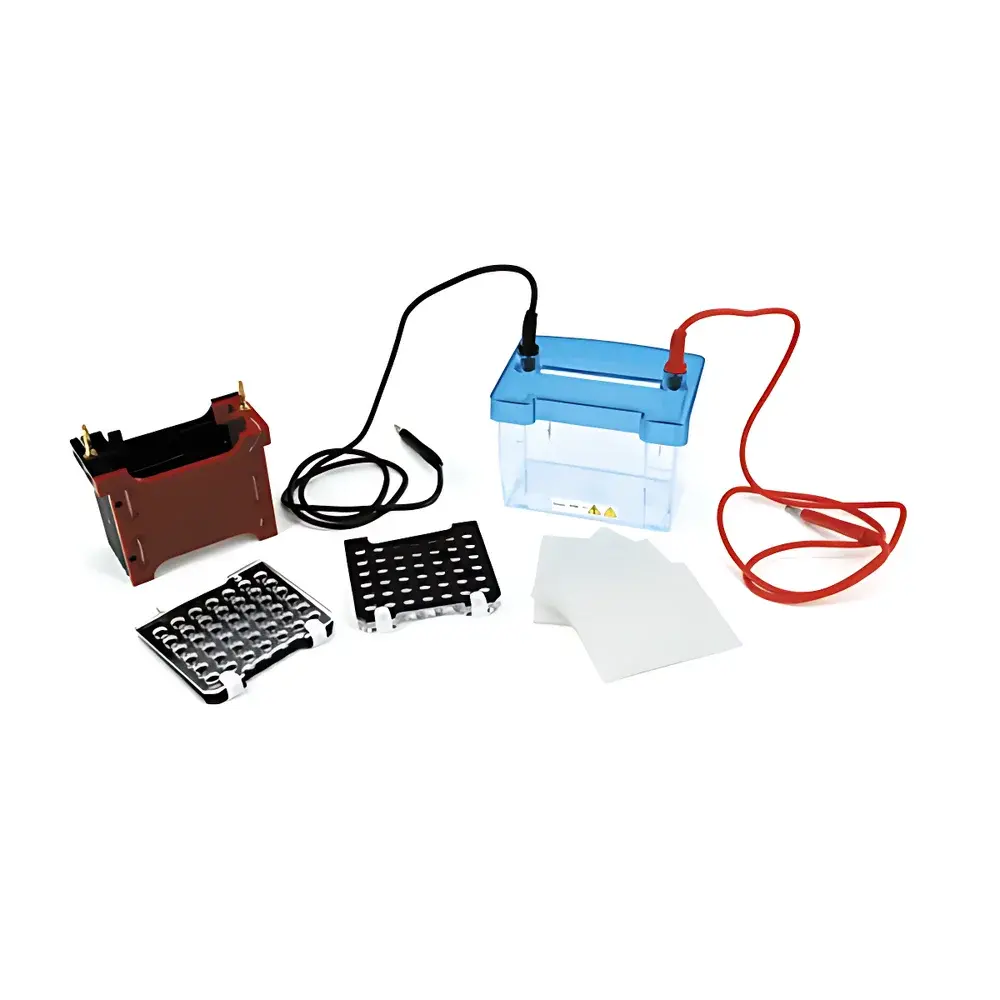
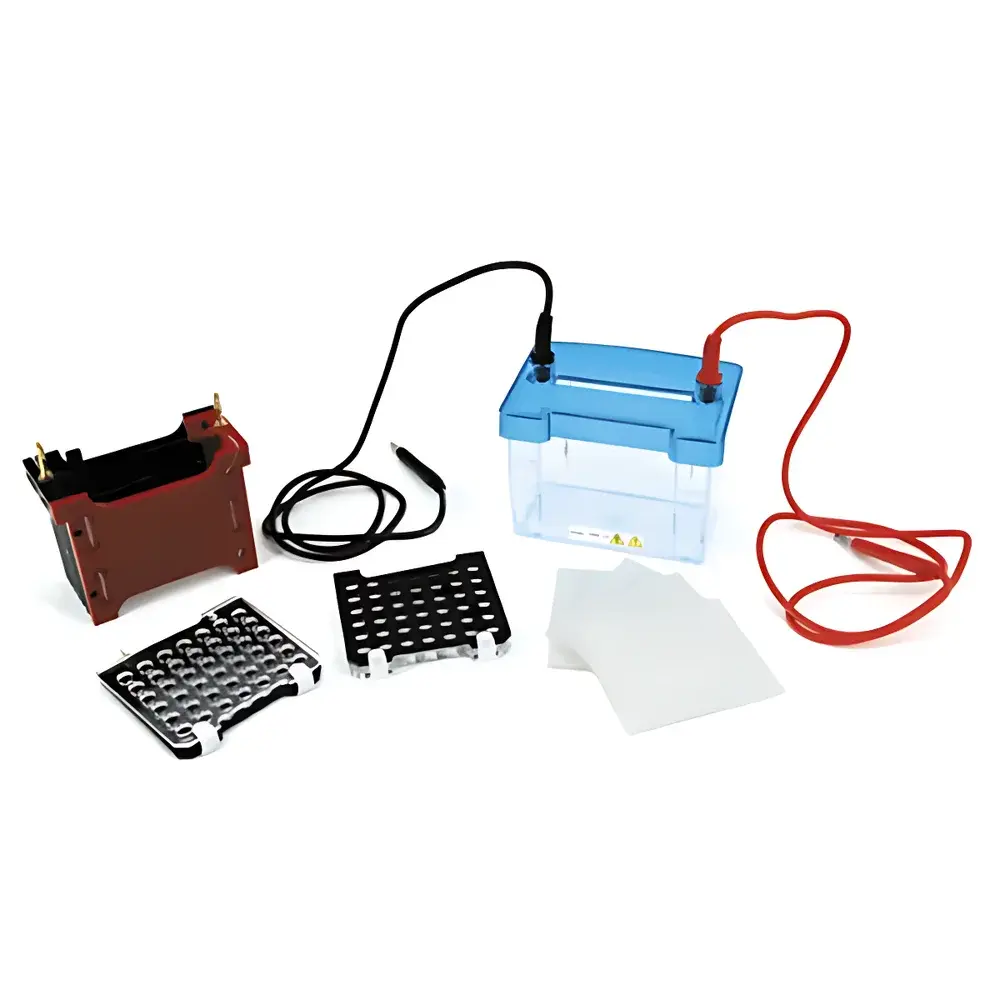
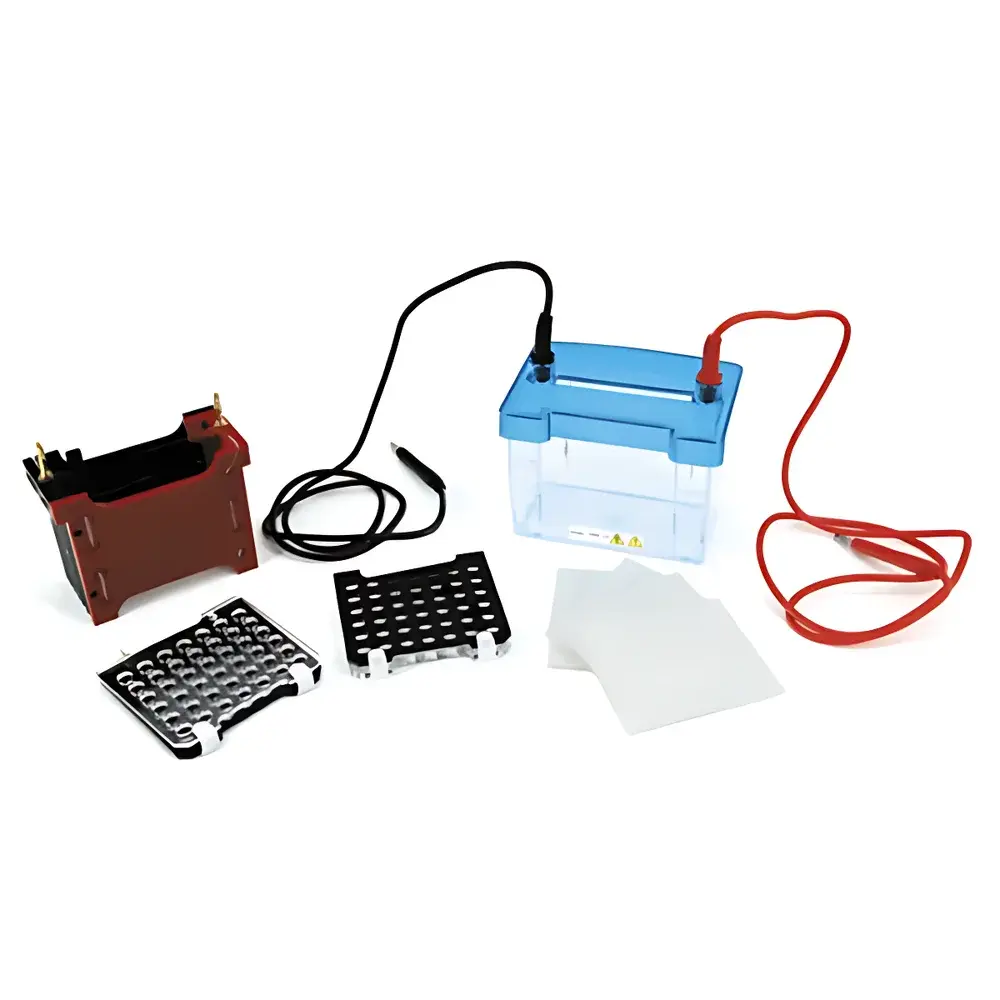
Beijing Liuyi DYCZ-40D Mini Trans-Blot Electrophoresis Apparatus
| Brand | Beijing Liuyi (LY) |
|---|---|
| Origin | Beijing, China |
| Instrument Type | Semi-Dry Trans-Blot Electrophoresis System |
| Gel Support Plate Dimensions | 95 × 87 mm |
| Overall Dimensions (L × W × H) | 140 × 100 × 150 mm |
| Buffer Capacity | 400 mL |
| Weight | 1 kg |
| Housing Material | High-Transparency Polycarbonate (Dual-Color Molded Cassette Assembly) |
Overview
The Beijing Liuyi DYCZ-40D Mini Trans-Blot Electrophoresis Apparatus is a compact, semi-dry electrophoretic transfer system engineered for rapid and reproducible protein or nucleic acid transfer from polyacrylamide or agarose gels to solid-phase membranes—including nitrocellulose (NC), polyvinylidene difluoride (PVDF), and nylon membranes. Operating on the principle of electroblotting, the DYCZ-40D applies a controlled direct current across a sandwich assembly comprising gel, membrane, and conductive filter papers saturated with transfer buffer. This configuration establishes a uniform electric field perpendicular to the gel plane, driving charged macromolecules—primarily proteins in SDS-PAGE applications—out of the gel matrix and onto the immobilizing membrane surface. Its semi-dry architecture eliminates the need for large-volume tank-based buffer reservoirs, significantly reducing transfer time (typically 45–90 minutes) while maintaining high transfer fidelity for proteins ranging from 10 kDa to >200 kDa. Designed explicitly for benchtop Western blotting workflows, the DYCZ-40D complements standard mini-gel systems such as the DYCZ-24DN and supports routine validation, pilot-scale optimization, and teaching-lab applications where space, power efficiency, and procedural simplicity are critical.
Key Features
- Compact semi-dry transfer format with footprint of only 140 × 100 mm—optimized for limited fume hood or laminar flow cabinet space.
- Dual-color, high-transparency polycarbonate cassette assembly enables unambiguous orientation of gel-membrane sandwiches, minimizing misalignment errors during assembly.
- Uniform electrode contact surface ensures consistent field distribution across the entire 95 × 87 mm active transfer area.
- Integrated buffer reservoir design holds up to 400 mL of transfer buffer (e.g., Tris-Glycine-Methanol or CAPS-based systems), supporting stable conductivity over extended runs.
- Modular construction allows easy disassembly for cleaning, decontamination, and replacement of filter papers or cooling plates.
- No external power supply required—compatible with standard DC power supplies delivering 10–100 V and 0.1–1.5 A output.
Sample Compatibility & Compliance
The DYCZ-40D accommodates standard mini-format gels (up to 95 × 87 mm) cast in vertical or horizontal formats, including SDS-PAGE, native PAGE, and agarose gels for nucleic acid transfer. It supports both wet and semi-dry protocols when paired with appropriate buffer systems and thermal management accessories. While not certified to ISO/IEC 17025 or FDA 21 CFR Part 11 out-of-the-box, the instrument’s mechanical repeatability and documented transfer efficiency (validated via Ponceau S staining and immunodetection) align with GLP-aligned laboratory practices for qualitative and semi-quantitative Western blotting. Users performing regulated assays are advised to establish in-house operational qualification (OQ) protocols, including field uniformity mapping and transfer yield assessment using reference protein ladders.
Software & Data Management
The DYCZ-40D is a hardware-only electrophoretic transfer module with no embedded microcontroller, display, or digital interface. All operational parameters—including voltage, current, duration, and buffer composition—are set externally via user-configured power supplies and documented manually or within laboratory information management systems (LIMS). This analog architecture ensures full audit trail transparency, eliminates firmware-related compliance risks, and facilitates integration into validated environments where electronic records must adhere to ALCOA+ principles (Attributable, Legible, Contemporaneous, Original, Accurate, Complete, Consistent, Enduring, Available). Transfer conditions are routinely recorded alongside gel imaging metadata in compliant Western blot documentation workflows.
Applications
- Routine Western blotting for detection of target proteins in cell lysates, tissue homogenates, and purified fractions.
- Preparative transfer prior to mass spectrometry-compatible membrane excision and in-gel digestion.
- Nucleic acid blotting (Southern/Northern) using alkaline or neutral transfer buffers.
- Teaching laboratories requiring low-cost, low-maintenance transfer instrumentation with minimal training overhead.
- Method development for optimizing transfer efficiency across diverse protein molecular weights and gel concentrations.
- High-throughput screening support when deployed in parallel with multi-gel casting stations.
FAQ
What gel thicknesses are compatible with the DYCZ-40D?
Standard 1.0 mm and 1.5 mm thick mini-gels are supported; thicker gels (>2.0 mm) may require extended transfer time or increased voltage to maintain efficiency.
Can the DYCZ-40D be used for wet transfer?
No—it is mechanically configured exclusively for semi-dry transfer; wet transfer requires a separate tank-based apparatus with circulating buffer and cooling.
Is pre-wetting of the membrane required before assembly?
Yes—PVDF membranes must be activated in 100% methanol, and NC membranes should be equilibrated in transfer buffer for ≥5 minutes to ensure complete hydration and binding capacity.
How often should the polycarbonate cassette be cleaned?
After each use, rinse thoroughly with deionized water and air-dry; avoid organic solvents that may stress polycarbonate integrity.
Does the DYCZ-40D include a cooling plate?
No—heat dissipation relies on ambient convection and buffer thermal mass; for high-current transfers (>1.0 A), users may add an optional aluminum cooling plate between electrodes.





