
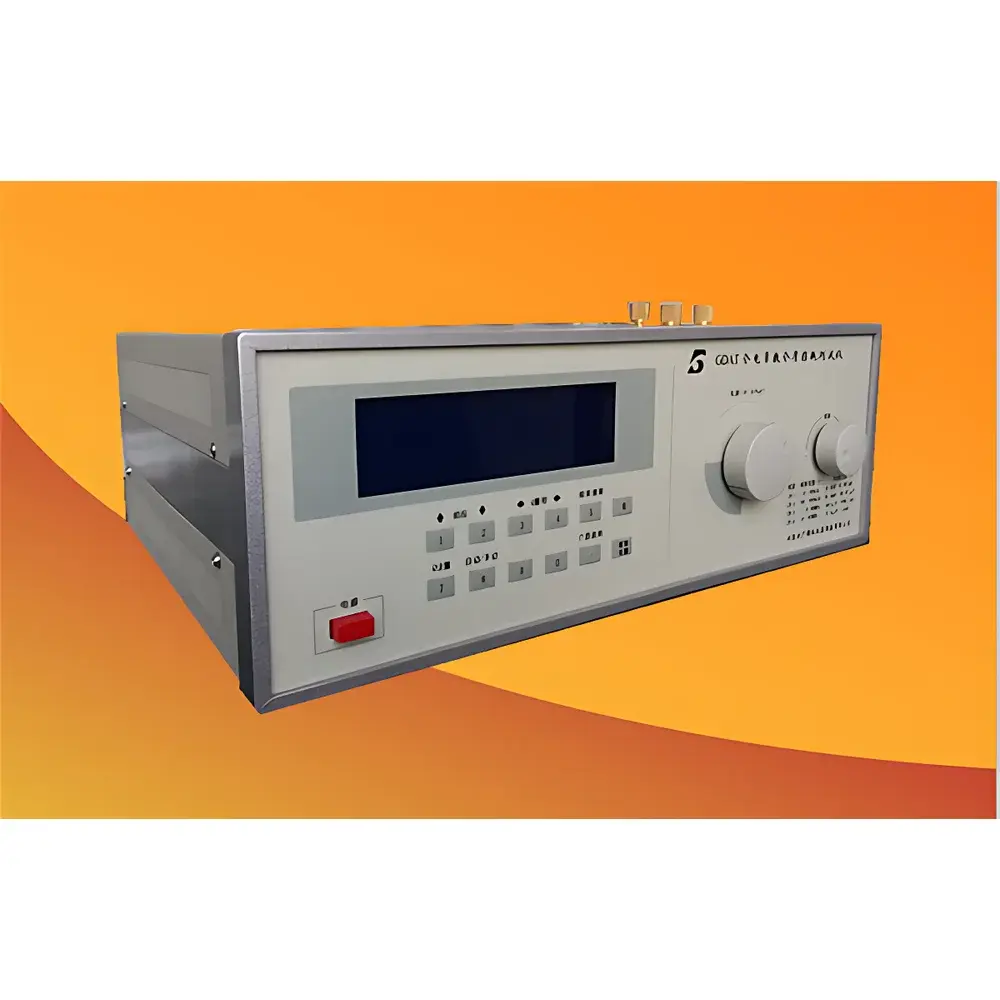
Beijing North Guang Precision Instruments GDAT*A High-Frequency Dielectric Constant and Loss Tangent Analyzer
| Brand | Beijing North Guang Precision Instruments |
|---|---|
| Origin | Beijing, China |
| Manufacturer Type | OEM Manufacturer |
| Product Origin | Domestic (China) |
| Model | GDAT*A |
| Frequency Range | 10 kHz – 70 MHz (CH1–CH4 segmented) |
| Q Factor Range | 2–1023 |
| Capacitance Measurement Range | 1–460 pF (direct), 14.5 nH–8.14 H inductance |
| Main Capacitor Tuning Range | 40–500 pF (±1.5 pF <150 pF |
| Frequency Accuracy | ±3×10⁻⁵ ±1 digit |
| Operating Temperature | 0–40 °C |
| Relative Humidity | <80% RH |
| Power Supply | 220 V ±10%, 50 Hz ±2.5 Hz |
| Power Consumption | ~25 W |
| Net Weight | ~7 kg |
| Dimensions (W×H×D) | 380×132×280 mm |
Overview
The Beijing North Guang Precision Instruments GDAT*A High-Frequency Dielectric Constant and Loss Tangent Analyzer is a precision impedance-based measurement system engineered for the quantitative characterization of complex permittivity (ε* = ε′ − jε″) and dissipation factor (tan δ) in solid and liquid dielectric materials across a broad high-frequency spectrum (10 kHz to 70 MHz). It operates on the principle of series/parallel resonance in a calibrated LC circuit, where the sample—configured as the dielectric medium between parallel-plate electrodes—is integrated into a high-Q resonant cavity. The instrument leverages a dual-capacitor test fixture comprising a fixed parallel-plate capacitor for sample clamping and a linear micrometer-tuned cylindrical capacitor for fine resonance adjustment. Coupled with an integrated Q-meter architecture, it delivers traceable measurements of capacitance (C), dissipation factor (D), and quality factor (Q), from which ε′ and tan δ are derived using standardized geometric calibration parameters. Designed for laboratory-grade reproducibility, the GDAT*A supports ASTM D150-compliant three-terminal (guarded electrode) configurations to suppress fringing field effects and minimize edge capacitance errors—critical for accurate ε′ determination in low-loss insulators and polymer films.
Key Features
- Segmented frequency coverage across four calibrated bands: CH1 (10–99.9999 kHz), CH2 (100–999.999 kHz), CH3 (1–9.99999 MHz), and CH4 (10–70 MHz), enabling optimized signal-to-noise ratio per band
- Q-factor measurement range of 2–1023 with five manual/auto-ranging scales (30, 100, 300, 1000) and programmable Q-pass/fail threshold (5–1000)
- High-stability main tuning capacitor (40–500 pF) with absolute accuracy of ±1.5 pF below 150 pF and ±1% above, referenced to NIST-traceable calibration protocols
- Dual-mode electrode configuration supporting unguarded contact, guarded (ASTM D150 three-terminal), and non-contact air-gap compensated measurement methods
- Low-residual-inductance test fixture architecture minimizing stray reactance; residual parameter correction algorithms embedded in firmware per IEC 60250 guidelines
- Thermally stabilized analog front-end with <0.5 °C internal temperature drift over 4-hour operation, ensuring measurement continuity during extended QC runs
Sample Compatibility & Compliance
The GDAT*A accommodates rigid and semi-rigid dielectrics (e.g., epoxy resins, PTFE, alumina ceramics, polyimide films) and low-conductivity liquids (e.g., transformer oils, silicone fluids) with thicknesses ranging from 0.1 mm to 5 mm. Sample mounting employs a precision-machined brass parallel-plate holder with optional guarded electrode inserts conforming to ASTM D150 Section 8 (Three-Terminal Method) and IEC 60250 Annex B. For compliant operation in regulated environments—including ISO/IEC 17025-accredited laboratories—the instrument supports documented calibration intervals, operator-accessible system verification routines (using certified reference capacitors), and full audit trail logging when interfaced with external LIMS or ELN platforms. While not inherently 21 CFR Part 11 compliant (as a standalone benchtop instrument), its analog output and RS-232 interface enable integration into validated data acquisition systems meeting GLP/GMP documentation requirements.
Software & Data Management
The GDAT*A operates as a self-contained hardware platform with no embedded OS or proprietary GUI. All measurement data—including raw C, D, Q, and f values—are accessible via analog meter outputs and RS-232 serial interface (ASCII protocol, 9600 baud, N81). Users may integrate the instrument into custom LabVIEW, Python (PySerial), or MATLAB environments for automated sweep sequencing, multi-point ε′/tan δ mapping, and statistical process control (SPC) charting. Calibration coefficients (e.g., electrode area A, spacing d, ε₀) are stored in non-volatile memory and recalled per test configuration. Firmware revision history, last calibration date, and operator ID fields are configurable via terminal command set—enabling alignment with internal SOPs for metrological traceability.
Applications
This analyzer serves critical roles in R&D and quality assurance for advanced materials including high-frequency PCB substrates (e.g., Rogers RO4000®, Taconic RF-35), aerospace-grade composites, battery separator films, medical-grade silicones, and pharmaceutical excipient powders (via slurry dispersion in low-loss solvents). Typical use cases include: monitoring moisture-induced ε′ drift in hygroscopic polymers; validating batch-to-batch consistency of ceramic capacitor dielectrics; characterizing relaxation behavior in piezoelectric ceramics near Curie temperature; and verifying dielectric homogeneity in thin-film photovoltaic encapsulants. Its ability to resolve tan δ down to 10⁻⁴ at 1 MHz makes it suitable for detecting early-stage oxidation in transformer insulation oils per IEEE C57.104 guidelines.
FAQ
What measurement method does the GDAT*A use?
It implements the resonance-based Q-meter method with parallel-plate or guarded-electrode sample fixtures, aligned with ASTM D150 and IEC 60250 standards.
Can it measure conductive or lossy materials?
Yes—within limits. Materials with conductivity >10⁻⁶ S/m may require series-equivalent modeling and are best evaluated using the CH1–CH2 low-frequency bands to avoid excessive Q degradation.
Is calibration required before each use?
A 30-minute warm-up is mandatory for thermal stabilization; zeroing and open-circuit residual compensation should be performed daily using the built-in calibration routine.
Does it support automated frequency sweeps?
No native sweep mode exists; however, external controllers can step through CH1–CH4 bands and log data via RS-232, enabling full spectral profiling with user-defined resolution.
How is edge capacitance error mitigated?
Through optional guarded-electrode fixtures that divert fringing flux away from the active measurement region—reducing systematic ε′ overestimation by up to 8% in thin (<0.5 mm) samples.



