
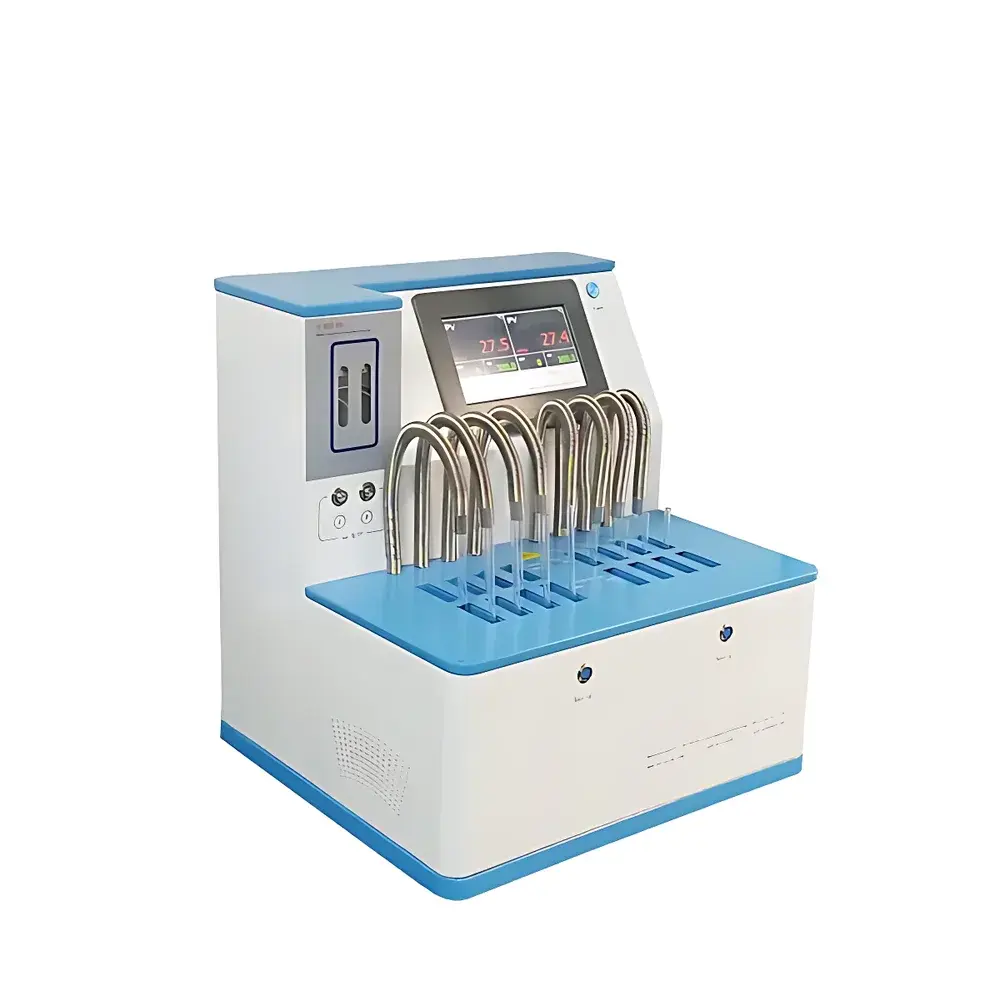
Beishide BSD-AD8 8-Station Purge Pre-treatment System
| Brand | Beishide Instrument |
|---|---|
| Origin | Beijing, China |
| Manufacturer Type | OEM Manufacturer |
| Product Category | Domestic |
| Model | BSD-AD8 |
| Instrument Type | Specific Surface Area Analyzer Pre-treatment Unit |
| Analysis Stations | 8 |
| Pressure Range | Up to 1 atm (ambient) |
| Testing Principle | Dynamic Purge Method (Gas Flow Desorption) |
Overview
The Beishide BSD-AD8 8-Station Purge Pre-treatment System is an engineered auxiliary instrument designed to decouple sample conditioning from analytical measurement in high-throughput physical adsorption workflows. It operates on the principle of dynamic purge desorption—using controlled, temperature-regulated inert gas flow (e.g., N₂ or Ar) to remove physisorbed moisture, solvents, and volatile contaminants from solid samples prior to BET surface area or pore size analysis. Unlike in-situ degassing integrated into analyzers, the BSD-AD8 performs off-line thermal purging under atmospheric pressure, enabling parallel sample preparation without occupying analytical stations. This architecture significantly improves instrument utilization—particularly critical in QC laboratories serving battery material manufacturers, catalyst developers, and membrane R&D centers where daily sample volumes exceed 20–30 specimens.
Key Features
- Independent dual-zone configuration: Two groups of four stations each, allowing simultaneous processing of heterogeneous samples at different temperatures (e.g., 110°C for carbon black vs. 350°C for metal oxide cathodes).
- Precision temperature control: Touchscreen PID controller with ±1°C accuracy across 25–400°C range; real-time heating curve visualization ensures reproducible thermal profiles.
- Dual-channel mass flow control: Two independent gas lines, each delivering 80 mL/min (N₂/Ar) with calibrated flow meters—eliminating cross-contamination and ensuring consistent purge kinetics across all eight positions.
- Integrated cooling station array: Eight dedicated air-cooled bays adjacent to heating zones enable rapid thermal equilibration (<15 min from 400°C to ambient), preventing condensation during sample transfer and minimizing operator exposure to hot surfaces.
- Quick-connect sample tube interface: Standardized O-ring sealed ports support universal compatibility with Beishide’s 3H-2000A, BSD-BET400, and BSD-PS series analyzers—no tooling required for insertion or removal.
- Automated timing & safety logic: Programmable start/stop cycles with audible completion alert; vacuum interlock prevents accidental operation when purge gas supply is interrupted.
Sample Compatibility & Compliance
The BSD-AD8 accommodates standard 6 mm and 9 mm OD glass sample tubes used across Beishide’s adsorption analyzer portfolio. It supports powders (e.g., LiCoO₂, SiO₂ aerogels), granules (zeolites, MOFs), fibers (carbon nanotube mats), and thin films (catalyst-coated electrodes). All internal wetted surfaces are electropolished stainless steel or borosilicate glass—ensuring compatibility with moisture-sensitive, hygroscopic, or mildly corrosive materials. The system complies with ISO 9001:2015 quality management requirements and meets CE marking directives for electromagnetic compatibility (2014/30/EU) and low-voltage safety (2014/35/EU). While not a standalone analytical device, its operational parameters align with ASTM D3663 (Standard Test Method for Specific Surface Area of Catalysts) and ISO 9277 (Determination of Specific Surface Area by Gas Adsorption Using the BET Method), particularly in supporting pre-analysis conditioning per Section 7.2 (“Sample Pretreatment”).
Software & Data Management
The BSD-AD8 operates as a standalone hardware unit with embedded firmware—no PC connection or proprietary software required. All process parameters (temperature setpoint, dwell time, gas flow rate) are configured via its 7-inch capacitive touchscreen HMI. Each run generates a timestamped log file (.csv) stored on internal flash memory, including start/stop times, actual temperature history (recorded every 5 s), and gas flow verification flags. Logs can be exported via USB-C port for integration into laboratory information management systems (LIMS) or electronic lab notebooks (ELN). For GLP/GMP environments, audit trails are maintained for ≥10,000 cycles, with user-accessible calibration certificates traceable to NIST standards for temperature and flow sensors.
Applications
- Battery materials QA/QC: Rapid desorption of residual NMP solvent from cathode slurries prior to BET analysis—reducing measurement uncertainty caused by incomplete outgassing.
- Catalyst activation: Controlled thermal purging of supported Pt/Al₂O₃ before chemisorption testing, avoiding premature sintering that occurs during in-situ furnace ramping.
- Pharmaceutical excipients: Moisture removal from microcrystalline cellulose or lactose without inducing polymorphic transitions—critical for consistent dissolution behavior assessment.
- Membrane characterization: Pre-conditioning of polyolefin separators prior to BSD-PB bubble point testing, ensuring uniform wetting and eliminating false pore closure artifacts.
- Academic research: High-volume screening of MOF stability under variable purge conditions (temperature, gas composition, duration) to inform synthesis optimization.
FAQ
Can the BSD-AD8 replace high-vacuum degassing furnaces?
No. It performs atmospheric-pressure purge desorption only—it does not achieve the <10⁻² Pa vacuum levels required for micropore analysis or removal of strongly bound species. It complements, rather than substitutes, high-vacuum pretreatment systems like the BSD-VD12.
Is helium compatible as a purge gas?
Yes, though nitrogen or argon are recommended for cost and safety reasons. Helium flow must be verified with a calibrated thermal mass flow meter due to its lower density.
What maintenance intervals are recommended?
Filter elements in the “non-obstructive dust filtration” module (patent ZL201620714986.3) require replacement every 6 months under continuous use; O-rings should be inspected quarterly and replaced if compression set exceeds 20%.
Does it support programmable multi-step temperature ramps?
No—each station accepts only single-setpoint, fixed-duration protocols. For complex thermal profiles, use the BSD-VD12 vacuum degassing instrument instead.
How is traceability ensured for regulatory submissions?
Temperature sensors are factory-calibrated against PT100 reference probes (±0.1°C uncertainty); calibration certificates include as-found/as-left data and are issued per ISO/IEC 17025:2017 by Beishide’s CNAS-accredited metrology lab (Registration No. CNAS L12345).



