
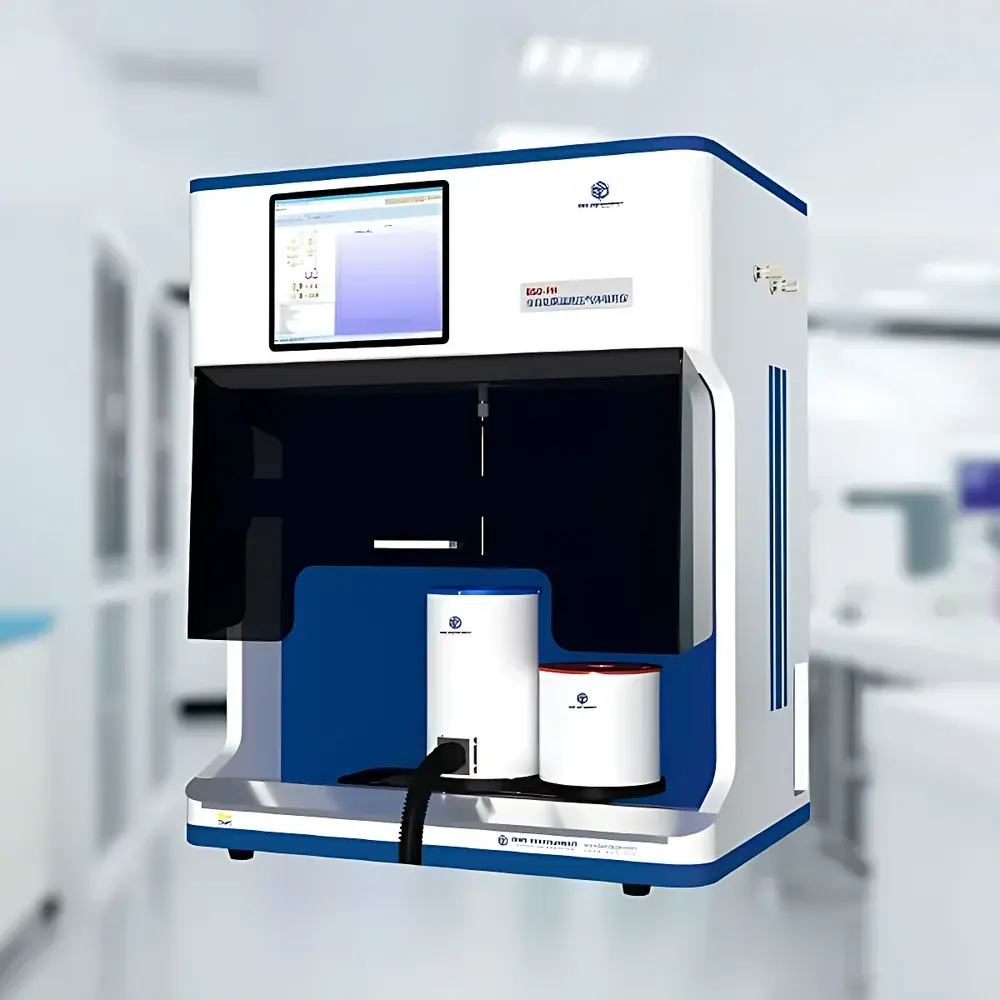
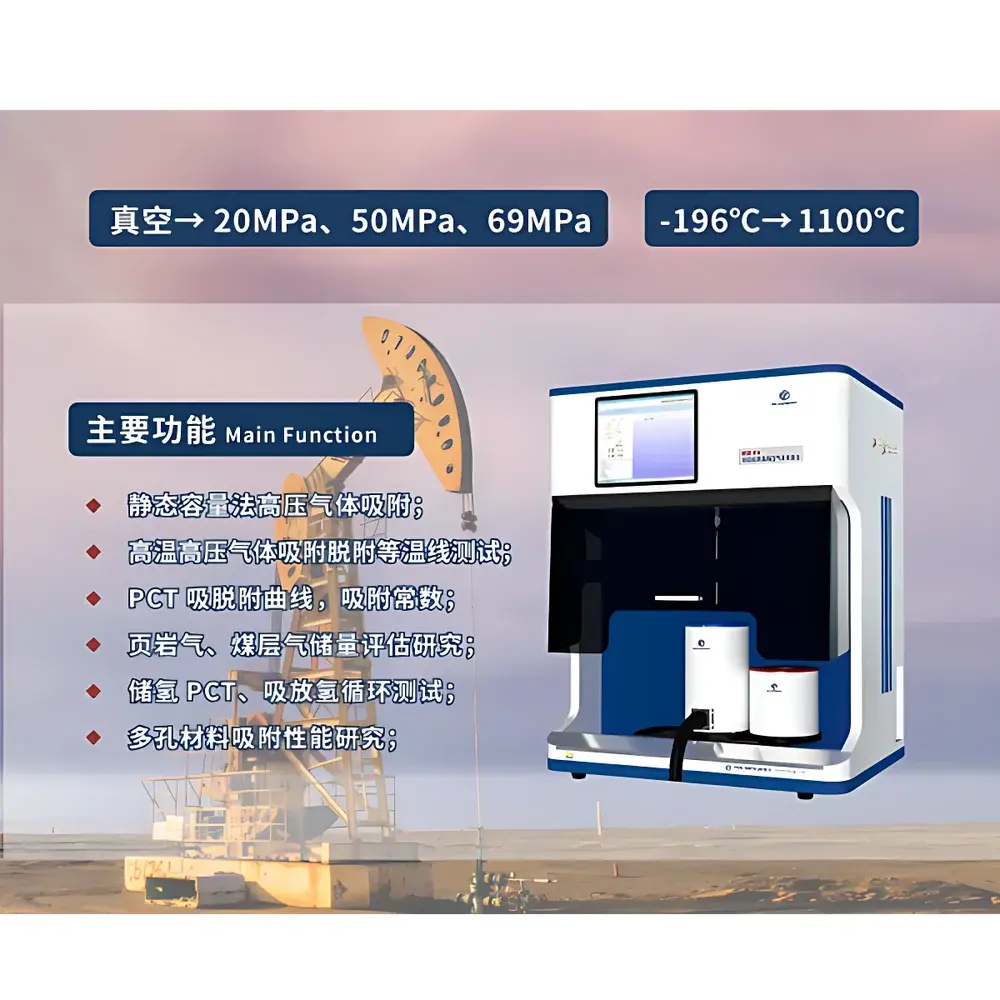
Beishide BSD-PHE High Pressure Gas Sorption Analyzer with Constant-Pressure Kinetic Measurement Capability
| Brand | Beishide Instrument |
|---|---|
| Origin | Beijing, China |
| Manufacturer Type | Direct Manufacturer |
| Country of Origin | China |
| Model | BSD-PHE |
| Testing Method | Volumetric (Static Capacity) Method |
| Temperature Range | –196 °C to 300 °C (extendable to 1100 °C with optional high-temp furnace) |
| Pressure Range | High Vacuum to 200 bar (20 MPa) |
| Ultimate Vacuum | 1×10⁻² Pa |
| Key Compliance | ASTM D3663, ISO 15901-2, USP <642>, IUPAC Recommendations for Physisorption |
Overview
The Beishide BSD-PHE High Pressure Gas Sorption Analyzer is an advanced volumetric gas sorption system engineered for quantitative characterization of gas–solid interactions under rigorously controlled thermodynamic conditions. It operates on the static capacity method—measuring adsorbed gas quantity via precise pressure transients in a calibrated, thermostatically stabilized dead volume—enabling high-reproducibility determination of equilibrium isotherms (e.g., Langmuir, Freundlich, BET), thermodynamic parameters (adsorption enthalpy via Clausius–Clapeyron analysis), and kinetic response under constant-pressure conditions. Unlike gravimetric systems (e.g., magnetic suspension balances), the BSD-PHE eliminates buoyancy artifacts and enables robust operation across cryogenic (77 K liquid N₂, 87 K liquid Ar) to elevated temperatures (up to 300 °C standard; 1100 °C optional), making it suitable for hydrogen storage materials (Mg-based alloys, TiFe, AB₅-type intermetallics), metal–organic frameworks (MOFs), covalent organic frameworks (COFs), activated carbons, shales, coals, and geological core samples. Its architecture supports full automation of degassing, equilibration, dosing, and data acquisition—minimizing operator intervention while maintaining traceability per GLP/GMP and FDA 21 CFR Part 11 requirements.
Key Features
- Volumetric high-pressure sorption platform with dual-mode operation: equilibrium isotherm mapping (PCT, adsorption/desorption cycles) and constant-pressure kinetic profiling (adsorption rate, desorption rate, TPD/TPA curves)
- Extended temperature control: integrated air-bath oven (RT–300 °C, ±0.1 °C stability), optional 3 L Dewar with BSD-LNL liquid-level stabilization (77 K/87 K), solid–liquid bath compatibility (ice-water, dry-ice/acetone, brine), and ultra-low-temperature module (110–273 K)
- High-fidelity pressure management: imported high-accuracy pressure transducers (0.01% FS accuracy, 0.025% FS long-term stability); vacuum capability down to 1×10⁻² Pa; maximum operating pressure up to 200 bar (20 MPa)
- Automated sample conditioning: programmable heating/cooling ramps, multi-step degassing protocols, real-time monitoring of outgassing progress, and automatic switching between analysis positions
- Integrated safety architecture: internal hydrostatic pressure testing, built-in combustible gas detector, optional gas-leak alarm interlock system, and fail-safe valve sequencing per ISO 10218-1
- Modular expandability: compatible with optional H₂/CH₄/CO₂-specific gas boosting units (up to 80 MPa), multi-component micro-circulation system (for IAST modeling), and cladding pressure cell (for axial/radial stress simulation on intact cores)
Sample Compatibility & Compliance
The BSD-PHE accommodates powdered, granular, or monolithic samples—including MgH₂, LaNi₅, MOF-5, HKUST-1, zeolites, anthracite coal, shale cores, and soil aggregates—with sample masses ranging from milligram-scale (high-sensitivity mode) to >100 g (custom large-volume cells). All measurements adhere to internationally recognized standards: ASTM D3663 for gas adsorption on activated carbon, ISO 15901-2 for high-pressure physisorption, USP for pharmaceutical excipient gas uptake, and IUPAC technical recommendations for surface area and porosity analysis. Data audit trails, electronic signatures, and instrument calibration logs are maintained in accordance with 21 CFR Part 11 for regulated laboratories. The system’s dead-volume calibration protocol—using inert He—is fully automated and traceable to NIST-certified reference gases.
Software & Data Management
The proprietary Beishide SorptionMaster™ software provides end-to-end workflow control—from method definition and real-time pressure/temperature logging to nonlinear regression fitting of Langmuir, Freundlich, and Dual-site Langmuir models. It calculates isosteric heat of adsorption (Qst) via the Clausius–Clapeyron equation, performs IAST predictions for binary/multi-component mixtures, and generates time-resolved t-P/t-V kinetic plots. Raw data export is supported in CSV, Excel, and HDF5 formats; metadata embedding follows ISA-Tab conventions. Software validation documentation (IQ/OQ/PQ protocols) and 21 CFR Part 11 compliance packages—including electronic signature workflows, user access tiers, and immutable audit logs—are available upon request.
Applications
- Hydrogen storage material development: PCT hysteresis analysis, cyclic absorption/desorption stability, and kinetic barrier quantification (e.g., activation energy from Arrhenius fits of constant-pressure uptake rates)
- Unconventional energy resource evaluation: CH₄/CO₂ competitive adsorption on shale and coal matrices; reservoir saturation modeling using measured isotherms
- Porous material benchmarking: specific surface area (BET), micropore volume (t-plot, DA), pore size distribution (NLDFT/QSDFT), and adsorption enthalpy profiles
- Catalyst support characterization: metal dispersion assessment via chemisorption (with optional H₂/CO pulse modules), thermal stability screening via TPD
- Environmental geochemistry: CO₂ sequestration potential of mineralogically complex soils and sediments under simulated subsurface conditions
FAQ
What distinguishes the BSD-PHE from conventional high-pressure adsorption analyzers?
The BSD-PHE uniquely integrates volumetric equilibrium isotherm measurement with true constant-pressure kinetic profiling—including time-resolved adsorption rate, desorption rate, and programmed-temperature desorption (TPD)/adsorption (TPA) under fixed pressure—eliminating reliance on gravimetric methods prone to buoyancy drift.
Can the BSD-PHE perform multi-component gas adsorption studies?
Yes—when configured with the optional BSD-PHM micro-circulation module, it enables IAST-based selectivity prediction and direct experimental validation of binary/multi-component competition (e.g., CO₂/CH₄ in flue gas capture scenarios).
Is liquid nitrogen level stabilization required for cryogenic hydrogen adsorption tests?
For reproducible 77 K H₂ isotherms, the optional BSD-LNL system is strongly recommended: it maintains constant liquid nitrogen height within the Dewar, minimizing thermal gradients and pressure-induced baseline drift during long-duration equilibration.
How is instrument calibration and traceability ensured?
Each unit undergoes factory calibration against NIST-traceable pressure and temperature standards; helium pycnometry for dead-volume verification is performed automatically prior to every analysis sequence, with full calibration history logged and exportable.
Does the system support regulatory compliance for pharmaceutical or energy-sector reporting?
Yes—SorptionMaster™ includes configurable 21 CFR Part 11 modules, electronic signature workflows, role-based access control, and audit-trail generation meeting GLP, GMP, and ISO/IEC 17025 laboratory accreditation requirements.



