
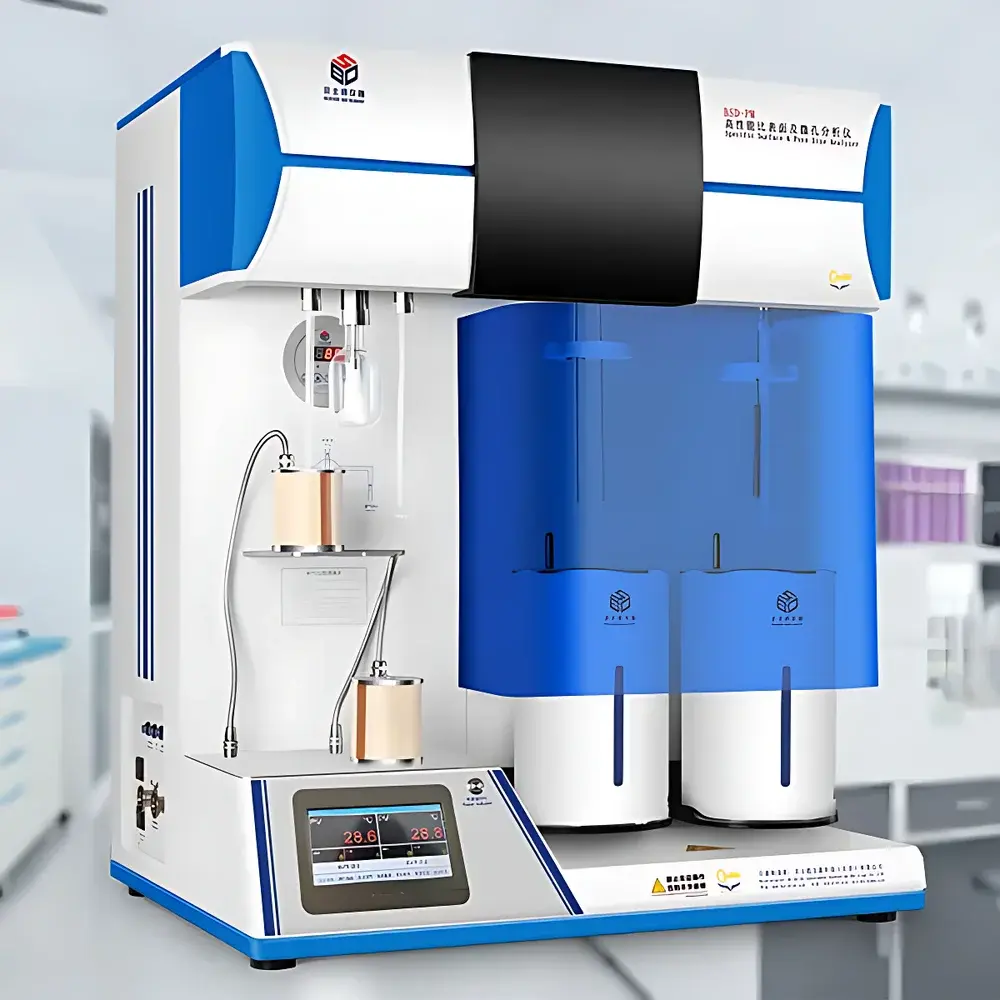
Beishide BSD-PM High-Performance Specific Surface Area and Micropore Analyzer
| Brand | Beishide Instrument |
|---|---|
| Origin | Beijing, China |
| Manufacturer Type | Direct Manufacturer |
| Product Category | Domestic |
| Model | BSD-PM |
| Instrument Type | Specific Surface Area and Pore Size Analyzer |
| Measurement Principle | Static Volumetric Method (Gas Adsorption) |
| Number of Analysis Stations | 1–12 |
| Specific Surface Area Range | ≥0.0005 m²/g |
| Pore Diameter Range | 0.35–500 nm |
| Pressure Range | 0–1000 Torr (with optional 0–0.1 Torr high-resolution sensor) |
| Repeatability | ≤±0.01% for surface area, ≤±0.02 nm for most probable pore diameter |
| Vacuum Level | PS Series — 4×10⁻² Pa |
| Degassing Stations | 2 independent thermal treatment stations (RT–400 °C, ±0.1 °C control accuracy) |
| Independent P₀ Station | Patented helical saturation vapor pressure station |
| Compliance Standards | GB/T 19587–2017, ISO 9277:2010, ISO 15901-1/2/3:2005–2007, GB/T 39713–2020, GB/T 21650.1–3, GB/T 13390–2008, GB/T 10722–2014, GB/T 7702.20–2008, GB/T 6609.35–2009 |
Overview
The Beishide BSD-PM High-Performance Specific Surface Area and Micropore Analyzer is a fully automated, static volumetric gas adsorption system engineered for precision characterization of specific surface area, microporosity, mesoporosity, and macroporosity in solid materials. Operating at cryogenic temperatures (typically 77.3 K using liquid nitrogen), the instrument quantifies gas uptake (e.g., N₂, Ar, CO₂) via controlled dose-and-equilibrate cycles within calibrated, fixed-volume sample tubes. Adsorption and desorption isotherms are acquired by direct measurement of equilibrium pressure—derived from high-stability capacitance manometers—and converted to adsorbed quantity using the ideal gas law (PV = nRT). Unlike dynamic (flow-through) systems, the BSD-PM eliminates carrier gas dependency, mechanical cryostat movement, and associated baseline drift, delivering inherently higher reproducibility and reduced operator intervention. Its dual-pump architecture (mechanical + turbomolecular in PM configuration) enables ultra-low-pressure measurement down to P/P₀ = 10⁻⁸, essential for accurate micropore analysis via t-plot, αₛ-plot, or DFT/NLDFT kernel modeling.
Key Features
- Modular station configuration: 1–12 independent analysis positions with individual pressure transducers and temperature-controlled Dewar interfaces.
- Dual degassing stations operating concurrently with analysis—enabling uninterrupted workflow and maximizing instrument uptime.
- Patented helical P₀ station ensures traceable, real-time saturation vapor pressure measurement without cross-contamination or thermal lag.
- Programmable thermal desorption: 0.1 °C resolution over 25–400 °C range; ramp rate and hold profiles fully customizable in software.
- Multi-range pressure sensing: Each station equipped with both 0–1000 Torr (for P₀ and macro/mesopore region) and optional 0–0.1 Torr ultra-low-pressure sensors (for micropore filling analysis).
- ISO/GB-compliant hardware architecture: All vacuum components, valves, and manometers meet ASTM E2912 and ISO 14644 cleanroom-grade sealing specifications.
- Integrated leak-check and outgassing validation routines compliant with GLP audit requirements.
Sample Compatibility & Compliance
The BSD-PM supports non-corrosive adsorbates including N₂ (77.3 K), Ar (87 K), CO₂ (273 K), and Kr (77 K), enabling flexible material classification per IUPAC recommendations. It accommodates powders, granules, monoliths, and catalyst pellets (max. Ø 12 mm × H 30 mm) across diverse sectors: battery electrode materials, MOFs, zeolites, activated carbons, pharmaceutical excipients, ceramic precursors, and metallurgical powders. The system conforms to critical international standards—including ISO 9277:2010 (BET surface area), ISO 15901-2:2006 (meso/macropore distribution), ISO 15901-3:2007 (micropore analysis), and multiple Chinese national standards (GB/T 19587–2017, GB/T 21650.1–3, GB/T 39713–2020). Data acquisition meets FDA 21 CFR Part 11 requirements for electronic records and signatures when operated in validated mode with audit-trail logging enabled.
Software & Data Management
The proprietary BDSoft™ v4.2 platform provides full instrument control, isotherm acquisition, and advanced data reduction. It includes built-in modules for BET, Langmuir, t-plot, BJH, DH, HK, SF, and NLDFT/QSDFT modeling—with selectable kernel libraries for carbon, silica, alumina, and zeolite frameworks. All raw pressure-time datasets are stored in HDF5 format with embedded metadata (sample ID, operator, calibration timestamps, P₀ reference, vacuum history). Export options include ASTM E1985-compliant CSV, ISO-standardized XML, and PDF reports containing uncertainty propagation per GUM guidelines. Role-based access control, electronic signature workflows, and 21 CFR Part 11-compliant audit trails are available upon configuration for regulated environments.
Applications
The BSD-PM delivers quantitative microstructural insight for R&D and QC laboratories requiring traceable, repeatable porosimetry. Key use cases include: optimization of Li-ion battery cathode/anode surface accessibility and pore tortuosity; quality control of pharmaceutical tablet excipients per USP ; certification of catalyst support integrity in petrochemical refining; validation of MOF synthesis batch consistency; pore network reconstruction for geological shale core analysis; and regulatory submission support for medical device coatings under ISO 10993-18. Its ability to resolve sub-0.4 nm micropores and quantify total pore volume up to 500 nm enables correlative interpretation with SEM-EDS, XRD, and mercury intrusion data.
FAQ
What adsorption theories does the BSD-PM support for data analysis?
BET, Langmuir, t-plot, αs-plot, BJH, Dollimore-Heal, Horvath-Kawazoe, Saito-Foley, and non-local density functional theory (NLDFT) with material-specific kernel libraries.
Can the instrument perform CO₂ adsorption at 0 °C for ultramicropore analysis?
Yes—optional temperature-controlled adsorption manifold supports isothermal measurements at 273 K using CO₂, enhancing sensitivity for pores <0.7 nm.
Is remote monitoring and operation supported?
Yes—BDSoft™ includes secure TLS-encrypted web interface for real-time status, queue management, and live isotherm visualization from any authorized network endpoint.
How is calibration traceability maintained?
Primary calibration uses NIST-traceable stainless steel volumes and certified reference materials (e.g., NIST SRM 1990, 2970); all pressure sensors are factory-calibrated against dead-weight testers with annual recalibration certificates.
Does the system support GLP-compliant reporting for pharmaceutical applications?
Yes—when configured with electronic signatures, audit trail logging, and version-controlled method templates, it satisfies ICH GCP and EU Annex 11 requirements for analytical instrument qualification.



