
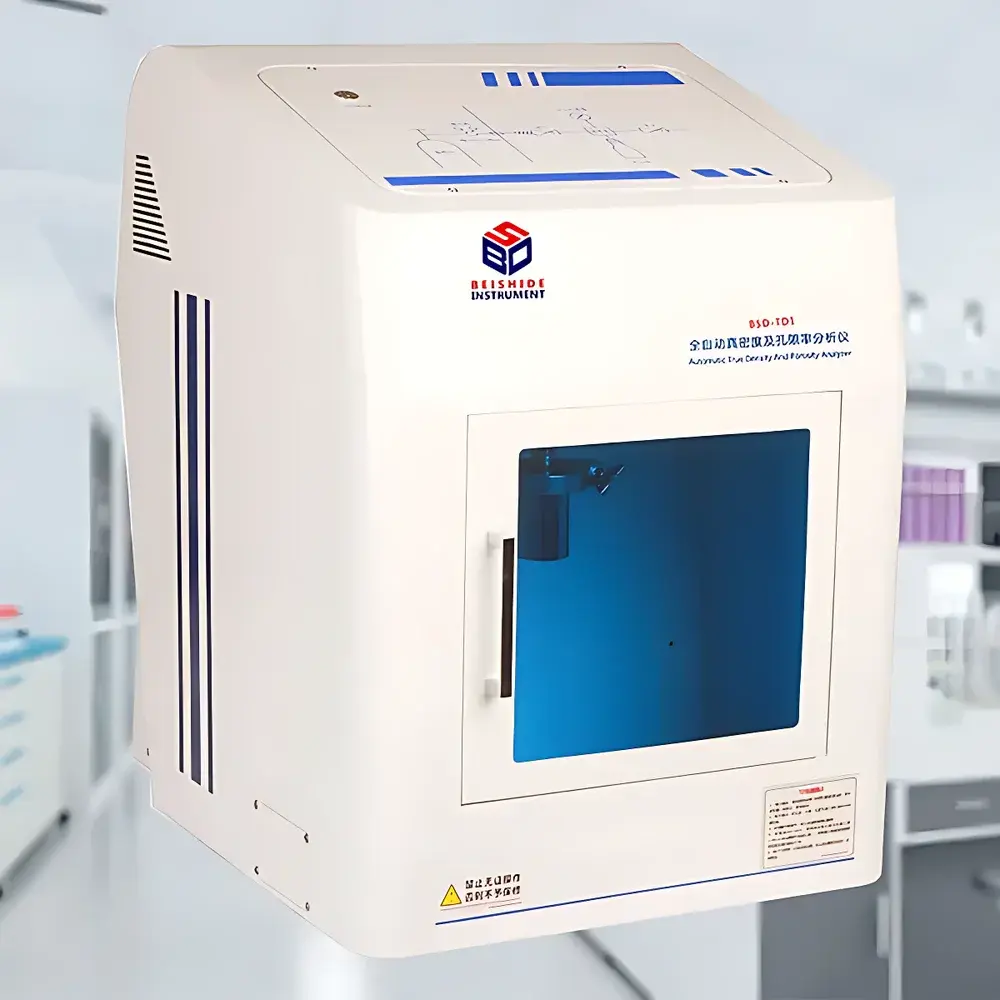
Beishide BSD-TD-K True Density Analyzer with Pore Volume & Porosity Measurement Capability
| Brand | Beishide Instrument |
|---|---|
| Origin | Beijing, China |
| Manufacturer Type | Direct Manufacturer |
| Origin Category | Domestic (China) |
| Model | BSD-TD-K |
| Price Range | USD 14,000 – 21,000 |
| Application Field | General-purpose density analysis |
| Instrument Type | True Density Analyzer |
| Form Factor | Benchtop Laboratory Instrument |
| Sample Types | Powders, solid blocks, slurries, liquids |
| Density Measurement Range | 0.001–10 g/cm³ (typical for solids & liquids) |
| Density Accuracy | ±0.03% (relative to certified Al reference standard) |
| Temperature Control Range | −10 °C to +50 °C, stability ±0.1 °C |
| Repeatability | ±0.00001 g/cm³ |
| Resolution | 0.0001 g/cm³ |
| Minimum Sample Volume | 3 mL |
| Maximum Sample Volume | 2000 mL |
| Test Cycle Time | 3–6 min (excluding thermal equilibration) |
| Pressure Mode | Positive-pressure gas expansion (He or N₂, optional vacuum pump for degassing) |
| Valve System | Pneumatically actuated valves (zero self-heating) |
| Calibration Standard | Certified aluminum reference cylinder (NIM-traceable) |
| Compliance | GB/T 23561.2–2009, GB/T 10799–2008 (Annex B), ISO 12154:2014 (gas pycnometry), ASTM D5550–22 (standard test method for true density of calcined petroleum coke) |
Overview
The Beishide BSD-TD-K True Density Analyzer is a high-precision, benchtop gas pycnometer engineered for the accurate determination of true (skeletal) density and closed-pore volume of solid and semi-solid materials. It operates on the principle of gas expansion displacement—applying the ideal gas law (PV = nRT) under controlled isothermal conditions—to quantify the volume displaced by a sample’s solid matrix, including inaccessible closed pores. Unlike liquid-immersion methods, this helium- or nitrogen-based technique avoids sample dissolution, swelling, or surface wetting artifacts, delivering metrologically traceable results aligned with ISO 12154:2014 and ASTM D5550–22. The instrument integrates a dual-chamber system comprising a variable-volume sample chamber and a thermally stabilized reference chamber, enabling direct volumetric quantification without reliance on fluid calibration or empirical corrections.
Key Features
- Pneumatic valve architecture eliminates resistive heating inherent in solenoid valves—ensuring thermal stability of the reference and sample chambers to within ±0.1 °C and preserving volumetric accuracy at the ±0.03% level.
- “Bottom-mount bayonet-style” sample cell design maximizes chamber volume utilization (>90% for 10 mL cells), minimizing dead volume and enhancing precision for low-mass samples—distinct from conventional top-loaded configurations that introduce >90% unused cavity space.
- Modular gas circuitry with zero intermediate fittings ensures leak-tight integrity and uniform temperature distribution across all pneumatic pathways.
- Programmable isothermal control enables automated thermal equilibration prior to measurement, with user-selectable pressure balance timing (default, preset, or custom) to accommodate heterogeneous or porous structures.
- Expandable reference volume system automatically engages auxiliary expansion chambers when large sample volumes (>100 mL) or low-density materials require improved pressure-ratio resolution between chambers.
- Full automation sequence—including purge, sample chamber evacuation, reference chamber pressurization, gas transfer, equilibrium detection, and atmospheric recovery—is executed via a single GUI-initiated command.
Sample Compatibility & Compliance
The BSD-TD-K accommodates powders (including nanomaterials and catalysts), monolithic solids, granules, slurries, and low-volatility liquids. Its 3–2000 mL sample capacity range supports both micro-scale R&D validation (e.g., 3 mL micro-cell for <100 mg pharmaceutical powders) and industrial QC batch verification (e.g., 2 L cells for refractory aggregates). All measurements comply with national and international standards: GB/T 23561.2–2009 (coal rock density), GB/T 10799–2008 Annex B (open/closed cell correction for foams), ISO 12154:2014 (gas pycnometry), and ASTM D5550–22. Each unit ships with a NIM-certified aluminum reference standard, and full metrological traceability is documented in the factory calibration certificate issued by the Beijing Institute of Metrology.
Software & Data Management
The embedded Windows-based control software provides real-time graphical monitoring of pressure transients, temperature profiles, and valve status. All hardware operations—including valve sequencing, pressure ramping, and thermal soak—are configurable via intuitive drag-and-drop workflow templates. Raw data files (CSV/ASCII) include timestamped pressure readings, temperature logs, and calculated density values with uncertainty propagation per GUM (JCGM 100:2008). Audit trails record operator ID, method version, calibration history, and parameter modifications—supporting GLP/GMP compliance and 21 CFR Part 11 readiness when deployed with network-authenticated user accounts and electronic signatures. Instrument runtime logs capture every hardware event to the millisecond, facilitating root-cause analysis during technical audits or method validation.
Applications
This analyzer serves critical roles in materials science, pharmaceutical development, battery electrode formulation, geotechnical engineering, and polymer manufacturing. It quantifies true density for quality control of active pharmaceutical ingredients (APIs), determines closed-porosity fractions in ceramic green bodies, validates electrode compaction density in Li-ion battery R&D, measures skeletal density of activated carbons and MOFs, and supports ASTM-compliant reporting for mineral aggregate certification. Its ability to resolve density differences as small as 0.00001 g/cm³ makes it suitable for detecting subtle batch-to-batch variations in crystallinity, sintering degree, or phase segregation—particularly where pore structure directly impacts functional performance (e.g., permeability, mechanical strength, ion transport).
FAQ
What gases are recommended for operation?
Helium is preferred for highest accuracy due to its low condensability and near-ideal behavior at ambient temperatures; nitrogen may be used where cost or safety constraints apply—both conform to ISO 12154 requirements.
Is vacuum capability required?
Vacuum degassing (via optional pump) improves removal of adsorbed moisture or air from porous samples but is not mandatory for density measurement itself; positive-pressure operation suffices for most routine analyses.
How does the instrument correct for cut-surface errors in foam testing?
It implements the “8-section correction method” specified in GB/T 10799–2008 Annex B to adjust measured open/closed cell fractions for machining-induced pore rupture during specimen preparation.
Can the system be integrated into a LIMS environment?
Yes—via OPC UA or TCP/IP protocol support, raw data and metadata can be exported to laboratory information management systems with configurable field mapping and secure authentication.
What maintenance is required for long-term accuracy?
Annual recalibration against NIST-traceable standards is recommended; pneumatic valves require no lubrication or periodic replacement, and the modular gas path permits rapid isolation and verification of individual components during service.



