
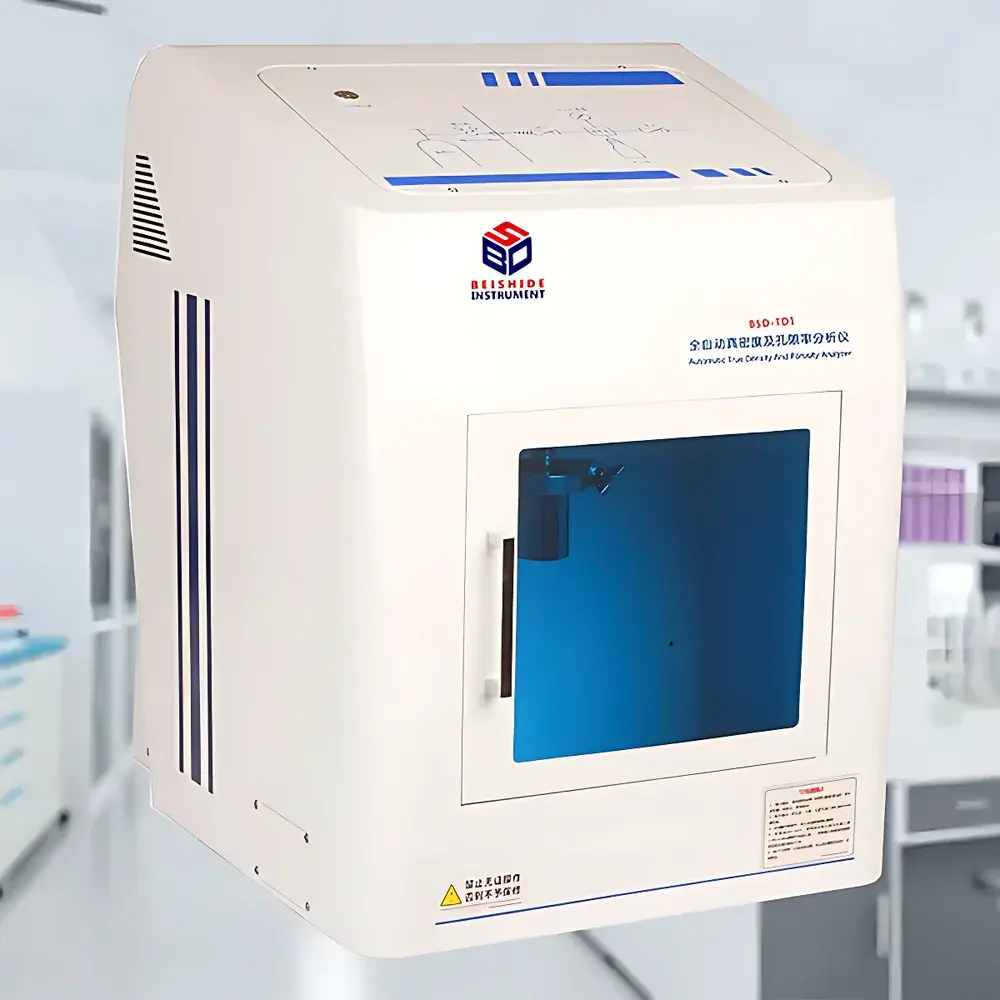
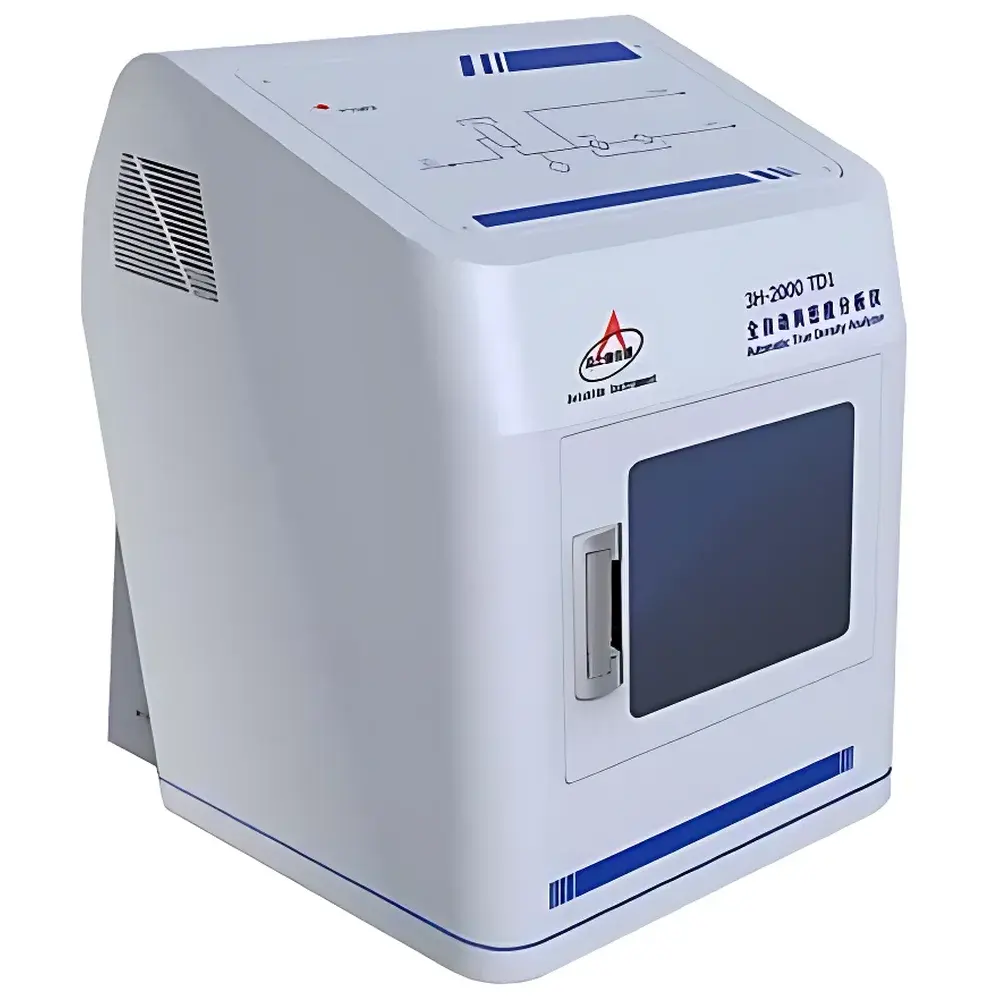
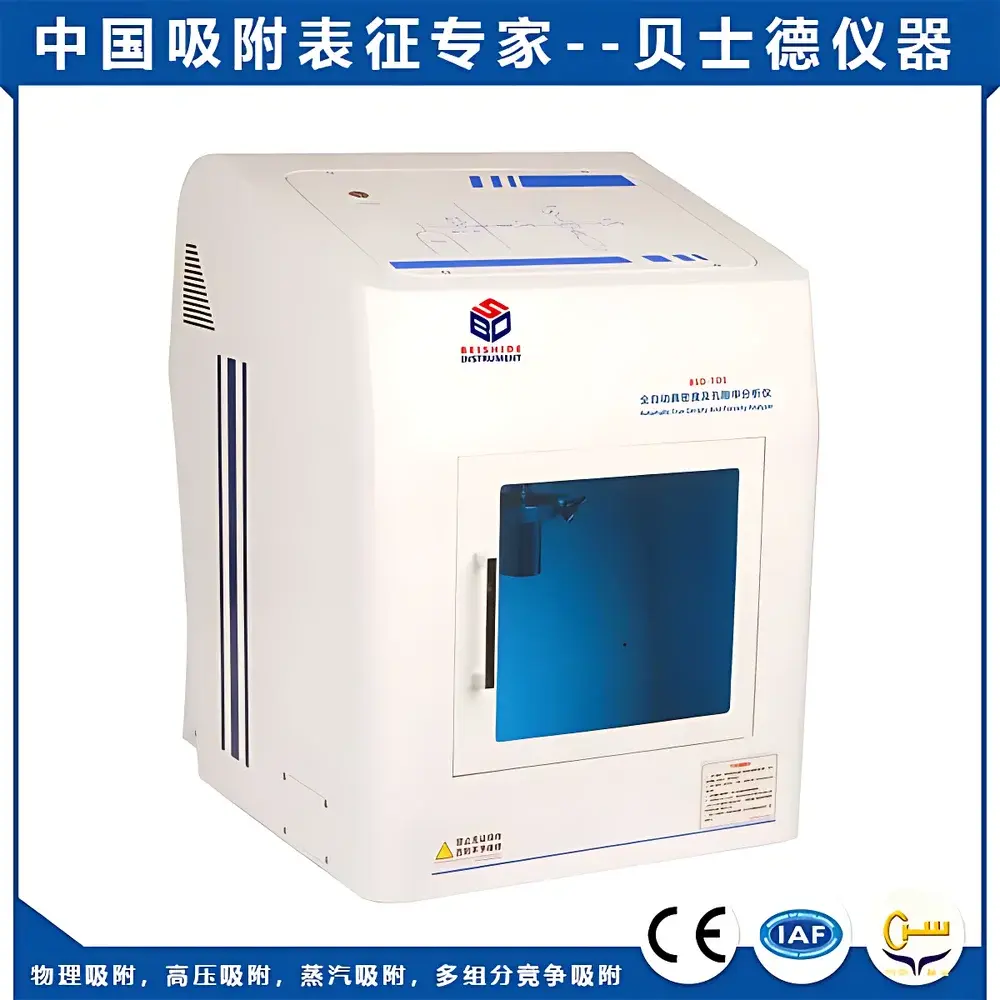
Beishide BSD-TD True Density Analyzer
| Brand | Beishide Instrument |
|---|---|
| Origin | Beijing, China |
| Manufacturer Type | Manufacturer |
| Product Category | Domestic |
| Model | BSD-TD |
| Instrument Type | True Density Analyzer |
| Form Factor | Benchtop Laboratory Instrument |
| Sample Type | Solid (powder, granule, bulk, foam, ceramic, metal, rock core), slurry, non-volatile liquid |
| Density Range | 0.01–2000 g/cm³ |
| Density Accuracy | ±0.03% |
| Repeatability | ±0.015% |
| Resolution | 0.0001 g/cm³ |
| Minimum Sample Volume | 0.01–2000 mL |
| Temperature Control Range | 0–40 °C |
| Temperature Stability | < ±0.1 °C |
| Analysis Stations | 1 or 2 |
| Measurement Principle | Gas Expansion Displacement (based on ideal gas law PV = nRT) using inert gas (He or N₂) |
| Compliant Standards | GB/T 40401-2021, GB/T 10799-2008, GB/T 5071-2013, ASTM D2856, ASTM D6226, MT/T 713-1997 |
Overview
The Beishide BSD-TD True Density Analyzer is a precision benchtop instrument engineered for the accurate determination of true (skeletal) density and open/closed cell porosity of solid and semi-solid materials. It operates on the gas expansion displacement principle — a gravimetrically referenced, non-destructive method grounded in the ideal gas law (PV = nRT). Unlike liquid pycnometry, which risks sample dissolution, swelling, or surface adsorption artifacts, this technique employs helium or nitrogen as the probe gas. Due to its small molecular diameter, the gas fully penetrates interstitial voids, micro-pores, and surface irregularities, enabling measurement of the true skeletal volume — including closed pores — with high fidelity. The resulting true density (ρtrue = m / Vskeletal) serves as a foundational physical parameter in quality control, material characterization, and R&D across ceramics, pharmaceuticals, battery electrode development, geoscience, and polymer engineering.
Key Features
- Gas expansion displacement architecture with dual-chamber design: primary test chamber and reference chamber (with optional expansion cavity) — automatically selected based on sample cell volume to maximize volumetric resolution.
- Patented “bottom-mount bayonet-style” sample cell (Patent No. ZL201120436207.5): enables rapid, contamination-free loading and maximizes chamber volume utilization — critical for low-density, high-porosity foams where free-volume error dominates uncertainty.
- Dedicated cuboidal sample cell for open/closed porosity analysis (Patent No. ZL201420149458.9): achieves >80% volume utilization versus <50% for conventional cylindrical cells, directly improving porosity calculation accuracy per GB/T 10799-2008.
- Pneumatic solenoid valves (SMC Japan): eliminate thermal drift from electromagnetic coil heating; ensure stable valve temperature during repeated cycling — avoiding gas expansion artifacts that could introduce >0.3% volumetric error per 1 °C deviation.
- Programmable thermostatic control (Patent No. ZL201220707191.3): maintains chamber temperature within ±0.1 °C across 0–40 °C range; auto-synchronizes equilibration and measurement phases.
- Single- or dual-station configuration: full-cycle analysis completed in 0.5–1 minute per station; dual-station mode supports throughput-critical QC environments without compromising metrological integrity.
Sample Compatibility & Compliance
The BSD-TD accommodates diverse physical forms: powders, granules, monolithic solids (e.g., sintered ceramics, metal alloys), rock cores, rigid and flexible foams, tablets, and non-volatile slurries. Its inert-gas methodology avoids chemical interaction, making it suitable for moisture-sensitive, reactive, or soluble samples. The system conforms to multiple international and national standards governing true density and pore structure analysis, including GB/T 40401-2021 (skeletal density by gas displacement), GB/T 10799-2008 (open/closed cell content in rigid foams), GB/T 5071-2013 (refractory true density), ASTM D2856 and D6226 (foam porosity), and MT/T 713-1997 (coal dust true density). These compliance pathways support audit-ready documentation for GLP, GMP, and ISO/IEC 17025-accredited laboratories.
Software & Data Management
Embedded firmware and PC-based analytical software provide full instrument control, real-time pressure/temperature monitoring, and automated data reduction. Each measurement includes timestamped metadata: ambient conditions, gas type, cell volume, equilibration duration, and raw pressure transients. Density and porosity values are calculated per standardized equations defined in referenced methods. Audit trail functionality logs all user actions, parameter modifications, and calibration events — satisfying FDA 21 CFR Part 11 requirements for electronic records and signatures when configured with user authentication and role-based access controls. Export formats include CSV, PDF reports, and XML for LIMS integration.
Applications
- Pharmaceuticals: quantifying true density of active pharmaceutical ingredients (APIs) and excipients to model powder flow, compaction behavior, and dissolution kinetics.
- Battery R&D: evaluating electrode coating density and calendering-induced porosity changes in Li-ion anode/cathode layers.
- Geoscience: determining matrix density and total porosity of reservoir rock cores for petrophysical modeling.
- Advanced ceramics & metallurgy: verifying sintering density, detecting residual porosity, and qualifying structural integrity post-processing.
- Polymer & foam manufacturing: validating open/closed cell ratios per ASTM D2856 for acoustic insulation, buoyancy, or thermal barrier applications.
- Quality assurance labs: routine verification of material lot consistency against specification limits for density and pore fraction.
FAQ
What gases are compatible with the BSD-TD? Why is helium preferred?
Helium is the recommended probe gas due to its small kinetic diameter (2.6 Å), ensuring complete penetration into sub-nanometer pores. Nitrogen may be used for cost-sensitive applications where ultra-high resolution is not required.
Can the BSD-TD measure liquids?
Yes — non-volatile liquids can be measured using sealed sample cells; volatile or reactive liquids require custom containment protocols and are not supported under standard operation.
How does the instrument handle irregularly shaped solids?
Irregular solids are accommodated via the cuboidal sample cell design and volumetric calibration routines; no geometric assumptions are made — the gas displacement method inherently measures actual skeletal volume regardless of external morphology.
Is calibration traceable to national standards?
Yes — volumetric calibration is performed using NIST-traceable stainless steel standards; density accuracy is verified against certified reference materials (CRMs) such as fused quartz or sapphire spheres.
Does the system support IQ/OQ/PQ validation documentation?
Comprehensive validation templates (including installation qualification, operational qualification, and performance qualification protocols) are provided to support regulated environment deployment.



