
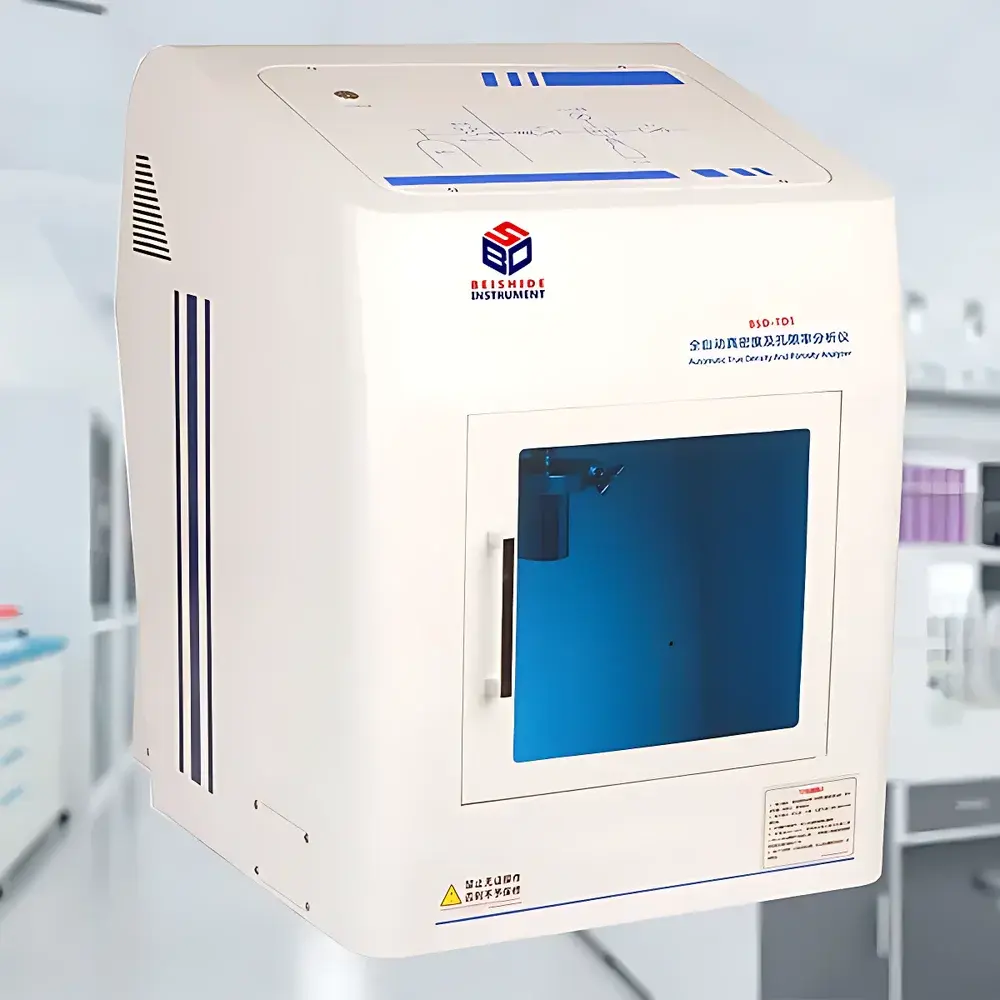
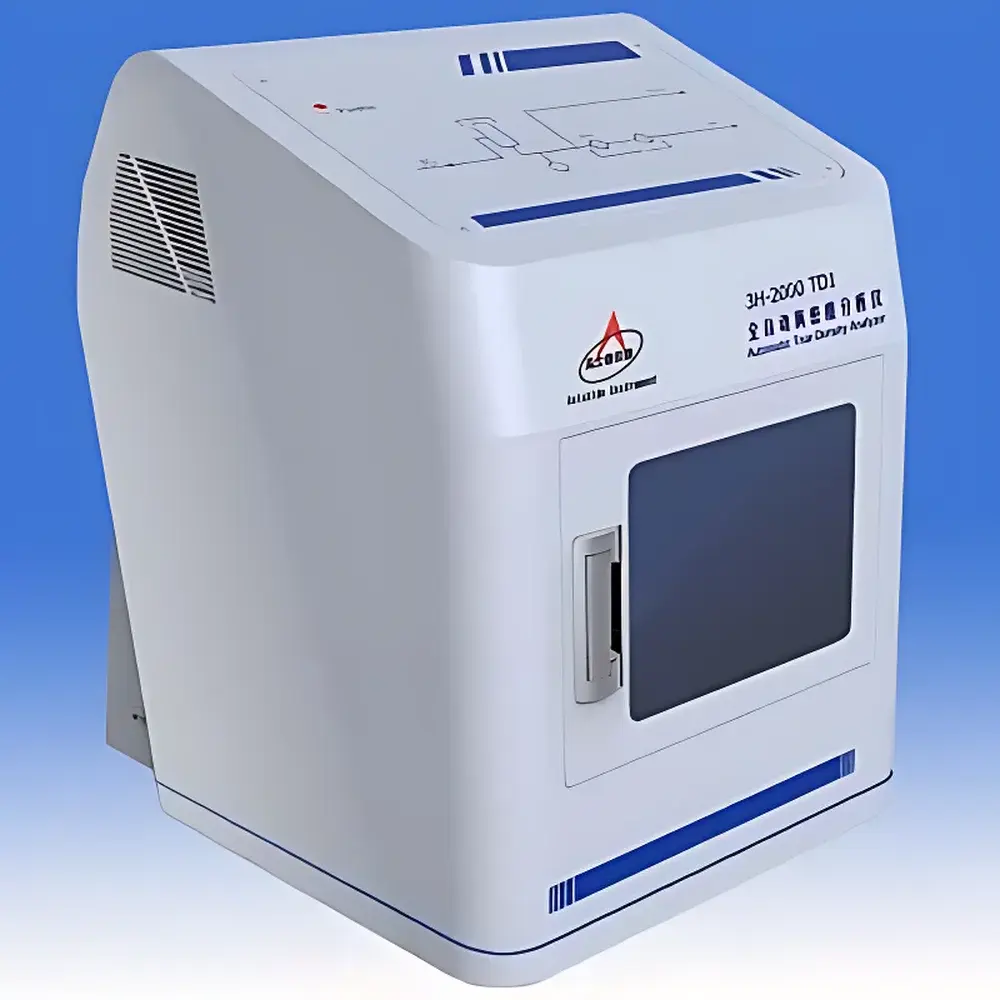
Beishide BSD-TDK Gas Pycnometer for True Density and Porosity Analysis
| Brand | Beishide Instrument |
|---|---|
| Origin | Beijing, China |
| Manufacturer Type | Direct Manufacturer |
| Regional Category | Domestic (China) |
| Model | BSD-TDK |
| Instrument Type | True Density Analyzer |
| Form Factor | Benchtop Laboratory Instrument |
| Measurement Principle | Gas Displacement (Helium Pycnometry) |
| Density Range | 0.01–2000 g/mL |
| Density Accuracy | ±0.06% |
| Repeatability | ±0.04% |
| Resolution | 0.0001 g/mL |
| Temperature Control Range | 0–40 °C |
| Sample Volume Capacity | 0.01–500 mL |
| Analysis Time | 3–5 min per run (≤60 s for 10 mL cell) |
| Standard Sample Cells | 10 mL, 50 mL, 150 mL (custom larger cells available) |
| Reference Chamber | Dual internal reference volumes optimized per cell size |
| Pressure Range | 0–1 bar (user-adjustable) |
| Operating Gas | High-purity helium (≥99.999%), nitrogen optional |
| Gas Handling | Automated multi-cycle purge & leak-check sequence |
| Data Compliance | Supports audit-trail export, PDF report generation (single/batch), GLP/GMP-ready metadata logging |
| Hardware Interface | Embedded controller with graphical UI, voice-guided operation, remote Internet control capability |
Overview
The Beishide BSD-TDK Gas Pycnometer is a benchtop true density and open-porosity analyzer engineered for precision volumetric determination of solid and semi-solid materials using gas displacement pycnometry—specifically helium expansion based on the ideal gas law (PV = nRT). Unlike liquid immersion methods, this technique eliminates sample dissolution, surface adsorption artifacts, or structural alteration, making it suitable for hygroscopic, reactive, porous, or friable specimens including powders, granules, monoliths, foams, pastes, and non-volatile liquids. The instrument quantifies the *true volume*—defined as the volume occupied exclusively by the solid matrix, excluding closed pores—by measuring pressure differentials between a calibrated reference chamber and a sample chamber before and after equilibration. From this, true density (ρ = m/Vtrue) is derived with traceable uncertainty. The system complies with ASTM D5550, ISO 12154, and USP guidelines for gas pycnometry, and its architecture supports regulatory data integrity requirements including 21 CFR Part 11–compatible electronic records when integrated with validated LIMS environments.
Key Features
- Fully automated gas displacement cycle with real-time pressure monitoring and adaptive equilibrium detection—no manual valve actuation or timing intervention required.
- Dual-reference chamber design dynamically selects optimal reference volume (Vref) based on installed sample cell size (10/50/150 mL), minimizing compressibility-induced error across wide sample volume ranges (0.01–500 mL).
- Integrated self-diagnostic protocol validates system integrity prior to each analysis: automatic leak detection, pressure sensor calibration verification, and valve response profiling—all logged with timestamped pass/fail status.
- High-stability temperature-controlled environment (0–40 °C, ±0.1 °C stability) mitigates thermal drift during pressure transients, ensuring repeatability ≤±0.04% RSD over 10 consecutive runs.
- Embedded ARM-based controller with capacitive touchscreen GUI supports multilingual interface, voice-assisted operation, hardware parameter auto-recall via EEPROM chip memory, and zero-configuration reinitialization after power loss.
- Comprehensive data governance: raw pressure/time series export (CSV), batch PDF reporting with embedded metadata (operator ID, timestamp, cell ID, gas lot#, calibration certificate ID), and full audit trail with second-resolution logging of all user actions and system events.
Sample Compatibility & Compliance
The BSD-TDK accommodates heterogeneous physical forms without pretreatment: free-flowing powders (e.g., pharmaceutical excipients, battery cathode materials), cohesive agglomerates (ceramic green bodies), low-density foams (polyurethane, aerogels), irregularly shaped solids (catalyst pellets, geological cores), and viscous suspensions (slurries,膏状物). It excludes volatile liquids, highly adsorptive materials requiring degassing (e.g., activated carbon without prior outgassing), or samples reacting with helium/nitrogen. Regulatory alignment includes adherence to ISO/IEC 17025 documentation standards for calibration traceability (NIST-traceable pressure transducers), ASTM D5550–22 for method validation, and compatibility with GLP-compliant workflows via configurable electronic signature and role-based access control in networked deployments.
Software & Data Management
The proprietary Beishide PycnoControl™ software provides deterministic test sequencing, real-time curve visualization (P vs. t), and post-run calculation of density, % porosity (when combined with skeletal density reference), and inter-run statistical summaries (mean, SD, CV%). All datasets are stored in encrypted SQLite databases with immutable hash signatures. Export modules support CSV (raw sensor outputs), XML (structured metadata), and PDF (formatted reports with digital signature fields). Audit trails record operator login/logout, parameter modifications, calibration events, and emergency aborts—each entry cryptographically time-stamped and non-erasable. Remote diagnostics and firmware updates are supported via TLS-secured HTTP(S) endpoints compliant with enterprise IT security policies.
Applications
This instrument serves quality control laboratories in advanced materials R&D (battery electrode density optimization), pharmaceutical manufacturing (API crystallinity assessment, tablet density mapping), geosciences (rock matrix density for porosity modeling), and catalysis (support material skeletal density for metal dispersion calculations). It is routinely deployed to validate ASTM D7262 for carbon black structure, ISO 1183-3 for polymer density grading, and internal SOPs governing powder flowability correlations. In academic settings, it enables fundamental studies of pore network topology via sequential helium vs. mercury intrusion comparisons.
FAQ
What gases are compatible with the BSD-TDK?
Helium (≥99.999% purity) is standard due to its small kinetic diameter and inertness; nitrogen may be used for non-critical applications where lower resolution is acceptable.
Can the instrument measure closed-cell porosity?
No—it determines *true density*, i.e., volume excluding both open and closed pores; closed porosity requires complementary techniques such as mercury intrusion porosimetry or micro-CT.
Is sample preparation required?
Minimal: samples must be dry and free of surface contaminants; no grinding or sieving is necessary unless dictated by application-specific homogeneity requirements.
How is calibration performed?
Factory calibration uses NIST-traceable stainless-steel reference spheres; users perform daily verification with supplied certified density standards (e.g., fused quartz, sapphire).
Does the system support 21 CFR Part 11 compliance?
Yes—when operated with validated software configuration, electronic signatures, and audit-trail archiving enabled, it meets predicate rule requirements for electronic records in regulated environments.



