
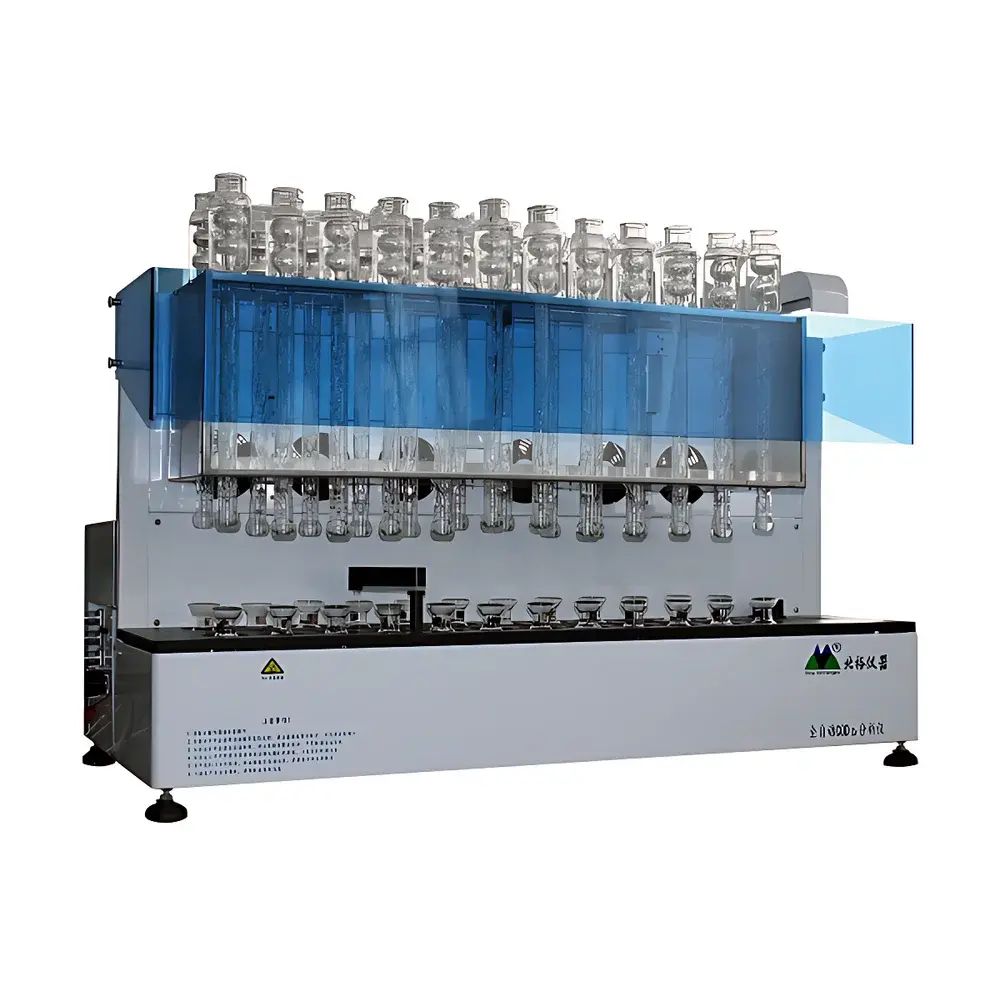
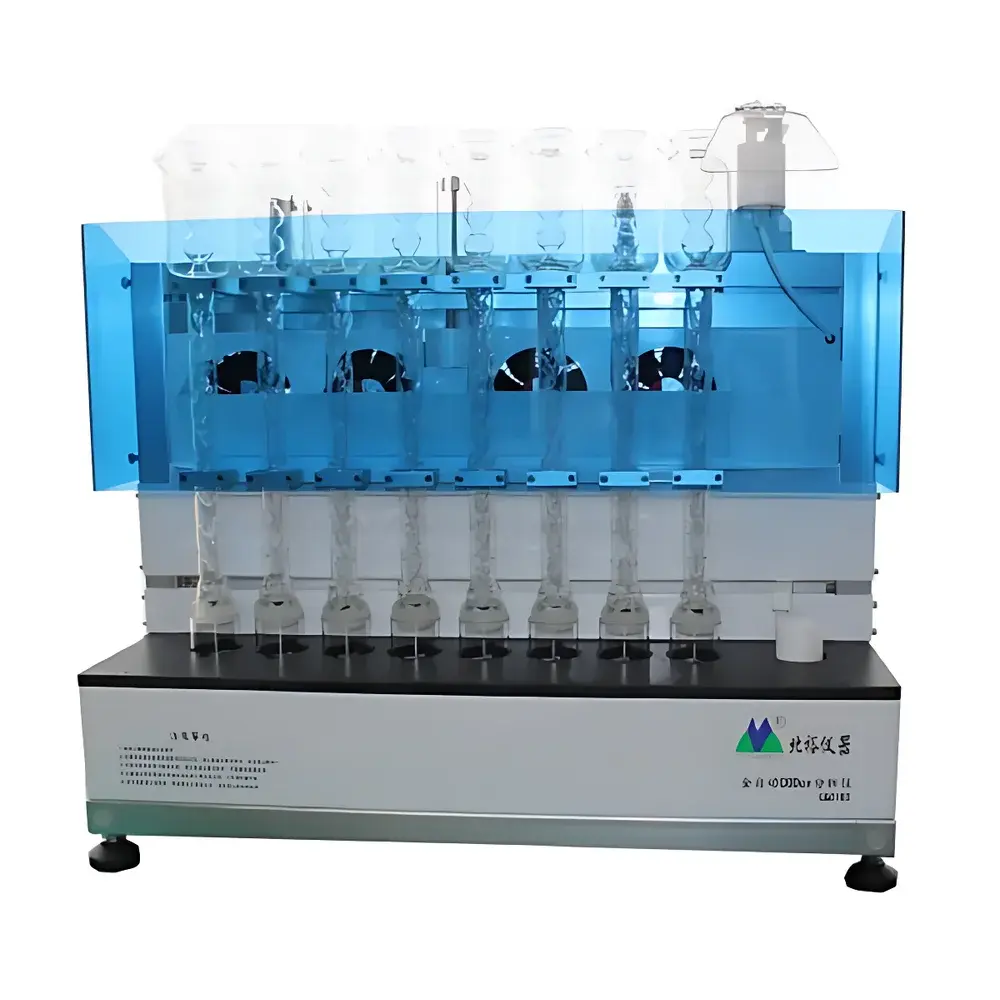
Beiyu Technologies CGC-182/186 Fully Automated CODCr Analyzer
| Brand | Beiyu Technologies |
|---|---|
| Origin | Shanghai, China |
| Manufacturer Type | Direct Manufacturer |
| Model | CGC-182 / CGC-186 |
| Wavelength | 610 ± 20 nm |
| Measurement Range | 10–5000 mg/L |
| Accuracy | ≤ ±10% |
| Repeatability | ≤ ±5% |
| LOD | 4 mg/L |
| Analysis Time | 2 h per batch |
| Sample Throughput | 16 or 24 digestion positions |
Overview
The Beiyu Technologies CGC-182/186 Fully Automated CODCr Analyzer is an engineered solution for standardized, high-throughput chemical oxygen demand (COD) determination in environmental laboratories. It implements the dichromate oxidation method—strictly aligned with HJ 828–2017 (“Water Quality – Determination of Chemical Oxygen Demand – Dichromate Method”)—to quantify oxidizable organic and inorganic substances in surface water, domestic wastewater, and industrial effluents. Unlike semi-automated or manual systems, this instrument integrates a precision robotic platform with machine vision-based endpoint detection, eliminating subjective visual interpretation while preserving full method fidelity. The system performs closed-loop digestion at reflux conditions (150 °C, 2 h), followed by automated titration with standardized ferrous ammonium sulfate (FAS), all under programmable thermal and fluidic control. Its architecture supports unattended operation across multiple batches, reducing analyst exposure to hazardous reagents (e.g., concentrated H2SO4, Ag2SO4, HgSO4) and minimizing inter-operator variability.
Key Features
- Machine vision endpoint recognition: High-resolution CMOS imaging coupled with real-time colorimetric analysis replaces human visual judgment during titration, delivering >99.2% endpoint identification consistency—exceeding both manual assessment reproducibility and electrochemical (potentiometric/current-based) alternatives in robustness against turbidity or matrix interference.
- Modular dual-heating digestion block: Independent PID-controlled heating zones for each digestion position ensure uniform thermal profiles across all 16 or 24 sample wells, preventing cross-contamination and enabling simultaneous low- and high-concentration sample processing without dilution.
- Programmable reagent delivery: Dual-syringe injection pumps with chemically resistant PTFE/PEEK tubing provide precise, pulse-free dispensing of sulfuric acid, potassium dichromate, silver sulfate, and ferrous ammonium sulfate—calibrated to ±0.5% volumetric accuracy per cycle.
- Integrated thermal management: Reflux condensation system maintains consistent vapor return during digestion; programmable ramp-and-hold temperature profiles prevent thermal shock to glassware and improve Cr(VI) reduction kinetics.
- Full audit trail compliance: All instrument actions—including reagent volumes, digestion time/temperature, titrant consumption, and endpoint timestamps—are logged with user ID, timestamp, and digital signature in accordance with GLP and ISO/IEC 17025 requirements.
Sample Compatibility & Compliance
The CGC-182/186 accepts standard 16-mm or 20-mm borosilicate digestion tubes (up to 10 mL sample volume). It accommodates complex matrices including saline wastewater (≤30 g/L Cl−, compensated via mercury sulfate masking), suspended solids-rich influents (pre-filtered per HJ 828–2017), and low-COD surface waters requiring pre-concentration. Method validation data confirm linearity (R² ≥ 0.999) across the full 10–5000 mg/L range, with spike recovery rates of 92–105% in certified reference materials (CRM) from NIST and EPA. The analyzer meets the performance criteria defined in HJ 828–2017, ISO 6060:1989, and ASTM D1252–06 (Method B), and supports 21 CFR Part 11-compliant electronic records when paired with Beiyu’s LIMS-integrated software suite.
Software & Data Management
The embedded Windows-based control software provides intuitive workflow configuration, method library management, and real-time monitoring of digestion progress, titration curves, and colorimetric response dynamics. Raw absorbance data (610 ± 20 nm) and derivative titration plots are exportable in CSV and PDF formats. Audit logs include operator login history, parameter changes, calibration events, and QC failure alerts—all time-stamped and non-erasable. Optional integration with laboratory information management systems (LIMS) enables automated result transfer to ELN platforms and supports configurable report templates compliant with CNAS-CL01:2018 and ISO/IEC 17025:2017 documentation requirements.
Applications
- Regulatory compliance testing for municipal wastewater treatment plants (WWTPs) reporting to local ecological environment bureaus.
- Industrial pretreatment verification in pharmaceutical, food processing, and textile manufacturing facilities.
- Research-grade COD profiling in limnological studies assessing eutrophication potential in lakes and reservoirs.
- Quality assurance in drinking water source protection programs where organic load tracking informs coagulation dosing.
- Method validation and inter-laboratory comparison studies under national proficiency testing schemes (e.g., China National Environmental Monitoring Centre PT programs).
FAQ
Does the CGC-182/186 require manual sample preparation prior to loading?
No—samples must be homogenized and filtered (0.45 µm) per HJ 828–2017, but all downstream steps—including reagent addition, digestion, cooling, titration, and calculation—are fully automated.
Can the system handle chloride interference above 1000 mg/L?
Yes—mercury sulfate is automatically dosed at programmable ratios (up to 10:1 HgSO4:Cl−) to suppress chloride oxidation; validation confirms accurate results up to 3000 mg/L Cl−.
Is remote monitoring supported?
Yes—the instrument features Ethernet and RS-232 interfaces; status, alarms, and real-time titration curves can be accessed via secure web interface or VNC-enabled remote desktop.
What maintenance is required for long-term reliability?
Monthly cleaning of optical windows and syringe pump valves; annual calibration of photometric sensor and titrant delivery system using NIST-traceable standards.
How does the machine vision system differentiate between endpoint and matrix-induced color shifts?
It applies multi-channel RGB spectral decomposition and temporal derivative analysis of hue saturation value (HSV) trajectories—rejecting transient fluctuations and confirming endpoint only upon sustained ΔHue < 2.5 units over 3 consecutive frames.
Related Products







