
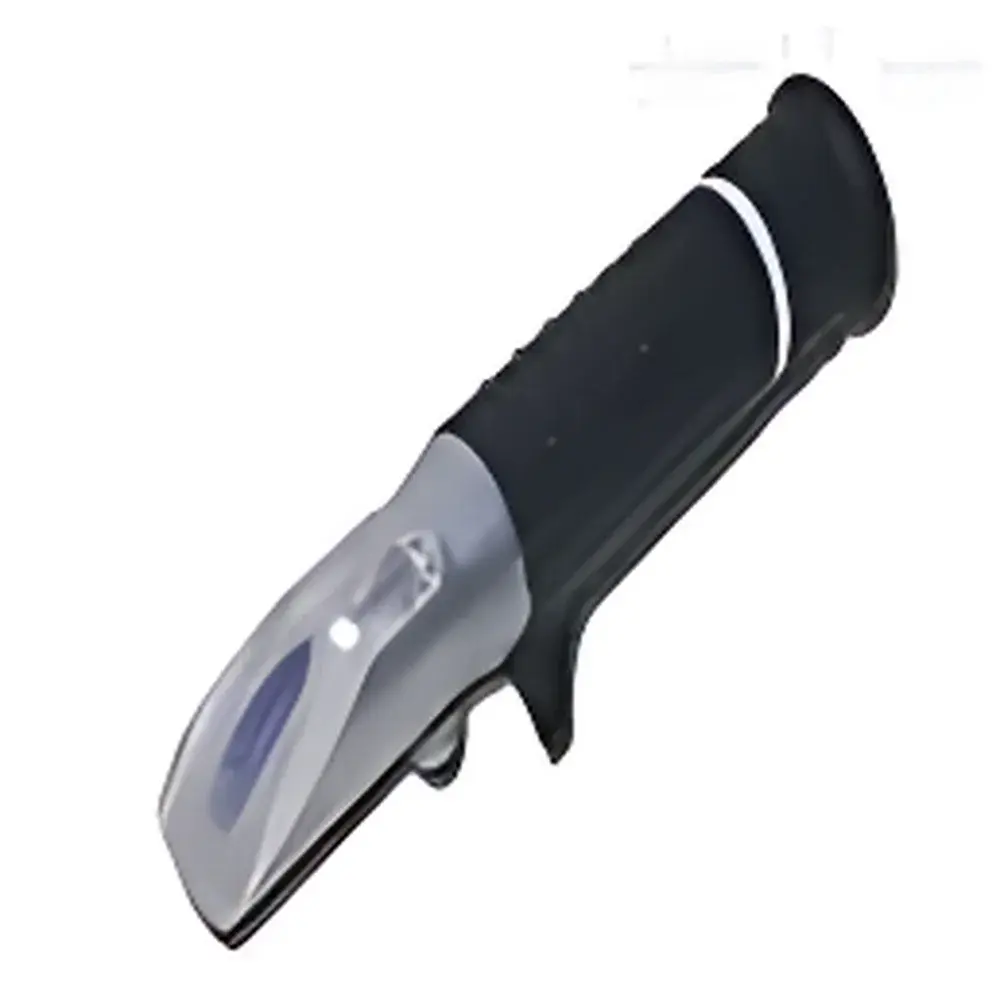
Bellingham + Stanley E-Line ATC Handheld Refractometer
| Brand | Bellingham + Stanley |
|---|---|
| Origin | United Kingdom |
| Type | Benchtop Refractometer |
| Model | E-Line |
| Temperature Control | Yes (Automatic Temperature Compensation) |
| Digital Display | Yes |
| Construction | All-metal body with heat-insulating rubber grip |
| Compliance | Designed to meet ISO 21748 and ASTM D1218 standards for refractive index measurement |
Overview
The Bellingham + Stanley E-Line ATC Handheld Refractometer is a precision optical instrument engineered for rapid, field-deployable determination of refractive index and related concentration parameters—primarily °Brix—in aqueous solutions. Operating on the principle of critical angle refraction, the device measures the angular deviation of light as it passes from a high-refractive-index prism into the sample medium; this deviation correlates directly with the sample’s solute concentration. Unlike laboratory-grade Abbe refractometers requiring temperature-stabilized stages, the E-Line series integrates Automatic Temperature Compensation (ATC) via a bimetallic thermal element, enabling reliable readings across ambient temperatures from 5 °C to 40 °C without external thermostating. Its compact, all-metal housing and ergonomic rubberized grip ensure mechanical robustness and operational stability during mobile or outdoor use—making it suitable for quality control technicians, agricultural extension officers, beverage processors, and food safety inspectors conducting on-site verification where benchtop instrumentation is impractical.
Key Features
- All-metal construction with corrosion-resistant anodized aluminum chassis and stainless-steel optical components for long-term dimensional stability and resistance to environmental degradation
- Ergonomic, heat-insulated rubber grip minimizing thermal transfer from operator hand to prism assembly—critical for maintaining measurement consistency when handling cold or warm samples
- High-contrast, parallax-free scale illumination system with adjustable eyepiece focus for precise visual interpolation between刻度 divisions
- Push-to-open prism cover mechanism ensuring repeatable prism surface exposure and protection against accidental contamination or scratching
- Integrated ATC mechanism compliant with ISO 21748 Annex B, compensating for temperature-induced refractive index drift in sugar-water systems within ±0.2 °C accuracy over the 10–30 °C range
- Digital display variant (E-Line Digital) provides real-time °Brix readout with 0.1-unit resolution and GLP-compliant timestamped data logging via optional USB interface
Sample Compatibility & Compliance
The E-Line refractometer accommodates liquid, semi-liquid, and low-viscosity suspensions—including fruit juices, syrups, coolants, antifreeze solutions, battery electrolytes, and fermentation broths. It is not intended for highly viscous, opaque, or particulate-laden samples that obstruct light transmission through the prism–sample interface. All models comply with international metrological standards for handheld refractometry: ISO 21748 (Refractometry — Determination of refractive index), ASTM D1218 (Standard Test Method for Refractive Index of Hydrocarbon Liquids), and EN 13479 (Foodstuffs — Determination of refractive index). Units are calibrated traceably to NIST SRM 1484 (sucrose solution reference standards) and certified per UKAS-accredited procedures at the Bellingham + Stanley calibration facility in Kent, UK.
Software & Data Management
The digital E-Line variant supports connectivity via micro-USB to Windows-based PCs running B+S RefraSoft v3.2—a validated application designed for regulated environments. RefraSoft enables audit-trail-enabled data capture, user-defined calibration curves (including non-sucrose matrices such as sodium chloride or ethylene glycol), statistical process control (SPC) charting, and export to CSV or PDF formats compatible with LIMS integration. The software conforms to FDA 21 CFR Part 11 requirements for electronic records and signatures, including role-based access control, electronic signature workflows, and immutable audit logs of all measurement, calibration, and configuration events.
Applications
- Agricultural field testing: Rapid assessment of fruit ripeness (°Brix), sap sugar content in maple syrup production, and honey adulteration screening
- Food & beverage manufacturing: In-line QC checks for juice concentration, soft drink syrup dilution, and dairy product solids content
- Automotive and industrial maintenance: Glycol concentration verification in engine coolants and brake fluids per SAE J1087 and ASTM D3372 specifications
- Pharmaceutical excipient control: Monitoring sucrose or dextrose concentrations in oral rehydration solutions and syrups under GMP-aligned SOPs
- Education and vocational training: Teaching core principles of optical density, Snell’s law, and solution thermodynamics in chemistry and food science laboratories
FAQ
Does the E-Line require periodic recalibration?
Yes—annual calibration against certified reference standards is recommended per ISO/IEC 17025 guidelines; Bellingham + Stanley offers UKAS-accredited recalibration services with full traceability documentation.
Can the E-Line measure non-aqueous liquids?
It is optimized for aqueous sucrose solutions; measurements of organic solvents (e.g., ethanol, acetone) require custom calibration curves and are not covered under standard warranty or compliance statements.
Is the ATC function adjustable or user-configurable?
No—the ATC mechanism is passive and factory-tuned to the temperature–refractive index relationship of sucrose–water systems; no user adjustment is provided or permitted.
What is the typical measurement repeatability?
Under controlled conditions (20 °C ±1 °C, clean prism, consistent sample application), repeatability is ≤±0.1 °Brix for models with 0.1-unit graduation and ≤±0.2 °Brix for coarser scales.
Are replacement prisms available as spare parts?
Yes—Bellingham + Stanley supplies OEM prism assemblies (Part No. PRISM-E-LINE) with pre-applied anti-scratch coating and certified flatness tolerance of λ/4 @ 633 nm.




