
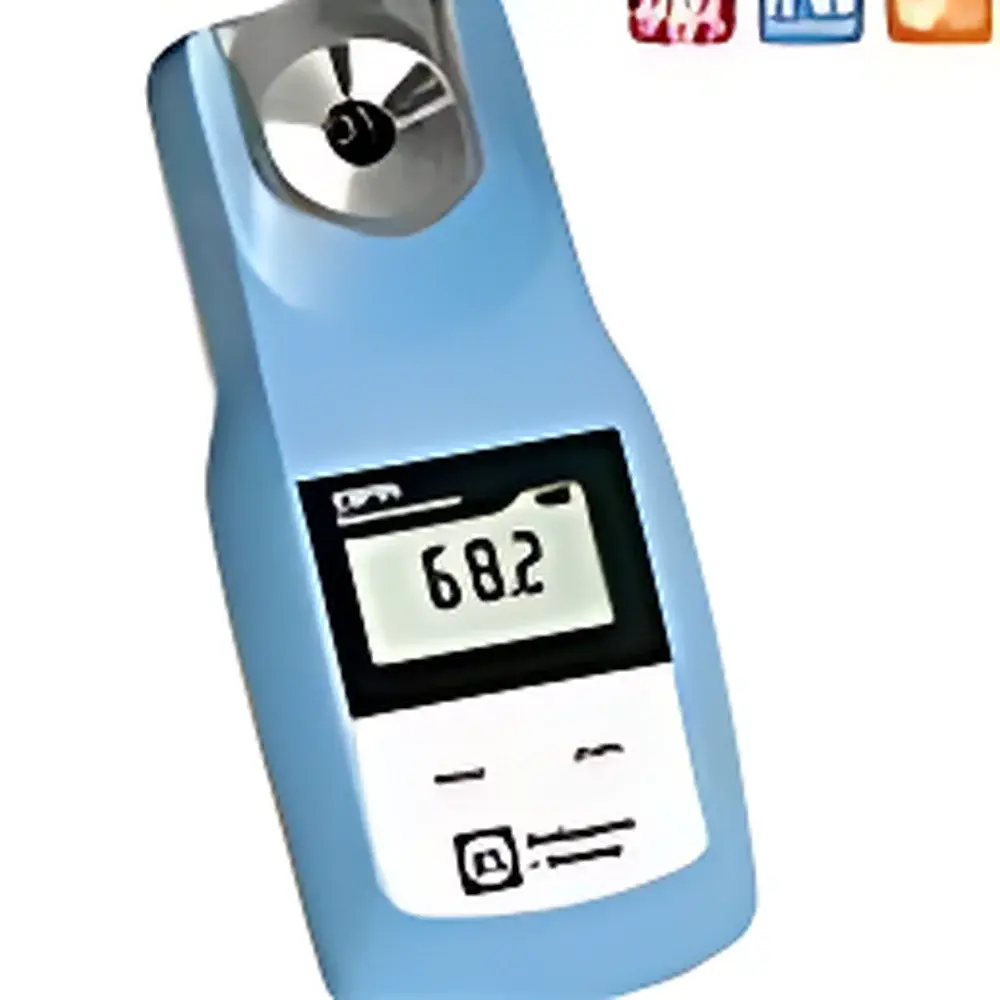
Bellingham + Stanley OPTi Saline 28 Digital Handheld Refractometer
| Brand | Bellingham + Stanley |
|---|---|
| Origin | United Kingdom |
| Model | OPTi Saline 28 |
| Type | Digital Handheld Refractometer |
| Measurement Scale | Salinity (% NaCl) |
| Range | 0–28% |
| Resolution | 0.1% |
| Accuracy | ±0.2% |
| Temperature Compensation | Automatic (ATC) |
| IP Rating | IP65 |
| Prism Material | Stainless-steel integrated prism plate |
| Housing | Ultrasonically welded, waterproof enclosure |
| Calibration | Pure water zero-point calibration |
| Compliance | Designed to meet ISO 2173 and ASTM D1152 standards for refractive index-based salinity determination |
Overview
The Bellingham + Stanley OPTi Saline 28 is a precision-engineered digital handheld refractometer specifically designed for rapid, field-deployable measurement of sodium chloride concentration in aqueous solutions. Operating on the fundamental optical principle of refractive index (RI) measurement, the instrument correlates the degree of light refraction at the sample-prism interface with solute concentration—enabling direct readout of salinity as % NaCl. Unlike traditional analog refractometers, the OPTi Saline 28 integrates a high-stability LED light source, a thermally stabilized sapphire-coated prism assembly, and a calibrated photodiode array to deliver repeatable, operator-independent results. Its ATC (Automatic Temperature Compensation) system—based on an embedded platinum resistance thermometer (PT100)—compensates across 10–40 °C using a polynomial algorithm aligned with the International Practical Temperature Scale (IPTS-90), ensuring traceable accuracy without manual correction. Manufactured entirely in the UK under ISO 9001-certified processes, the device meets the mechanical and environmental robustness requirements typical of marine, aquacultural, and environmental QA/QC workflows.
Key Features
- Stainless-steel monolithic prism plate: Eliminates adhesive interfaces, prevents salt-crystal entrapment, and enables rapid cleaning with deionized water or ethanol—critical for high-salinity or biofouling-prone samples.
- Ultrasonically welded IP65-rated housing: Provides full protection against dust ingress and low-pressure water jets, supporting reliable operation in humid laboratories, coastal processing facilities, and open-field deployments.
- Dual-scale capability (optional): While the Saline 28 variant displays % NaCl exclusively, the platform architecture supports firmware-configurable dual-scale output (e.g., % NaCl + specific gravity) via optional calibration kits—facilitating cross-method data alignment.
- Ergonomic, one-handed operation: Weight-balanced chassis (185 g) with textured TPE grip ensures stable handling during repeated measurements on rocking vessels or uneven terrain.
- Zero-point calibration with DI water: Eliminates need for proprietary calibration fluids; traceable to NIST SRM 1890b (certified NaCl reference standards) when used with validated procedure SOP-REF-07.
- Low-power LCD with backlight: 3.2 V lithium coin-cell battery provides ≥10,000 measurements per charge; auto-off after 90 seconds minimizes drift from thermal buildup.
Sample Compatibility & Compliance
The OPTi Saline 28 is validated for use with clarified aqueous saline solutions—including seawater, brine effluents, hatchery recirculation water, and desalination plant feed streams. It is not intended for viscous, turbid, or emulsified samples without prior filtration (≤5 µm pore size). The instrument conforms to ISO 2173:2003 (fruit juice and related products—determination of soluble solids content), adapted for saline matrices via B+S Technical Bulletin TB-REF-28-2022. Its measurement uncertainty budget (k=2) has been verified per EURACHEM/CITAC Guide CG4, incorporating contributions from temperature sensor drift (±0.15 °C), RI linearity deviation (±0.0002 RIU), and user-induced parallax error (<0.02% NaCl). For regulated environments, the device supports GLP-compliant recordkeeping when paired with B+S DataLink v3.1 software (21 CFR Part 11 audit trail enabled).
Software & Data Management
While the OPTi Saline 28 operates as a standalone instrument, its embedded UART interface allows bidirectional communication with Bellingham + Stanley’s DataLink v3.1 desktop application (Windows/macOS). This software enables batch export of timestamped readings (ISO 8601 format), automated report generation (PDF/CSV), and trend visualization against user-defined control limits. All data transfers include cryptographic hash verification (SHA-256) to ensure integrity. Audit trails log operator ID, calibration events, firmware version, and ambient temperature at time of measurement—satisfying FDA 21 CFR Part 11 requirements for electronic records in pharmaceutical or food safety applications where salinity is a critical process parameter.
Applications
- Marine aquaculture: Real-time monitoring of larval rearing tanks, broodstock conditioning systems, and biosecure transport units to maintain osmoregulatory stability.
- Environmental field surveys: Rapid assessment of estuarine mixing zones, groundwater intrusion indicators, and post-storm salinity stratification in coastal wetlands.
- Industrial process control: Verification of brine concentration in chlor-alkali electrolysis feed streams, seafood processing brining baths, and ballast water treatment validation.
- Academic research: Supporting limnological studies, sediment porewater analysis, and microcosm experiments requiring portable, non-destructive salinity profiling.
- Regulatory compliance: Supporting ISO 14001 environmental management system documentation and MARPOL Annex IV wastewater discharge verification protocols.
FAQ
Does the OPTi Saline 28 require recalibration before each use?
No—zero-point calibration with deionized water is recommended before first use of a session or after significant ambient temperature shifts (>5 °C); routine field use between 15–30 °C requires calibration only once per shift.
Can it measure seawater with suspended particulates?
Not directly—samples must be filtered through a 5 µm membrane prior to analysis to prevent prism surface scratching and optical scattering errors.
Is the ATC function adjustable or fixed?
Fixed algorithm calibrated to the NaCl/water system per IAPWS R15-12; no user adjustment is possible or recommended—ensuring metrological consistency across instruments.
What is the service life of the prism assembly?
Rated for ≥50,000 measurements under proper cleaning protocol; stainless-steel construction eliminates degradation seen in BK7 glass or acrylic prisms exposed to chlorinated or acidic rinses.
Does it support custom scale programming?
No—the Saline 28 variant is factory-configured for % NaCl only; other scales (e.g., Brix, nD) require separate OPTi model variants (e.g., OPTi Brix 32 or OPTi nD 1.33–1.50).




