
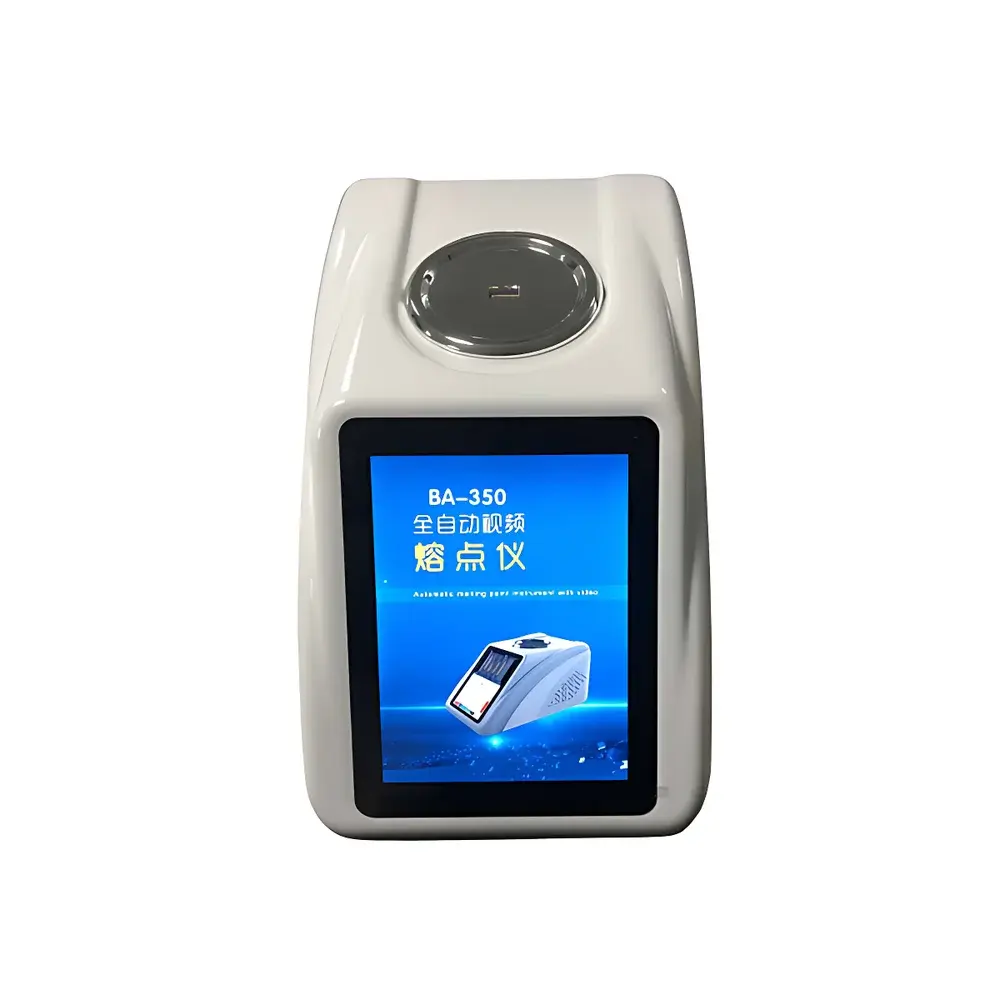
BenAng BA-350 Automated Video Melting Point Apparatus
| Brand | BenAng |
|---|---|
| Origin | Shanghai, China |
| Model | BA-350 |
| Temperature Range | Ambient to 350 °C |
| Heating Rate | 0.1–20.0 °C/min |
| Temperature Repeatability | ±0.1 °C |
| Temperature Accuracy | ±0.4 °C (<200 °C), ±0.7 °C (<300 °C) |
| Capillary Dimensions | ID 0.9–1.1 mm, Wall Thickness 0.10–0.15 mm |
| Sample Capacity | 4 samples per run |
| Temperature Resolution | 0.1 °C |
| Display | 8.1″ capacitive touchscreen |
| Imaging | 720p camera with 8× optical zoom |
| Data Storage | 32 GB internal (videos, thermograms, methods) |
| Connectivity | USB ×3, RS232, Wi-Fi |
| Compliance | FDA 21 CFR Part 11, GLP, Chinese GMP Annex for Lab Instruments |
Overview
The BenAng BA-350 Automated Video Melting Point Apparatus is a precision thermal analysis instrument engineered for the objective, reproducible determination of melting point and melting range (onset, clear point, and interval) of crystalline organic compounds. It operates on the principle of controlled linear heating of solid samples sealed in standard capillaries, coupled with real-time high-resolution video observation and automated image-based endpoint detection. Unlike traditional analog or semi-automated units, the BA-350 integrates closed-loop PID temperature control, digital thermal sensing, and synchronized optical monitoring—enabling unattended operation while maintaining metrological traceability to NIST-traceable reference standards. Its design adheres to the fundamental requirements of pharmacopeial methods (USP <741>, EP 2.2.17, ChP 0612), where melting behavior serves as both an identity test and a critical purity indicator: impurities depress and broaden the melting range, making precise measurement essential for quality control in API release, excipient qualification, and stability studies.
Key Features
- Full automation with real-time video capture: 720p CMOS camera with 8× optical zoom enables continuous recording of sample morphological changes during heating—capturing crystal collapse, meniscus formation, and complete liquefaction without operator intervention.
- Precision thermal control architecture: Dual-sensor feedback system ensures stable ramping across the full 0.1–20.0 °C/min range; nanolayered thermal insulation minimizes ambient drift and improves thermal response time by >35% compared to conventional air-bath designs.
- Regulatory-compliant software platform: Android-based OS with built-in audit trail, electronic signatures, role-based user management (up to 20 accounts), and immutable data logging—fully aligned with FDA 21 CFR Part 11 and GLP documentation requirements.
- High-fidelity data acquisition: 0.1 °C temperature resolution with verified accuracy (±0.4 °C below 200 °C; ±0.7 °C up to 300 °C) and repeatability of ±0.1 °C at 0.1 °C/min—validated using certified SRM 742a (indium) and SRM 722 (tin).
- Flexible reporting and interoperability: Direct export of thermograms, annotated videos, and summary reports to USB drives or network printers; supports PDF, CSV, and proprietary .mpd formats with embedded metadata (user, timestamp, method ID, calibration status).
Sample Compatibility & Compliance
The BA-350 accepts standard ASTM E324-compliant capillaries (ID 0.9–1.1 mm, wall thickness 0.10–0.15 mm), accommodating typical pharmaceutical, agrochemical, and fine chemical samples (e.g., APIs, intermediates, polymorphs, hydrates). Its 4-position sample stage allows parallel testing under identical thermal conditions—critical for comparative analysis or method validation. All firmware and software modules undergo annual verification against ISO/IEC 17025:2017 clause 5.9 (method validation) and ICH Q5C (stability testing guidelines). Instrument qualification includes IQ/OQ protocols compliant with EU Annex 15 and USP <1058> Analytical Instrument Qualification framework.
Software & Data Management
The embedded Android 11 OS hosts a purpose-built application supporting three operational modes: fully automated batch runs, manual stepwise heating, and calibration verification. Each test session automatically generates a structured dataset containing raw temperature/time logs, frame-stamped video (H.264), derivative thermogram overlays, and pass/fail flags based on configurable thresholds. All data are cryptographically hashed and timestamped upon creation; modifications trigger automatic versioning and require dual-authentication approval. Audit trails record every user action—including parameter edits, calibration events, and report exports—with retention configurable up to 10 years. Data integrity is further enforced via FIPS 140-2 validated encryption for stored videos and method files.
Applications
- Pharmaceutical QC/QA: Release testing of active pharmaceutical ingredients per USP monographs; polymorph screening during formulation development; identification of eutectic mixtures in blend uniformity assessment.
- Chemical R&D: Verification of synthetic product identity and purity; thermal profiling of novel ionic liquids and metal-organic frameworks (MOFs); degradation onset detection in heat-sensitive compounds.
- Food & Flavor Analysis: Melting characterization of cocoa butter equivalents, fatty acid esters, and encapsulated flavors—supporting compliance with Codex Alimentarius standards.
- Academic & Regulatory Labs: Teaching tool for thermal analysis fundamentals; reference instrument for inter-laboratory comparison studies under ISO/IEC 17043 proficiency testing schemes.
FAQ
Does the BA-350 support external calibration verification with certified reference materials?
Yes—the instrument includes dedicated calibration mode for indium (156.6 °C), tin (231.9 °C), and bismuth (271.4 °C) with auto-compensation for observed deviations.
Can historical video files be exported without compromising audit trail integrity?
Yes—exported videos retain embedded SHA-256 hashes and metadata; the original database entries remain read-only and tamper-evident.
Is the 32 GB internal storage field-upgradeable?
No—storage is soldered NAND flash; however, continuous archiving to network shares or USB 3.0 drives is supported via scheduled backup tasks.
What is the maximum allowable ambient temperature for reliable operation?
The unit is rated for continuous use at ambient temperatures between 15–30 °C and relative humidity ≤70% non-condensing, per IEC 61000-6-3 EMC specifications.
How does the BA-350 handle samples with broad or ambiguous melting transitions?
The software applies adaptive edge-detection algorithms to identify multiple inflection points within a single thermogram, allowing manual override of onset/clear definitions and generation of multi-point melt reports.



