
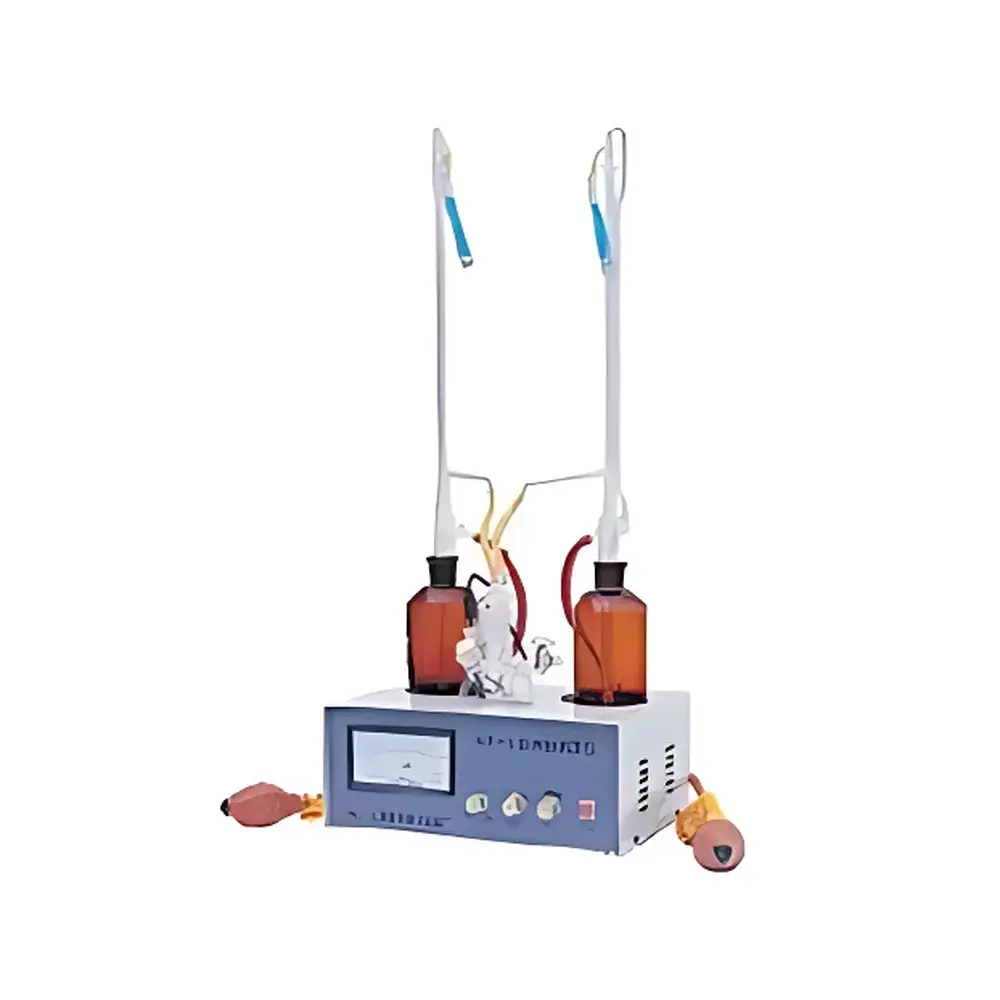
BenAng KF-1 Manual Karl Fischer Moisture Titrator
| Brand | BenAng |
|---|---|
| Origin | Shanghai, China |
| Manufacturer Type | Authorized Distributor |
| Country of Origin | China |
| Model | KF-1 |
| Power Supply | 220 V AC, 50 Hz |
| Power Consumption | 18 W |
| Operating Environment | 5–35 °C, <80% RH |
| Dimensions (L×W×H) | 345 × 245 × 140 mm |
| Measurement Range | 30 ppm to 100% w/w |
| Titration System | Standardized burette interface (interchangeable with common volumetric burettes) |
| Stirring | Electromagnetic, continuously variable speed control |
| Waste Disposal | Dry air pressure-assisted expulsion |
| Safety Design | Fully enclosed reaction system |
Overview
The BenAng KF-1 Manual Karl Fischer Moisture Titrator is a precision-engineered, benchtop volumetric titrator designed for quantitative determination of water content in solid, liquid, and gaseous samples using the classical Karl Fischer (KF) coulometric-free titration method. Based on the stoichiometric reaction between iodine, sulfur dioxide, methanol, and water—governed by the I₂ + SO₂ + CH₃OH + H₂O → 2HI + CH₃OSO₂H equilibrium—the KF-1 delivers trace-level moisture quantification across a broad dynamic range (30 ppm to 100% w/w). Its fully enclosed titration cell architecture minimizes atmospheric moisture ingress and operator exposure to reagents, ensuring analytical integrity and laboratory safety. Engineered for routine QC/QA environments—including pharmaceutical manufacturing, food quality control, polymer synthesis, and fine chemical production—the KF-1 adheres to foundational principles outlined in ASTM E203, ISO 760, and USP , serving as a validated reference platform where automated systems are not required or justified.
Key Features
- Manual volumetric KF titration system with standardized 10 mL and 25 mL burette compatibility—enabling rapid interchange based on sample water load and required precision.
- Electromagnetic stirring with infinitely variable speed control—ensuring homogeneous mixing during titration without mechanical wear or vibration-induced endpoint drift.
- Dry compressed air–assisted waste expulsion mechanism—eliminating manual siphoning or vacuum pump dependency while maintaining consistent cell pressure and reagent integrity.
- Dual-stage power regulation: primary 220 V AC input filtered through transformer rectification and voltage stabilization—delivering stable low-voltage DC supply to the analog endpoint detection circuitry for reproducible endpoint recognition.
- Hermetically sealed titration vessel assembly with PTFE-coated stopcocks and gas-tight septa—preventing ambient moisture contamination and enabling analysis of hygroscopic or volatile samples.
- Compact footprint (345 × 245 × 140 mm) optimized for shared lab benches; low power draw (18 W) supports continuous operation without thermal load concerns.
Sample Compatibility & Compliance
The KF-1 accommodates a wide spectrum of sample matrices, including but not limited to active pharmaceutical ingredients (APIs), excipients, lyophilized powders, edible oils, dairy powders, solvents (e.g., acetone, THF, chloroform), resins, catalysts, and metal salts. Sample introduction is performed via syringe injection into the sealed cell, supporting both direct liquid dosing and oven-heated headspace transfer for solids. While the instrument itself does not embed digital audit trails or electronic signatures, its operational workflow aligns with GLP and GMP documentation requirements when paired with controlled logbooks and calibrated glassware traceable to NIST standards. Routine verification per ISO/IEC 17025–compliant procedures—including reagent blank assessment, standard addition recovery (e.g., 1–10 mg water standards), and repeatability testing (n ≥ 6)—is recommended prior to regulated batch release.
Software & Data Management
As a manually operated titrator, the KF-1 does not incorporate embedded firmware, touchscreen interface, or data export functionality. Endpoint detection relies on analog potentiometric sensing (bipotentiometric dual-platinum electrode), with visual endpoint confirmation via colorimetric indicator (e.g., crystal violet) or electrometric inflection. All measurements require manual recording of burette initial/final volumes, sample mass, and calculated water content (% w/w or ppm) in accordance with internal SOPs. Laboratories implementing 21 CFR Part 11 compliance may integrate the KF-1 into broader electronic lab notebook (ELN) workflows by digitizing handwritten records using validated scanning and metadata tagging protocols. Calibration certificates for supplied burettes and analytical balances must be maintained separately as part of instrument qualification (IQ/OQ).
Applications
- Pharmaceutical: Quantification of residual moisture in freeze-dried vials, tablet granulations, and sterile APIs—critical for stability prediction and shelf-life assignment per ICH Q5C guidelines.
- Food & Beverage: Determination of water activity–related parameters in flour, spices, confectionery, and dehydrated vegetables to assess microbial risk and packaging integrity.
- Chemical Manufacturing: Verification of anhydrous conditions in solvent batches (e.g., DMF, DMSO) prior to Grignard or lithiation reactions.
- Polymers & Plastics: Monitoring moisture content in PET, PA6, and PC pellets pre-drying to prevent hydrolytic degradation during extrusion or injection molding.
- Quality Control Labs: Cost-effective alternative to automated KF systems for low-throughput environments requiring method flexibility and full operator control over titration kinetics.
FAQ
Is the KF-1 compliant with pharmacopeial methods such as USP or EP 2.5.12?
Yes—the KF-1 implements the fundamental volumetric Karl Fischer titration principle specified in these monographs. Full compliance requires user-established validation protocols, appropriate reagent certification, and documented system suitability testing.
Can the KF-1 measure samples with very low moisture content (<100 ppm)?
With careful technique—including pre-dried glassware, high-purity reagents, and minimized atmospheric exposure—it reliably quantifies down to 30 ppm. Sub-ppm accuracy requires coulometric instrumentation.
What maintenance is required for long-term reliability?
Annual verification of burette calibration, electrode cleaning with ethanol and ultrasonic bath, and replacement of desiccant in the air-drying tube are recommended. No firmware updates or software licensing applies.
Does the KF-1 support connection to LIMS or external printers?
No—it is a standalone analog instrument. Data must be transcribed manually or digitized externally via validated processes.
Is technical support available outside China?
BenAng provides remote application assistance and troubleshooting documentation in English; hardware service is coordinated through authorized regional distributors under warranty terms.



