
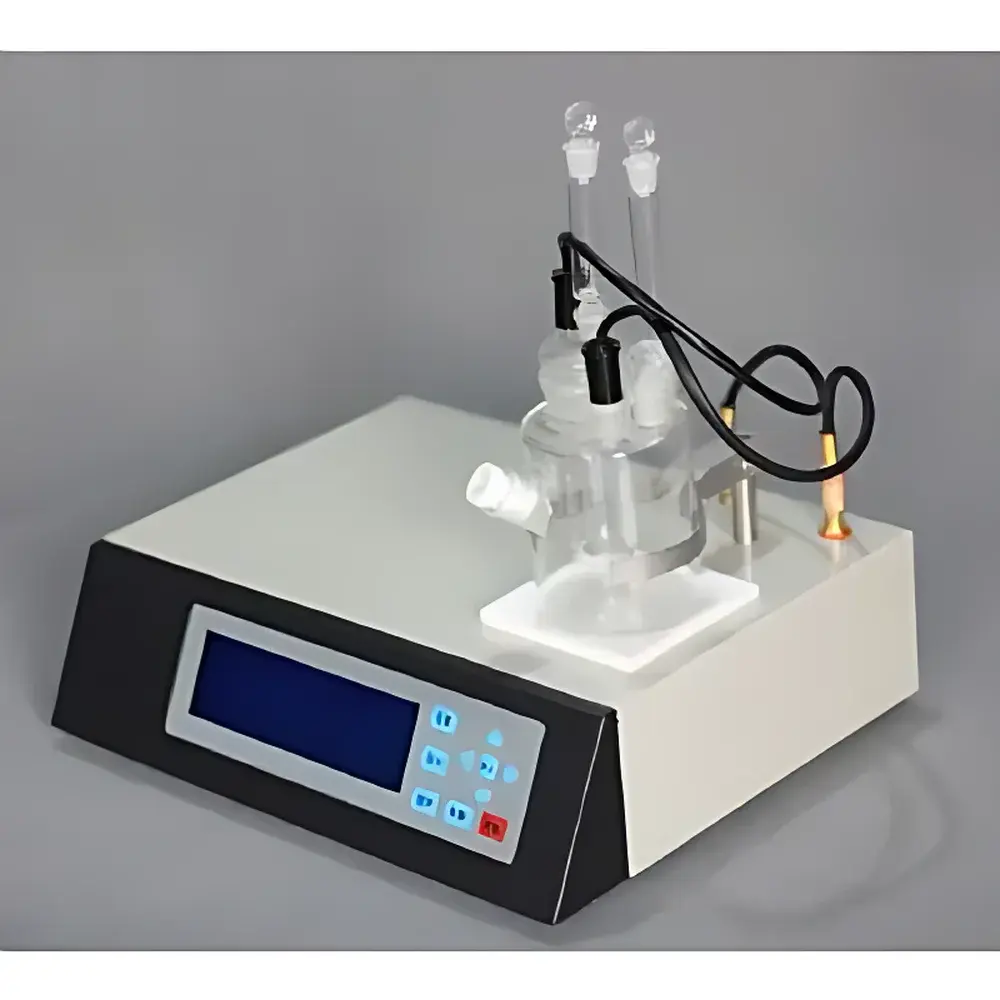
BenAng MA-2B Aldehyde-Ketone Specific Coulometric Karl Fischer Moisture Analyzer
| Brand | BenAng |
|---|---|
| Origin | Shanghai, China |
| Model | MA-2B |
| Instrument Type | Coulometric Karl Fischer Moisture Analyzer |
| Moisture Measurement Range | 3 µg – 100 mg (equivalent to 3 ppm – 100% w/w, depending on sample mass) |
| Accuracy | ±2 µg (for 3–1 mg water), ±0.2% (for 1–100 mg water, excluding sampling error) |
| Sensitivity | 0.1 µg |
| Minimum Sample Delivery Resolution | 1/2000 |
| Display | 240 × 64 dot-matrix LCD (blue backlight) |
| Built-in Clock | Non-volatile real-time clock (year/month/day/week/hour/minute/second |
| Operating Environment | 0–50 °C, ≤85% RH |
| Power Consumption | 30 W |
| Dimensions | 300 × 250 × 100 mm |
Overview
The BenAng MA-2B Aldehyde-Ketone Specific Coulometric Karl Fischer Moisture Analyzer is engineered for precise and reliable quantification of trace to bulk water content in chemically challenging samples containing reactive carbonyl functionalities—particularly aldehydes and ketones. Unlike conventional volumetric or coulometric KF systems, the MA-2B integrates a proprietary electrolyte formulation and optimized cell architecture that suppresses side reactions between KF reagents and α-hydrogen-bearing carbonyl compounds, thereby eliminating erroneous over-titration and ensuring stoichiometric accuracy. It operates on the principle of coulometric Karl Fischer titration, where iodine is electrogenerated in situ at the anode in proportion to the charge passed (Faraday’s law), enabling direct, absolute quantification of water without reliance on standardized titrant solutions. This makes the MA-2B especially suited for QC laboratories in fine chemical, pharmaceutical excipient, and polymer additive manufacturing environments where regulatory-grade reproducibility and method robustness are mandatory.
Key Features
- Carbonyl-selective coulometric KF methodology validated for formaldehyde, acetaldehyde, acetone, cyclohexanone, methyl ethyl ketone (MEK), and structurally analogous compounds.
- High-resolution micro-dosing capability with 1/2000 incremental precision, minimizing sample consumption and improving measurement repeatability across low-mass injections.
- Real-time reagent health monitoring: automated diagnostic algorithm detects iodine generation inefficiency and prompts user-initiated reagent replacement—reducing risk of false negatives due to exhausted anolyte.
- Integrated non-volatile real-time clock supporting GLP-compliant audit trails; time-stamped results stored internally with 10-year retention capacity.
- 240 × 64 dot-matrix blue-backlit LCD interface with full Chinese menu navigation—designed for bilingual operational environments without compromising ISO/IEC 17025 documentation integrity.
- Thermal line printer with low-noise operation, high legibility, and permanent hard-copy output compliant with FDA 21 CFR Part 11 record-keeping requirements when paired with appropriate lab information management system (LIMS) integration.
Sample Compatibility & Compliance
The MA-2B is validated for use with liquid, solid, and viscous samples containing aldehydes and ketones at concentrations ranging from 95% w/w. Its optimized anolyte composition prevents enolization-driven iodine consumption and minimizes interference from solvent systems including chloroform, toluene, and acetonitrile-based KF media. The analyzer conforms to ASTM E203–22 (Standard Test Method for Water Using Volumetric Karl Fischer Titration) and ISO 760:1978 (Determination of Water—Karl Fischer Method), with coulometric mode adherence to USP and EP 2.5.12. All firmware and calibration routines support traceability to NIST-traceable water standards. Device design meets IEC 61010-1 safety requirements for laboratory electrical equipment.
Software & Data Management
While the MA-2B operates as a standalone instrument with embedded firmware, its RS-232 serial interface enables bidirectional communication with external PCs running validated data acquisition software. Exported datasets include sample ID, injection volume/mass, titration curve metadata, endpoint detection timestamp, calculated water mass (µg), %w/w, RSD (%), and operator ID—all structured in CSV format for seamless import into LIMS or ELN platforms. Audit trail functionality records all parameter modifications, reagent change events, and calibration actions with immutable timestamps, satisfying ALCOA+ principles (Attributable, Legible, Contemporaneous, Original, Accurate, Complete, Consistent, Enduring, Available) under GMP/GLP frameworks.
Applications
- Quantitative moisture verification of polyvinyl alcohol (PVA) and polyacrylic acid precursors prior to emulsion polymerization.
- Stability-indicating assay of aldose-containing excipients (e.g., glucose, lactose monohydrate) in lyophilized biopharmaceutical formulations.
- QC release testing of ketone-based solvents (e.g., MEK, MIBK) used in coating and adhesive manufacturing per ISO 8503-2 surface preparation specifications.
- Raw material screening of aldehyde-functionalized crosslinkers (e.g., glyoxal, glutaraldehyde) where residual water impacts shelf-life and crosslinking kinetics.
- Method transfer support for pharmacopeial compliance (USP , JP 2.05, ChP 0832) in contract development and manufacturing organizations (CDMOs).
FAQ
Does the MA-2B require specialized KF reagents?
Yes—the instrument is calibrated and validated exclusively with BenAng’s MA-2B–certified anolyte and catholyte formulations, which contain stabilized iodine precursors and carbonyl-scavenging additives. Substitution with generic coulometric reagents invalidates accuracy claims and voids compliance with stated ±0.2% specification.
Can the MA-2B be used for non-aldehyde/ketone samples?
It may function, but accuracy and repeatability are not guaranteed outside its designated scope. For general-purpose coulometric analysis (e.g., hydrocarbons, alcohols, esters), BenAng recommends the MA-1 series.
Is the thermal printer compliant with 21 CFR Part 11 electronic records requirements?
The printed output itself satisfies the “original record” criterion; however, full Part 11 compliance requires integration with a validated electronic signature and audit trail system on the host PC or LIMS—not the instrument alone.
What maintenance intervals are recommended for electrode cleaning and cell rinsing?
Electrode surfaces should be inspected and cleaned with anhydrous methanol after every 50 analyses or at the end of each workday when handling high-boiling-point or viscous samples.
How is measurement uncertainty estimated for low-level water determination (e.g., 3–10 µg)?
Uncertainty is dominated by weighing error and injection variability. Users must apply ISO/IEC 17025–compliant uncertainty budgets incorporating balance calibration data, syringe certification, and repeatability studies per ISO/IEC Guide 98-3 (GUM).






