
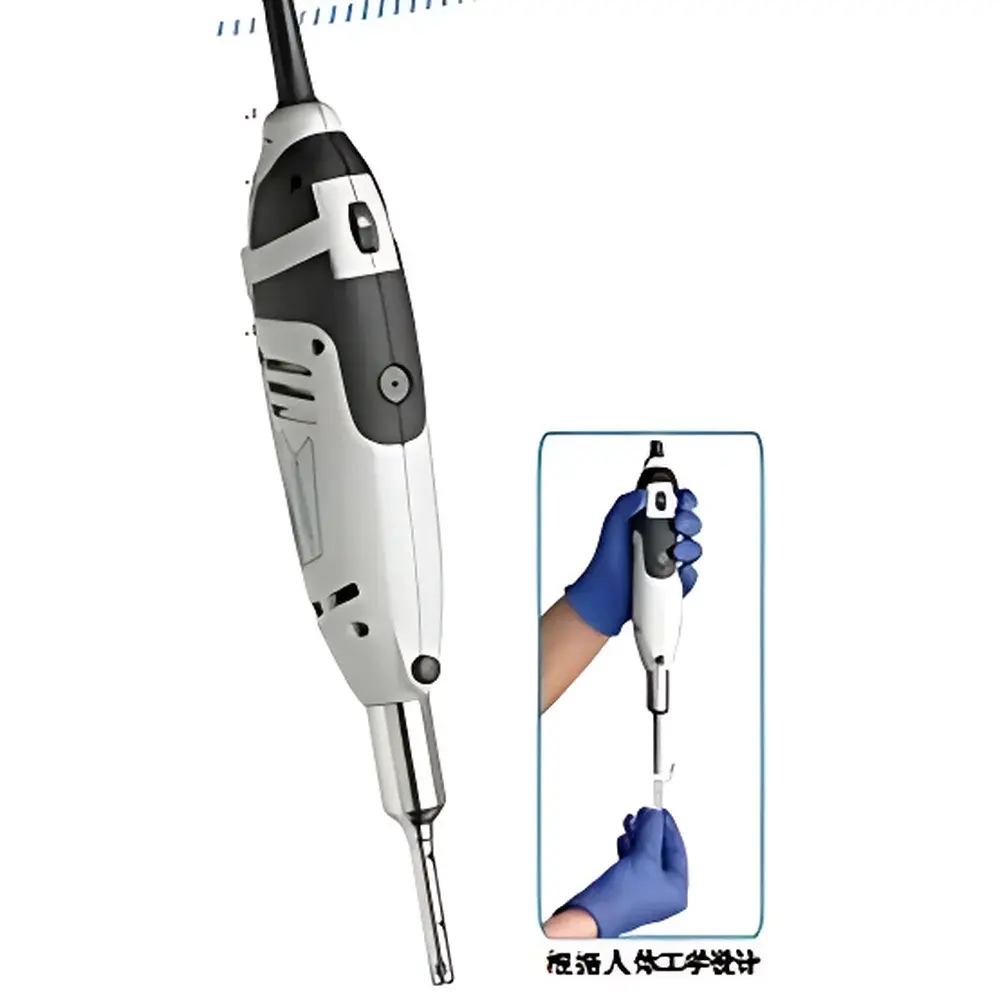
Benchmark D1000 Handheld Rotor-Stator Homogenizer
| Brand | Benchmark |
|---|---|
| Origin | USA |
| Model | D1000 |
| Instrument Type | Rotor-Stator Homogenizer |
| Dimensions (W×D×H) | 45 × 58 × 225 mm |
| Operating Temperature Range | +4 °C to +65 °C |
| Speed Range | 8,500–30,000 rpm |
| Sample Volume Capacity | 0.1–250 mL |
| Motor Power | 130 W |
| Noise Level | <70 dB(A) |
| Weight | 0.6 kg |
| Electrical Supply | 115 V, 60 Hz / 230 V, 50 Hz |
| Probe Options | 4 sizes (Ø5×50 mm, Ø7×50 mm, Ø10×115 mm, Ø14×130 mm) |
Overview
The Benchmark D1000 Handheld Rotor-Stator Homogenizer is an engineered solution for rapid, reproducible mechanical disruption of biological samples in research and quality control laboratories. Based on the well-established rotor-stator principle—where high-shear fluid dynamics are generated by a rapidly rotating rotor drawing sample into a precisely machined stator chamber—the D1000 delivers consistent homogenization across viscous, fibrous, or particulate-laden suspensions. Unlike bead-based or ultrasonic methods, this system avoids exogenous contamination, thermal buildup from cavitation, or nucleic acid shearing associated with excessive acoustic energy. Its handheld form factor enables direct immersion into tubes, beakers, or flasks, supporting both benchtop and biosafety cabinet workflows. Designed for operation within standard refrigerated (4 °C) and ambient-to-warm (up to 65 °C) environments, the D1000 maintains performance stability during temperature-sensitive extractions—including protein isolation, microbial lysis, and tissue homogenization prior to downstream ELISA, PCR, or HPLC analysis.
Key Features
- 130 W brushless motor delivering stable rotational speeds from 8,500 to 30,000 rpm, adjustable in six discrete steps for precise shear control
- Four interchangeable stainless-steel rotor-stator probes optimized for specific vessel geometries and sample viscosities: Ø5 mm and Ø7 mm (50 mm length) for microcentrifuge tubes (0.1–2 mL); Ø10 mm (115 mm) for 15–50 mL conical tubes; Ø14 mm (130 mm) for larger vessels up to 250 mL
- Ergonomic, lightweight housing (0.6 kg) with non-slip grip and integrated on/off switch for single-hand operation
- Low-noise design (<70 dB[A]) suitable for shared lab spaces without dedicated acoustic enclosures
- CE-compliant electrical architecture supporting dual-voltage input (115 V/60 Hz and 230 V/50 Hz), enabling global deployment without voltage converters
- Chemically resistant probe materials compatible with common solvents, detergents, and enzymatic buffers used in molecular biology and pharmacology workflows
Sample Compatibility & Compliance
The D1000 accommodates a broad range of biological matrices—including mammalian tissues, plant material, bacterial pellets, yeast cultures, and soft hydrogels—without requiring pre-chilling or cryogenic assistance. Its rotor-stator geometry ensures efficient energy transfer even in low-volume (10,000 mPa·s) samples where vortexing or pipette mixing proves inadequate. All probes are autoclavable at 121 °C for 20 minutes, supporting GLP-compliant cleaning validation protocols. While the instrument itself does not carry FDA 510(k) clearance or ISO 13485 certification as a medical device, its construction and operational parameters align with ISO 17025 requirements for equipment used in accredited testing laboratories. Users routinely integrate D1000-generated lysates into workflows compliant with USP , ASTM E2694 (microbial enumeration), and ISO 11133 (culture media preparation).
Software & Data Management
As a manually operated analog instrument, the D1000 does not incorporate embedded software, digital logging, or network connectivity. This design choice eliminates firmware dependencies, cybersecurity concerns, and calibration drift associated with microprocessor-controlled units—enhancing long-term reliability and reducing total cost of ownership. However, its deterministic speed settings (six fixed rpm values) enable full procedural traceability when documented alongside sample IDs, probe type, duration, and temperature in laboratory notebooks or LIMS entries. For labs requiring electronic record retention per 21 CFR Part 11, validated SOPs may specify manual entry of D1000 operating parameters into secure, audit-trail-enabled systems—consistent with FDA guidance on “legacy equipment” integration.
Applications
- Routine lysis of cultured cells (adherent and suspension) prior to Western blotting or flow cytometry sample prep
- Homogenization of frozen or fresh tissue biopsies for biomarker quantification (e.g., cytokine ELISAs, phosphoprotein assays)
- Preparation of uniform emulsions in formulation development (e.g., nanoemulsion-based drug delivery systems)
- Dispersion of nanoparticles and microparticles in aqueous or organic carriers for DLS or SEM characterization
- Disaggregation of fungal mycelia or algal biomass for metabolite extraction and sequencing library prep
- QC release testing of raw materials in food safety and cosmetic manufacturing (per AOAC 990.11 and ISO 6887-1)
FAQ
What is the recommended maintenance schedule for the D1000?
Routine inspection of probe threads and rotor integrity is advised after every 50 hours of cumulative use. Probes should be visually inspected for pitting or deformation and replaced if wear exceeds 0.1 mm radial deviation. Motor brushes are not user-serviceable; the brushless design eliminates scheduled brush replacement.
Can the D1000 be used in cold rooms or refrigerated centrifuges?
Yes—the unit operates reliably between +4 °C and +65 °C. Condensation on external surfaces must be wiped before actuation to prevent ingress. Prolonged exposure below 4 °C is not recommended due to potential lubricant stiffening in the drive shaft assembly.
Is sterilization of probes required between samples?
Sterilization is mandatory when processing human-derived or pathogenic samples. Autoclaving at 121 °C for 20 minutes is validated for all stainless-steel probes. Ethanol wipe-down suffices for non-regulated academic applications involving non-pathogenic strains.
How does rotor-stator homogenization compare to bead-beating for nucleic acid yield?
Rotor-stator systems generate less DNA fragmentation than high-energy bead mills, preserving longer amplicons (>5 kb) in PCR applications. However, for Gram-positive bacteria or spores, supplemental lysozyme or mechanical pretreatment may be necessary to achieve lysis efficiency comparable to BeadBug or BeadBlaster platforms.
Are replacement probes and spare parts available through authorized channels?
Yes—Benchmark-certified probes, O-rings, and drive couplings are distributed globally via ISO 9001-certified distributors. Each probe carries a serialized calibration certificate traceable to NIST standards for rotational balance verification.



