
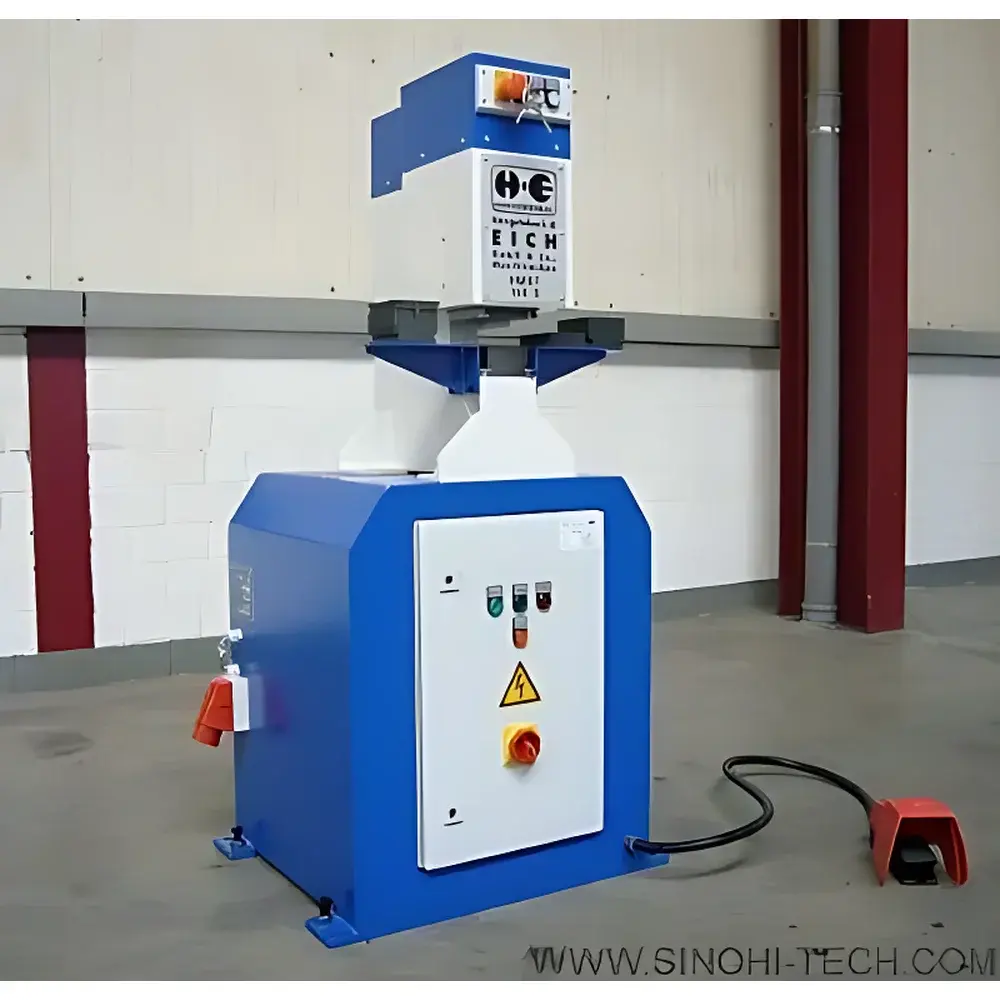
V-Bend Testing Machine HMST 150 S
| Origin | Germany |
|---|---|
| Manufacturer Type | Authorized Distributor |
| Origin Category | Imported |
| Model | HMST 150 S |
| Price | Upon Request |
Overview
The V-Bend Testing Machine HMST 150 S is a precision-engineered hydraulic multi-punch testing system designed for quantitative evaluation of coating integrity on metallic substrates—particularly cold-rolled steel sheets, galvanized steel, alloy-coated steels (e.g., GA, GI), and advanced functional coatings including PVD-deposited layers. It operates on the standardized V-bend deformation principle defined in ASTM D7438, ISO 6860, and EN 10169, wherein a rectangular test specimen is subjected to controlled plastic bending over a fixed V-shaped die using a hydraulically actuated punch. This induces localized tensile and compressive strain gradients across the coated surface, enabling systematic assessment of coating resistance to cracking, flaking, and delamination. The HMST 150 S delivers repeatable, traceable mechanical loading profiles with full force and displacement monitoring, making it suitable for R&D laboratories, quality control departments in automotive OEMs, and coating manufacturers requiring compliance with IATF 16949 and ISO/IEC 17025–accredited test protocols.
Key Features
- Hydraulic actuation with dual-range load capacity: 150 kN nominal bending force and 75 kN programmable return force, ensuring high-force deformation without overshoot or dwell-induced creep.
- Adjustable working pressure up to 200 bar, enabling fine-tuned load application across varying substrate thicknesses (0.4–2.4 mm) and yield strengths (up to 800 N/mm²).
- C-frame open-access design with unrestricted sample loading—accommodates specimens of arbitrary width and length via front-facing C-type loading aperture.
- Controlled kinematics: minimum punch descent speed ≥10 mm/s; maximum retraction speed 20 mm/s—optimized for consistent strain-rate application and operator safety.
- Integrated hydraulic power unit: 2.2 kW motor, 4.5 L/min pump flow rate, 20 L reservoir capacity, and low-noise operation (<75 dB(A)) compliant with ISO 4871.
- Rugged structural construction: total mass ≈630 kg; footprint 720 mm (W) × 570 mm (D) × 1475 mm (H); operational ambient range 0–50°C, RH ≤95% non-condensing.
Sample Compatibility & Compliance
The HMST 150 S supports flat sheet specimens with thicknesses from 0.4 mm to 2.4 mm, including electrogalvanized (EG), hot-dip galvanized (HDG), zinc–iron alloy (GA), aluminum–zinc alloy (AZ), and thin-film PVD coatings on steel or aluminum substrates. Its V-die geometry and punch radius conform to ASTM D7438 Annex A1 and ISO 6860 Clause 6.2 requirements for standardized bend angle (typically 180°) and die opening ratio. All mechanical components—including the hardened tool steel punch and die set—are calibrated per DIN 50125 and certified for long-term dimensional stability. The system meets CE machinery directive 2006/42/EC, EMC Directive 2014/30/EU, and is compatible with GLP-compliant documentation workflows when integrated with external data acquisition systems.
Software & Data Management
While the HMST 150 S operates via an embedded PLC-based control panel with tactile HMI interface, it provides analog and digital I/O ports (0–10 V, 4–20 mA, RS-485 Modbus RTU) for seamless integration with third-party SCADA platforms or LIMS environments. Force–displacement curves can be logged externally at ≥1 kHz sampling rate using compatible DAQ hardware. For audit-trail compliance, users may pair the machine with validated PC-based software supporting 21 CFR Part 11 electronic signatures, user-level access control, and raw data immutability features. Calibration certificates—including load cell verification per ISO 376 Class 0.5 and position encoder linearity testing—are issued annually and archived with unique traceability identifiers.
Applications
- Evaluation of zinc coating adhesion on automotive body-in-white (BIW) panels under simulated forming conditions.
- Comparative ranking of anti-corrosion coating systems (e.g., chromate-free passivations, silane hybrids) based on crack initiation thresholds.
- Process validation for continuous hot-dip galvanizing lines—correlating bath chemistry, cooling rates, and post-treatment parameters with bend performance.
- Development of ultra-high-strength steels (UHSS) with tailored coating architectures for press-hardening applications.
- Supporting failure analysis investigations where coating spallation precedes substrate fatigue in crash-relevant components.
FAQ
What standards does the HMST 150 S comply with for V-bend testing?
It supports test execution per ASTM D7438, ISO 6860, EN 10169, and JIS Z 2371—each requiring specific die angles, punch radii, and loading sequences.
Can the machine accommodate non-standard specimen widths?
Yes—the C-frame architecture eliminates lateral constraints; specimens wider than 720 mm may be tested with appropriate support fixtures.
Is hydraulic oil maintenance required between tests?
No routine oil replacement is needed between individual tests; however, scheduled oil analysis and filter replacement are recommended every 1,500 operating hours per DIN 51524 Part 2.
Does the system include force calibration documentation?
Each unit ships with a factory-issued calibration certificate traceable to PTB (Physikalisch-Technische Bundesanstalt), valid for 12 months from commissioning.
What electrical infrastructure is necessary for installation?
A dedicated 400 V / 50 Hz three-phase supply (with neutral and PE) and separate 220 V / 50 Hz circuit for solenoid valves are mandatory; voltage fluctuation must remain within ±5%.



