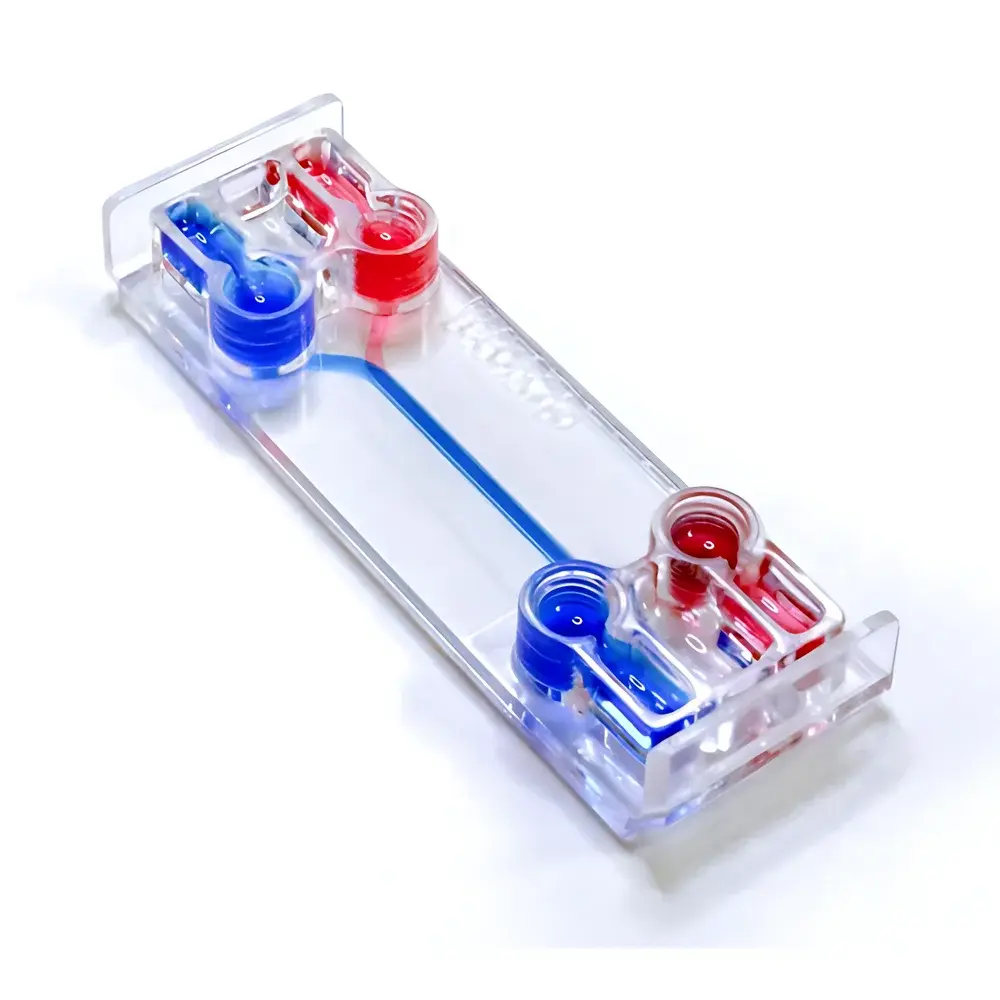
BEOnChip BE-DOUBLEFLOW Dual-Channel Permeable Membrane Microfluidic Cell Culture Chip
| Brand | BEOnChip |
|---|---|
| Origin | Spain |
| Model | BE-DOUBLEFLOW |
| Chip Format | Standard Microscope Slide (75 × 25 mm) |
| Membrane Options | Polycarbonate or PET with customizable pore sizes (0.4 µm, 1.0 µm, 3.0 µm, 8.0 µm) |
| Fluidic Interface | Integrated Luer-lock inlets/outlets |
| Optical Compatibility | Fully transparent, high-clarity cyclic olefin copolymer (COC) body |
| Sterility | Gamma-irradiated, individually packaged |
| Compatibility | Compatible with Fluigent pressure-based systems, syringe pumps, inverted & upright microscopes (including phase contrast, fluorescence, and time-lapse imaging) |
Overview
The BEOnChip BE-DOUBLEFLOW is a dual-channel microfluidic cell culture chip engineered for physiologically relevant co-culture and dynamic barrier modeling. Its core architecture features two parallel, independently addressable microchannels separated by a vertically integrated, track-etched porous membrane—enabling controlled paracrine signaling, transcellular transport, and mechanical shear stress application across confluent monolayers. Unlike static Transwell® systems, the BE-DOUBLEFLOW sustains continuous laminar flow in both channels, permitting real-time modulation of interfacial gradients (e.g., oxygen, cytokines, metabolites) while preserving cellular polarity and barrier integrity. Designed specifically for organ-on-a-chip applications, it supports long-term (>7-day) culture of primary cells, iPSC-derived lineages, and patient-derived organoids under perfused conditions that replicate in vivo hemodynamic and biochemical microenvironments.
Key Features
- Standard microscope slide footprint (75 × 25 mm) ensures seamless integration into existing inverted and upright microscopy platforms—including confocal, spinning-disk, and live-cell imaging setups.
- Optically clear cyclic olefin copolymer (COC) construction provides >90% light transmission from 240–800 nm, enabling high-fidelity phase contrast, DIC, and multi-channel fluorescence imaging without background autofluorescence.
- Interchangeable membrane inserts with certified pore size options (0.4 µm, 1.0 µm, 3.0 µm, 8.0 µm) allow precise control over molecular weight cutoff, cellular transmigration, and particle diffusion kinetics—critical for modeling endothelial, epithelial, or blood-brain barriers.
- Luer-lock fluidic ports enable rapid, leak-free connection to external actuation systems including Fluigent EZ-Flow pressure controllers, Harvard Apparatus PHD Ultra syringe pumps, or custom-built peristaltic manifolds.
- Surface chemistry is non-specifically passivated to minimize protein adsorption and support consistent cell attachment, proliferation, and recovery—validated for human umbilical vein endothelial cells (HUVECs), Caco-2, HepG2, primary alveolar epithelial cells, and circulating tumor cell (CTC) lines.
Sample Compatibility & Compliance
The BE-DOUBLEFLOW is validated for use with adherent mammalian cell types under standard CO₂ incubator conditions (37 °C, 5% CO₂, humidified). It supports both 2D monolayer and 3D extracellular matrix-embedded cultures (e.g., collagen I, Matrigel®, fibrin). The device conforms to ISO 10993-5 (cytotoxicity) and ISO 10993-12 (sample preparation for biological testing) standards. All chips are gamma-sterilized (25 kGy) and supplied in ISO Class 5 cleanroom-packaged blister trays. For GLP- or GMP-aligned workflows, full traceability documentation—including lot-specific sterility certificates, material biocompatibility reports, and dimensional QC data—is available upon request.
Software & Data Management
While the BE-DOUBLEFLOW operates as a hardware platform independent of proprietary software, it integrates natively with widely adopted lab automation and image analysis ecosystems. Flow rate calibration and pressure regulation are managed via vendor-agnostic protocols (e.g., Fluigent’s MAESFLO™ SDK or open-source Python libraries such as pypressure). Time-lapse image acquisition can be synchronized with flow triggers using TTL-compatible microscope stages (e.g., Prior ProScan III) and analyzed using Fiji/ImageJ, Imaris, or HALO® for quantitative assessment of barrier integrity (TEER proxy via fluorescent dextran flux), cell morphology dynamics, and particle trajectory mapping.
Applications
- Organ-specific barrier modeling: Dual-channel configuration enables side-specific seeding—for example, human lung microvascular endothelium in the basal channel and primary alveolar epithelium on the apical membrane surface—to recapitulate air–blood interface physiology.
- Circulating biomarker interaction studies: Introduction of fluorescently labeled bacteria, immune cells, or CTCs into one channel permits real-time tracking of adhesion, transmigration, and intracellular uptake across polarized layers.
- Hypoxia–normoxia gradient generation: Independent gas perfusion (e.g., 1% O₂ in one channel, ambient air-equilibrated medium in the other) facilitates investigation of metabolic crosstalk in tumor–stroma or ischemic–reperfusion models.
- Pharmacokinetic–pharmacodynamic (PK–PD) simulation: Enables compartmentalized drug dosing and metabolite sampling—ideal for preclinical evaluation of nanocarrier biodistribution, metabolizing enzyme induction, or transporter-mediated efflux (e.g., P-gp, BCRP).
FAQ
Can the BE-DOUBLEFLOW chip be reused after cell culture?
No. Each chip is designed for single-use under sterile, controlled experimental conditions to ensure reproducibility and eliminate cross-contamination risk.
Is membrane insertion performed by the user or pre-assembled?
All BE-DOUBLEFLOW chips ship with the selected membrane pre-integrated and sealed—no manual assembly or alignment is required.
What flow rates are recommended for maintaining physiological shear stress?
Typical operational range is 1–100 µL/min per channel, corresponding to wall shear stresses of 0.5–20 dyn/cm² depending on channel height and viscosity—values programmable via calibrated pressure or syringe pump profiles.
Does BEOnChip offer custom chip design services?
Yes. BEOnChip provides end-to-end microfluidic design, prototyping, and low-volume manufacturing support for academic and industrial partners—including geometry modification, alternative materials, and integration of embedded sensors (e.g., TEER electrodes, pH optodes).