
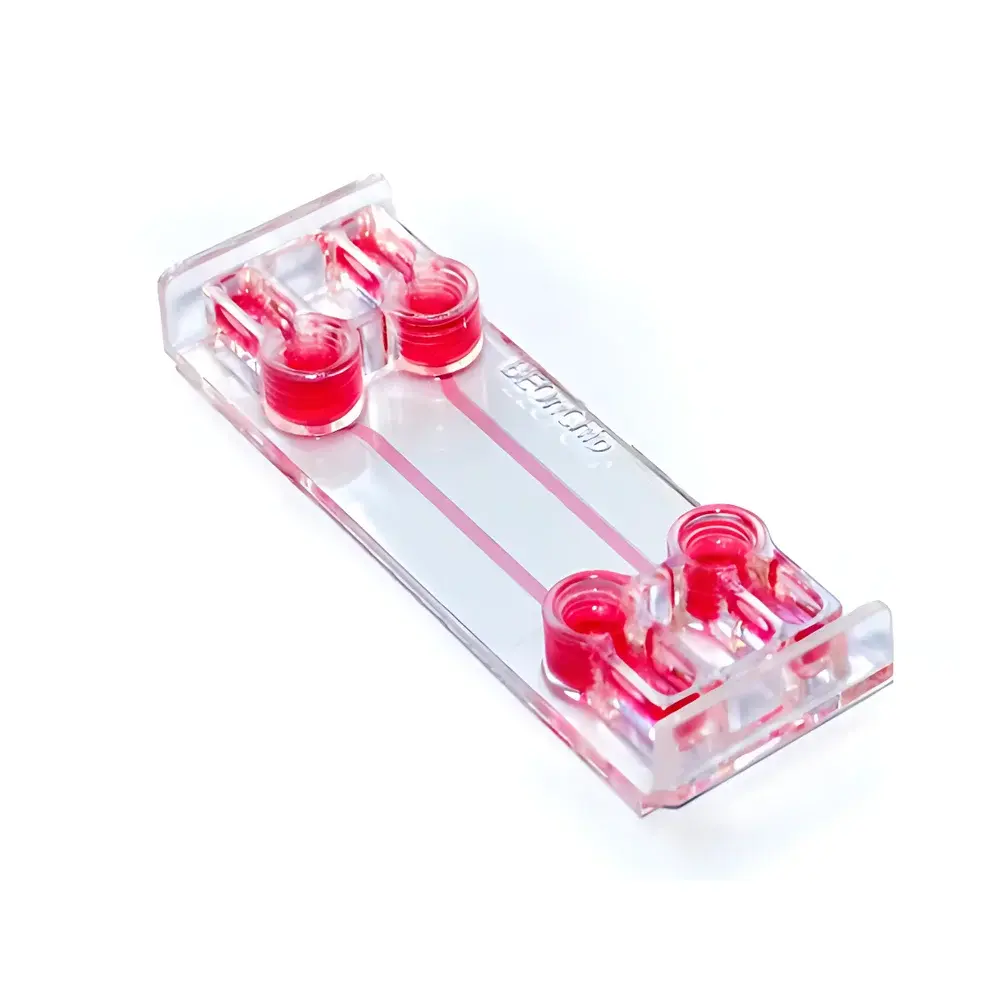
BeonChip BE-FLOW Microfluidic Cell Culture Chip for Shear Stress and Flow Modeling
| Brand | BeonChip |
|---|---|
| Origin | Spain |
| Model | BE-FLOW |
| Chip Format | Standard Microscope Slide-Sized (75.0 × 25.0 × 1.0 mm) |
| Channel Architecture | Dual Independent Parallel Channels |
| Flow Control | Independent Pressure-Driven Shear Regulation per Channel |
| Cell Culture Compatibility | 2D Monolayer & 3D Hydrogel-Embedded Cultures |
| Surface Treatment | Non-Fouling, Low-Adsorption Polymer Coating |
| Sterility | Pre-Sterilized (EO or Gamma, upon request) |
| Regulatory Status | For Research Use Only (RUO) |
Overview
The BeonChip BE-FLOW is a precision-engineered microfluidic cell culture chip designed to replicate physiologically relevant hemodynamic conditions—including laminar flow, defined wall shear stress, and dynamic nutrient exchange—in vitro. Based on proven Couette-type flow geometry and validated microchannel hydrodynamics, the BE-FLOW enables quantitative modeling of endothelial, vascular smooth muscle, and leukocyte adhesion dynamics under controlled mechanical stimuli. Its dual-channel architecture supports comparative experimental designs—such as co-culture of endothelial cells with pericytes or immune cells—without cross-contamination, making it particularly suited for mechanobiology studies in vascular biology, inflammation, thrombosis, and barrier function assays.
Key Features
- Microscope slide-form factor (75.0 × 25.0 × 1.0 mm) ensures seamless integration with standard inverted and confocal microscopy platforms, including motorized stage compatibility and high-NA objective access.
- Dual independent microchannels (each 500 µm wide × 100 µm high × 15 mm long) allow simultaneous application of distinct shear profiles—ranging from 0.5 to 20 dyn/cm²—using external pressure controllers (e.g., Fluigent EZ-Series) or syringe pumps.
- Surface-functionalized polymer substrate minimizes non-specific protein adsorption and supports robust cell attachment without extracellular matrix pre-coating in most primary and immortalized lines.
- Optimized inlet/outlet port geometry enables bubble-free priming and stable flow initiation; integrated reservoirs accommodate up to 200 µL volume per channel for extended perfusion experiments (≥72 h).
- Autoclavable and chemically resistant (compatible with 70% ethanol, isopropanol, and aqueous buffer systems), supporting rigorous cleaning protocols between experiments.
Sample Compatibility & Compliance
The BE-FLOW chip supports both 2D monolayer cultures on channel floors/walls and 3D encapsulation within hydrogels (e.g., collagen I, fibrin, Matrigel™) placed directly into the channels prior to polymerization. Primary human umbilical vein endothelial cells (HUVECs), brain microvascular endothelial cells (hCMEC/D3), THP-1 monocytes, and iPSC-derived vascular cells have been validated across multiple peer-reviewed studies. The device complies with ISO 10993-5 (cytotoxicity) and ISO 10993-12 (sample preparation for biological testing) standards. As an RUO product, it is not intended for diagnostic or therapeutic use and carries no CE marking for clinical application.
Software & Data Management
While the BE-FLOW chip itself is hardware-only and requires external fluidic actuation, its operation integrates natively with industry-standard flow control software—including Fluigent’s MAESFLO™ and ALP’s PumpControl Suite—for time-resolved shear profile programming and logging. All experimental metadata (flow rate, pressure, duration, temperature) can be exported in CSV or HDF5 format for alignment with image acquisition timestamps (e.g., via MetaMorph or NIS-Elements). Audit trails, user permissions, and electronic signatures may be implemented through laboratory information management systems (LIMS) when paired with FDA 21 CFR Part 11–compliant pump controllers and acquisition software.
Applications
- Vascular barrier integrity assessment under oscillatory vs. unidirectional shear stress
- Leukocyte rolling, adhesion, and transmigration kinetics across activated endothelium
- Shear-dependent gene expression profiling (RNA-seq, qPCR) following 6–48 h perfusion
- Drug-induced changes in endothelial junctional protein localization (VE-cadherin, claudin-5)
- Co-culture models of blood-brain barrier (BBB) or tumor vasculature with stromal feedback
- High-content screening of anti-inflammatory or anti-thrombotic compounds under flow
FAQ
Can the BE-FLOW chip be reused after sterilization?
Yes—provided proper cleaning (e.g., 70% ethanol flush followed by PBS rinse) and validation of channel integrity (e.g., dye test or pressure leak check), reuse is feasible for non-clinical research applications.
Is custom chip design available?
BeonChip offers bespoke microfluidic design services, including channel geometry modification, integrated sensors (e.g., embedded electrodes), and multi-layer bonding for organ-on-chip configurations—subject to minimum order quantities and NDA execution.
What pump types are recommended for optimal shear control?
Pressure-driven systems (e.g., Fluigent MFCS™-EZ or OB1) deliver superior flow stability and step-response fidelity compared to syringe pumps, especially below 10 µL/min; however, calibrated syringe pumps remain viable for longer-term static-dynamic transition experiments.
Does the chip support real-time imaging during flow?
Yes—the optical clarity of the top PDMS/glass interface and shallow channel height (100 µm) enable high-resolution phase contrast, fluorescence, and TIRF imaging without flow-induced vibration artifacts when mounted on vibration-damped stages.




