
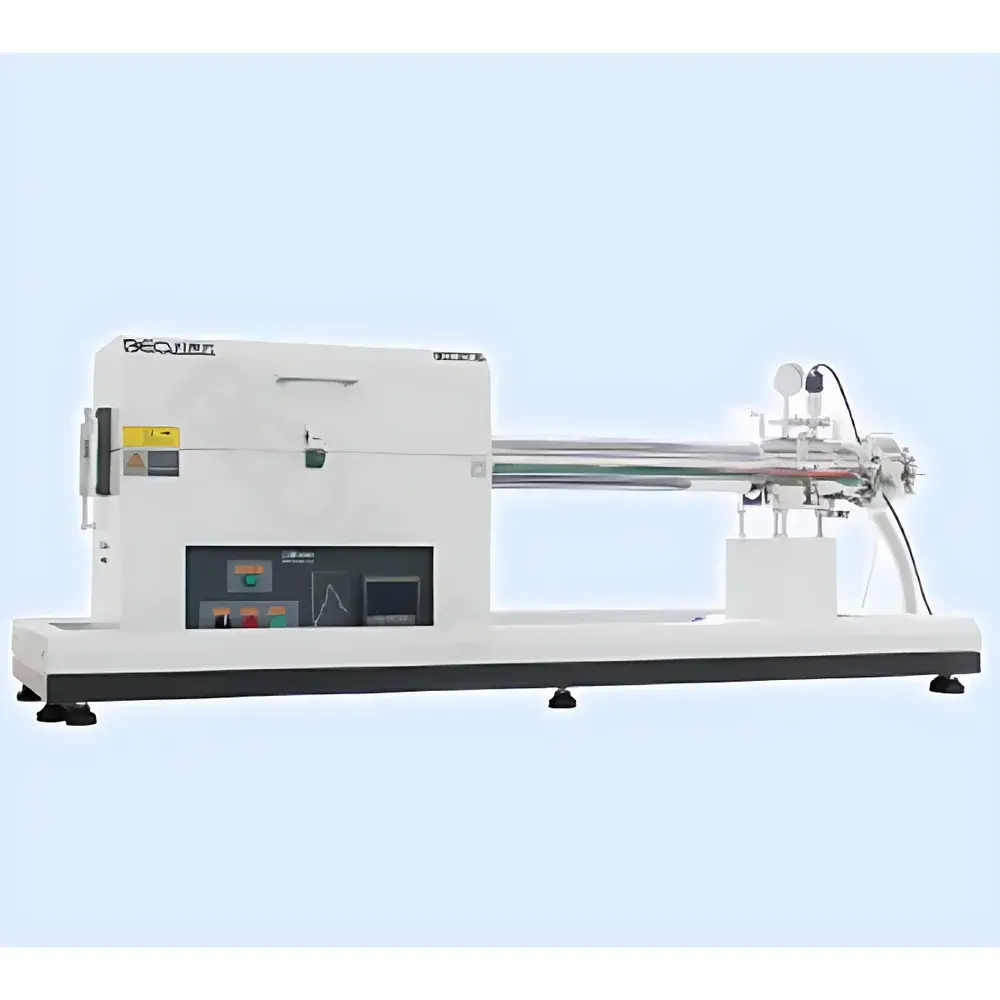
BEQ BTF-1200C-DSL High-Temperature & High-Pressure Horizontal Tube Furnace
| Brand | BEQ |
|---|---|
| Origin | Anhui, China |
| Model | BTF-1200C-DSL |
| Instrument Type | Horizontal Tube Furnace |
| Max Temperature | 1100 °C (with alloy steel pressure tube) |
| Operating Temperature Range | ≤1050 °C (alloy steel tube) |
| Pressure Rating | 4 MPa at ≤800 °C |
| Control Accuracy | ±1 °C |
| Heating Zone Length | 440 mm |
| Uniform Temperature Zone Length | 200 mm |
| Tube Dimensions | Φ50 × 500 mm |
| Movable Range | 700 mm |
| Rated Power | 3 kW |
| Supply | AC 220 V, 50/60 Hz |
| Heating Element | Imported Kanthal resistance wire |
| Control Method | Fuzzy PID with auto-tuning, 30-segment programmable ramp-soak profile |
| Safety Features | Over-temperature and thermocouple break alarm |
| Cooling | Internal water-cooled armored flange |
| Sealing | BEQ patented clamp-type flange |
Overview
The BEQ BTF-1200C-DSL is a horizontally oriented, high-temperature and high-pressure tube furnace engineered for controlled thermal processing under reactive or inert gas atmospheres, vacuum, or elevated pressure conditions. Designed around a robust horizontal configuration with a single-end sliding rail system, it enables rapid thermal cycling by physically withdrawing the heated zone from the sample—minimizing thermal inertia and improving process repeatability. Its core architecture integrates an alloy steel pressure-rated tube (Φ50 × 500 mm), capable of withstanding up to 4 MPa at temperatures ≤800 °C, and features dual independent control loops for precise regulation of both temperature and gas pressure. The furnace employs Kanthal A1 resistance wire heating elements, delivering uniform thermal distribution across a 440 mm heating zone, with a certified 200 mm uniformity zone (±1 °C). It operates on standard AC 220 V power and is rated at 3 kW, making it suitable for benchtop integration in university labs, materials R&D centers, and pilot-scale synthesis facilities.
Key Features
- Horizontally mounted sliding rail mechanism enabling axial displacement of the furnace tube over 700 mm—facilitating rapid cooling, safe sample loading/unloading, and thermal quenching protocols
- Alloy steel pressure tube certified for operation up to 4 MPa at ≤800 °C, 2.5 MPa at ≤900 °C, and 1.2 MPa at ≤1000 °C; ambient pressure only above 1050 °C
- Dual independent digital controllers—one dedicated to temperature (±1 °C accuracy), the other to pressure—with isolated sensor inputs and real-time monitoring
- Patented clamp-type flange sealing system with integrated internal water-cooled armored flange, ensuring leak-tight integrity and thermal stability at high differential pressures
- Fuzzy PID temperature controller with auto-tuning capability and 30-segment programmable ramp-soak profiles, supporting complex thermal schedules required for sintering, annealing, CVD, and carburization
- Pneumatic spring-assisted hinged door design allowing hands-free, multi-angle access to the furnace chamber while maintaining operator safety and ergonomic workflow
- Comprehensive safety suite including over-temperature cutoff, thermocouple failure detection, and audible/visual alarm outputs compliant with IEC 61000-6-2 EMC immunity standards
Sample Compatibility & Compliance
The BTF-1200C-DSL accommodates cylindrical samples, crucibles, and gas-permeable substrates up to Φ45 mm in diameter and 400 mm in length. Its pressure-rated tube and sealed flange interface support compatibility with ASTM E2923 (standard practice for pressure vessel testing), ISO 10434 (flange design for high-pressure systems), and ASME B31.3 process piping guidelines when configured with appropriate pressure relief and interlock accessories. While not inherently 21 CFR Part 11–compliant, the furnace’s analog/digital I/O ports enable integration into validated GxP environments when paired with compliant data acquisition hardware and audit-trail-enabled SCADA software. It meets CE marking requirements for electromagnetic compatibility (EMC) and low-voltage directive (LVD) when installed per manufacturer-specified grounding and ventilation protocols.
Software & Data Management
The furnace operates via a front-panel touchscreen HMI with local data logging (up to 10,000 timestamped records stored internally). Optional RS485 Modbus RTU or Ethernet TCP/IP communication interfaces allow bidirectional integration with LabVIEW, MATLAB, or third-party LIMS/SCADA platforms. When deployed in regulated environments, external DAQ systems with electronic signature and audit trail functionality (e.g., Siemens Desigo CC or Yokogawa CENTUM VP) may be used to satisfy GLP/GMP documentation requirements. No proprietary cloud service or vendor-hosted platform is involved—data ownership and retention remain fully under user control.
Applications
- High-pressure solid-state synthesis (e.g., metal hydride formation, nitride ceramics)
- Controlled-atmosphere annealing of semiconductor wafers and thin-film electrodes
- Catalyst activation and regeneration under syngas or H₂/N₂ mixtures at elevated pressure
- Thermal gravimetric analysis (TGA) coupling with mass spectrometry via heated transfer lines
- Chemical vapor deposition (CVD) precursor decomposition studies under variable p–T conditions
- Materials aging tests per ASTM E1530 (fire resistance of building materials) and ISO 21628 (high-temperature oxidation behavior)
FAQ
What vacuum level can the BTF-1200C-DSL achieve, and what pumping options are recommended?
With a mechanical pump such as the BS-V10 (Bois) or Edwards RV8, base pressures of ~1 Pa are attainable. For ultra-high vacuum applications down to 10⁻⁴ Pa, a two-stage system comprising a mechanical backing pump and a turbomolecular pump (e.g., KSKE FF-110 or Edwards nEXT85) is required.
Can mass flow controllers (MFCs) be integrated directly with the furnace gas inlet?
Yes—the furnace includes standardized 1/4″ VCR or Swagelok-compatible gas ports. MFCs with full-scale ranges from 10 to 500 sccm (e.g., Brooks 5850E or Alicat MC-Series) can be connected using stainless-steel tubing and calibrated for N₂, Ar, H₂, or O₂.
Is the furnace compatible with automated process sequencing and remote monitoring?
Via optional Modbus RTU or Ethernet interfaces, the unit supports integration into PLC-based automation systems or Python-controlled experimental workflows using open-source libraries such as pymodbus or pyserial.
What maintenance intervals are recommended for the heating elements and pressure seals?
Kanthal A1 heating elements typically exceed 5,000 hours of cumulative operation below 1050 °C. Clamp flange gaskets (Inconel 718 or graphite-reinforced PTFE) should be inspected after every 50 high-pressure cycles or annually—whichever occurs first.
Does BEQ provide calibration certificates traceable to NIST or national metrology institutes?
Factory calibration reports (including thermocouple verification and pressure transducer linearity checks) are supplied with each unit. NIST-traceable third-party calibration services are available upon request through BEQ’s authorized metrology partners in North America and EU.



