
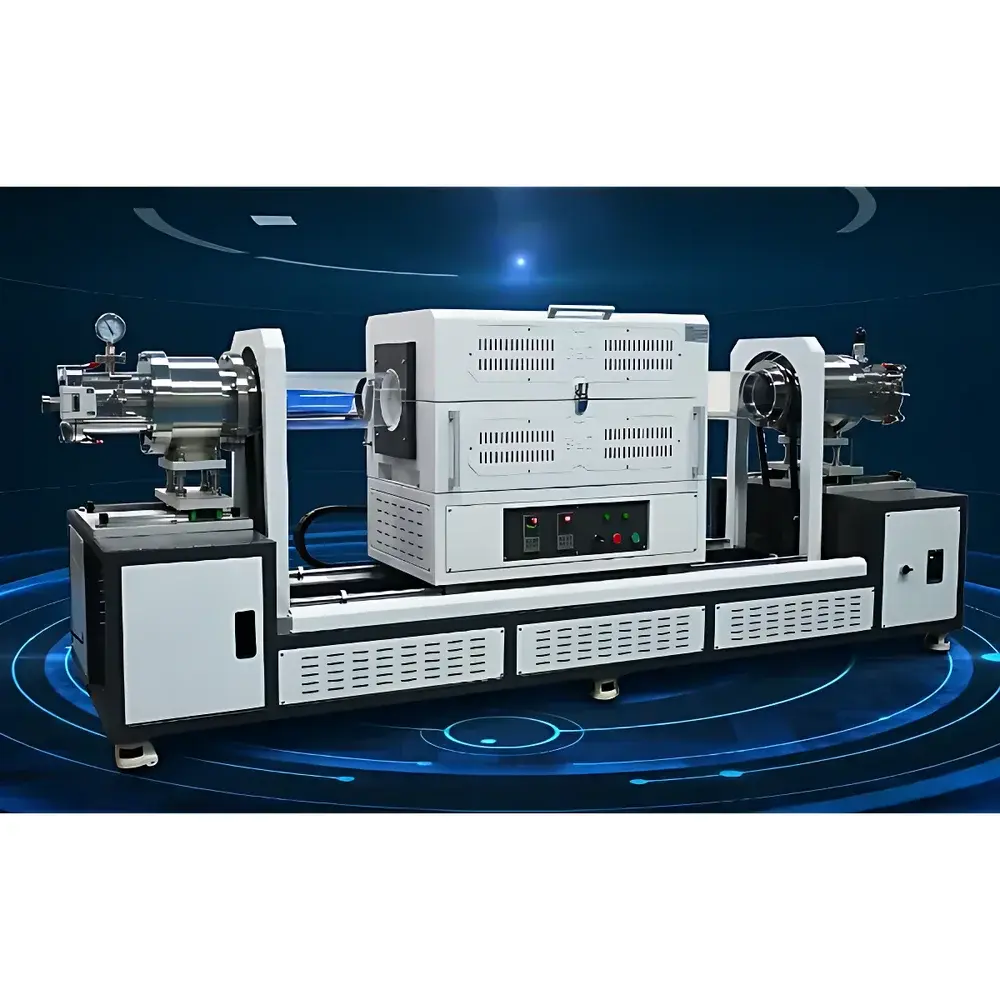
BEQ BTF-1200C-II-UAR-SL Dual-Zone Rotating Tube Furnace with Ultrasonic Atomization
| Brand | BEQ |
|---|---|
| Origin | Anhui, China |
| Model | BTF-1200C-II-UAR-SL |
| Max Temperature | 1200 °C |
| Temperature Control Accuracy | ±1 °C |
| Max Power | 7.2 kW |
| Heating Rate (to Max Temp) | ≤10 °C/min |
| Heating Method | Resistance Wire |
| Control System | Fuzzy PID + Self-Tuning Regulation, 30-Stage Programmable Logic Controller |
| Safety Features | Over-Temperature & Thermocouple Break Alarms |
| Rotation Mechanism | Geared Motor with Bidirectional Speed Control |
| Atomization System | 60 kHz Digital Ultrasonic Nebulizer with Adjustable Output |
| Insulation Material | Vacuum-Formed Alumina Fiber |
| Thermocouple Type | K-Type |
| Structural Frame | Anodized Aerospace Aluminum with Chrome-Plated Dual Linear Rails |
| Vacuum Flange | Multi-Port Longitudinal Design |
Overview
The BEQ BTF-1200C-II-UAR-SL is a high-precision dual-zone rotating tube furnace engineered for advanced materials synthesis, thin-film deposition, and controlled-atmosphere thermal processing. Unlike conventional single-zone furnaces, its independently controllable dual heating zones enable precise axial temperature gradients—critical for crystal growth, chemical vapor transport, and gradient annealing protocols. The furnace integrates three synchronized functional modules: (1) a thermally stable alumina fiber-insulated reaction chamber; (2) a programmable bidirectional rotation system for uniform sample exposure; and (3) an integrated ultrasonic atomization unit for in-situ precursor delivery during thermal treatment. Its operation conforms to fundamental principles of solid-state diffusion kinetics and vapor-phase mass transport, supporting reproducible process development under inert, reducing, or reactive gas environments (N₂, Ar, H₂, NH₃, or mixed gases). Designed for laboratory-scale R&D and pilot-scale process validation, it meets core engineering requirements for thermal stability, positional repeatability, and temporal control fidelity.
Key Features
- Dual independent heating zones (each up to 1200 °C), enabling programmable axial thermal profiles with ±1 °C stability across the 400 mm hot zone length
- Rotational mechanism driven by a precision geared DC motor, offering continuous speed adjustment from 0–30 rpm with forward/reverse direction control—ensuring homogeneous thermal exposure and particle suspension during powder processing
- Ultrasonic atomization subsystem operating at 60 kHz digital frequency, delivering fine aerosol droplets (median diameter <5 µm) with adjustable flow rate and duty cycle for controlled liquid precursor introduction into the hot zone
- Vacuum-formed alumina fiber insulation (density ~180 kg/m³) providing low thermal conductivity (<0.15 W/m·K at 1000 °C), minimal outgassing, and Class 100 cleanroom compatibility
- Fully programmable 30-stage temperature ramp/soak controller with fuzzy PID algorithm and auto-tuning capability—supporting complex thermal cycles required for sintering, carburizing, or oxidation studies
- Integrated safety architecture including dual independent over-temperature cutoffs, K-type thermocouple break detection, and real-time fault logging compliant with IEC 61508 functional safety guidelines
Sample Compatibility & Compliance
The BTF-1200C-II-UAR-SL accommodates standard quartz tubes (OD 60–100 mm, L ≤ 1200 mm) and supports diverse sample forms: powders, pellets, fibers, thin films on substrates, and coated wafers. Its vacuum-rated flange assembly (KF40/KF50 configurable) enables direct integration with mechanical pumps, turbomolecular pumps, and gas mass flow controllers. The system complies with ISO 9001 manufacturing standards and meets electrical safety requirements per IEC 61010-1 for laboratory equipment. While not certified for GMP production, its programmable logic, audit-trail-capable controller logs, and deterministic thermal response make it suitable for GLP-regulated research environments—including ASTM C1171 (carbon fiber heat treatment), ISO 11358 (polymer thermal degradation), and USP (thermal analysis of pharmaceutical excipients).
Software & Data Management
The embedded controller features RS485/Modbus RTU and optional Ethernet (TCP/IP) interfaces for remote monitoring and control via third-party SCADA or LabVIEW-based DAQ systems. All 30-stage programs—including setpoints, ramp rates, dwell times, rotation speed profiles, and atomization output levels—are stored in non-volatile memory with timestamped execution logs. Optional PC software (Windows/Linux compatible) provides graphical cycle visualization, real-time parameter overlay (temperature vs. time, rotation speed vs. position), and CSV export for post-processing in MATLAB or Python. Data integrity safeguards include write-protected program storage, cyclic redundancy check (CRC) verification on firmware updates, and user-level access control (operator/engineer/admin roles).
Applications
- Chemical vapor deposition (CVD) of metal oxides (e.g., ZnO, TiO₂) and chalcogenides (MoS₂, WS₂) using ultrasonically nebulized metal-organic precursors
- Controlled atmosphere annealing of battery cathode materials (NMC, LFP) with rotational homogenization to mitigate thermal segregation
- Synthesis of core-shell nanoparticles via sequential thermal decomposition and surface reaction in graded temperature fields
- Thermal gravimetric analysis (TGA)-coupled studies where continuous rotation minimizes boundary layer effects during weight-loss measurements
- Development of functional coatings on optical fibers or microstructured substrates requiring uniform thermal history and conformal precursor delivery
FAQ
What vacuum level can the furnace achieve with standard configuration?
With a two-stage rotary vane pump, typical base pressure is 1×10⁻² mbar; integration with a turbomolecular pump enables ≤5×10⁻⁶ mbar.
Is the ultrasonic atomizer compatible with corrosive precursors such as titanium tetrachloride (TiCl₄)?
Yes—when operated with quartz or PFA-lined nebulizer chambers and inert carrier gas (Ar/N₂), it supports halide- and alkoxide-based precursors under controlled flow conditions.
Can the rotation and atomization functions be synchronized with temperature ramps?
Yes—the controller allows conditional triggering: e.g., “start atomization at 400 °C” or “initiate rotation 5 minutes after reaching 800 °C”, with timing resolution of ±1 second.
What maintenance intervals are recommended for long-term reliability?
Alumina fiber insulation requires no scheduled replacement; annual verification of thermocouple calibration and motor gearbox lubrication is advised per ISO/IEC 17025 maintenance guidelines.
Does the system support compliance with FDA 21 CFR Part 11 for electronic records?
The base controller does not include Part 11-compliant audit trails; however, optional third-party software packages with electronic signatures, role-based access, and immutable log archiving are available upon request.



