
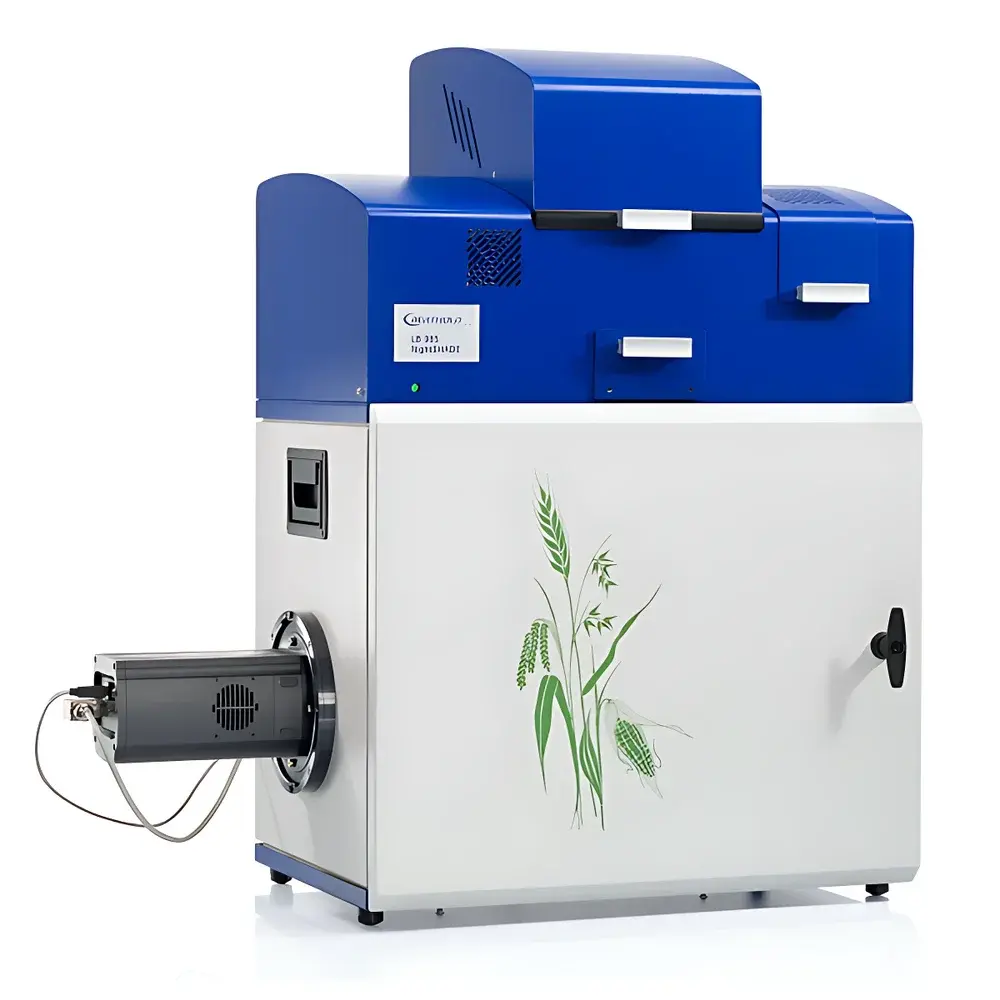
Berthold NightSHADE LB 985N Plant In Vivo Imaging System
| Brand | Berthold |
|---|---|
| Origin | Germany |
| Model | LB 985N |
| Resolution | 1024 × 1024 |
| Pixel Size | 13.3 µm |
| Sensor Type | Cooled EMCCD |
| Cooling Temperature | −20 °C (absolute) |
| Quantum Efficiency Peak | 500–750 nm |
| Imaging Modes | Bioluminescence, Chemiluminescence, Fluorescence (with GFP filter set) |
| Dual-Camera Configuration | Top-view + side-view |
| Stage | Motorized X-Y stage with 360° rotational capability |
| Environmental Control | Integrated temperature and humidity regulation |
| Software | indiGO™ control and analysis suite |
Overview
The Berthold NightSHADE LB 985N is a purpose-engineered plant in vivo imaging system designed for quantitative, low-light biophotonic detection in intact plant specimens. Built upon the proven optical architecture of the NightOWL platform, the LB 985N integrates cryogenically cooled electron-multiplying charge-coupled device (EMCCD) technology to enable single-photon-level sensitivity—critical for capturing weak, transient luminescent signals from luciferase reporters, ROS-sensitive chemiluminescent probes (e.g., luminol-enhanced assays), and low-expression fluorescent proteins such as GFP. Its spectral response is optimized across the 500–750 nm range, aligning precisely with peak emission wavelengths of common plant bioluminescent and fluorescent reporters. Unlike general-purpose microscopes or animal-focused IVIS systems, the LB 985N incorporates botanical-specific hardware: dual-axis imaging (top + lateral), a motorized 360° rotating sample stage, and tightly regulated environmental control (temperature and humidity), enabling longitudinal studies under physiologically relevant growth conditions.
Key Features
- Cryogenically cooled EMCCD sensor operating at −20 °C absolute temperature, minimizing dark current and enabling high signal-to-noise ratio at sub-second exposure times
- 1024 × 1024 pixel resolution with 13.3 µm pixel pitch—optimized for wide-field macro-imaging of whole seedlings, leaves, fungal colonies, and small potted plants
- Dual-camera configuration: primary top-view EMCCD for standard bioluminescence/fluorescence quantification; secondary side-view camera for orthogonal morphological assessment and 3D spatial context
- Integrated LED-based white-light illumination simulating natural photosynthetic photon flux—enabling non-invasive pre- and post-acquisition visual documentation without compromising dark-adapted detection sensitivity
- Motorized X-Y translation stage with programmable 360° rotation—facilitating multi-angle acquisition and automated time-lapse imaging across circadian cycles
- Onboard environmental chamber with independent PID-controlled temperature and relative humidity regulation (range: 15–30 °C; RH: 40–85%), supporting extended experiments under controlled growth conditions
Sample Compatibility & Compliance
The LB 985N accommodates diverse botanical sample formats—including Petri dishes (up to 150 mm diameter), multi-well plates (6–96-well), custom growth pots, and agar-based vertical plates—without requiring dissection or tissue fixation. Its large field-of-view and depth-of-field support imaging of intact Arabidopsis thaliana seedlings, Nicotiana benthamiana leaves, Medicago truncatula root systems, fungal hyphae on solid media, and even dwarf cereal seedlings up to 12 cm tall. The system complies with ISO/IEC 17025 principles for measurement traceability in research laboratories and supports audit-ready operation under GLP frameworks. All hardware control parameters, exposure settings, and environmental logs are timestamped and stored within indiGO™ software—ensuring full experimental reproducibility per FAIR data principles.
Software & Data Management
indiGO™ software serves as the unified control and analysis environment for the LB 985N. It provides real-time hardware synchronization, automated multi-channel acquisition (luminescence + fluorescence + brightfield), and batch-processing pipelines for ROI-based quantification, background subtraction, and kinetic curve fitting. Raw image data are saved in vendor-neutral TIFF format with embedded metadata (exposure time, binning, gain, temperature, humidity, stage position). The software includes built-in calibration tools for radiometric intensity normalization using NIST-traceable luminescence standards. For regulatory environments, indiGO™ supports 21 CFR Part 11-compliant user access controls, electronic signatures, and immutable audit trails—enabling use in GxP-aligned plant biotechnology workflows, including transgenic trait validation and agrochemical mode-of-action studies.
Applications
The LB 985N is routinely deployed in academic and industrial plant science laboratories for:
- Real-time monitoring of promoter activity via luciferase reporter constructs (e.g., CAB2::LUC, CCA1::LUC) to dissect circadian rhythms and photoperiodic responses
- Quantitative assessment of oxidative burst dynamics during pathogen-associated molecular pattern (PAMP)-triggered immunity using luminol- or L-012-enhanced chemiluminescence
- Longitudinal tracking of GFP/RFP-tagged protein localization during organogenesis, vascular development, or stress-induced relocalization
- High-throughput screening of chemical libraries for modulators of phytohormone signaling (e.g., auxin, ABA, jasmonate) using synthetic promoter-reporter lines
- Non-destructive evaluation of abiotic stress tolerance (drought, salinity, heavy metals) through spatiotemporal mapping of reporter gene expression and ROS accumulation
FAQ
What distinguishes the LB 985N from animal-focused in vivo imaging systems?
The LB 985N features botanical-specific engineering—including side-view imaging, 360° rotational staging, integrated environmental control, and LED-based daylight-spectrum illumination—absent in mammalian IVIS platforms.
Can the system perform simultaneous bioluminescence and fluorescence imaging?
Yes—when configured as the LUFlu variant, it includes a dedicated fluorescence excitation module and GFP emission filter set, enabling sequential or interleaved dual-mode acquisition with hardware-synchronized shutter control.
Is indiGO™ software compatible with third-party analysis tools?
All exported TIFF images contain standardized EXIF and custom metadata tags; data can be imported into ImageJ/Fiji, MATLAB, Python (via tifffile or OME-TIFF libraries), and commercial platforms such as MetaMorph or Imaris.
Does the system support kinetic time-lapse experiments over multiple days?
Yes—programmable acquisition schedules, stable thermal/hygrometric regulation, and low-phototoxicity LED lighting allow unattended multi-day imaging with minimal physiological perturbation.
What maintenance is required for the EMCCD sensor?
The sealed, thermoelectrically cooled sensor requires no consumables or periodic recalibration; routine cleaning of optical windows and verification of environmental chamber seal integrity are recommended every 6 months.




