
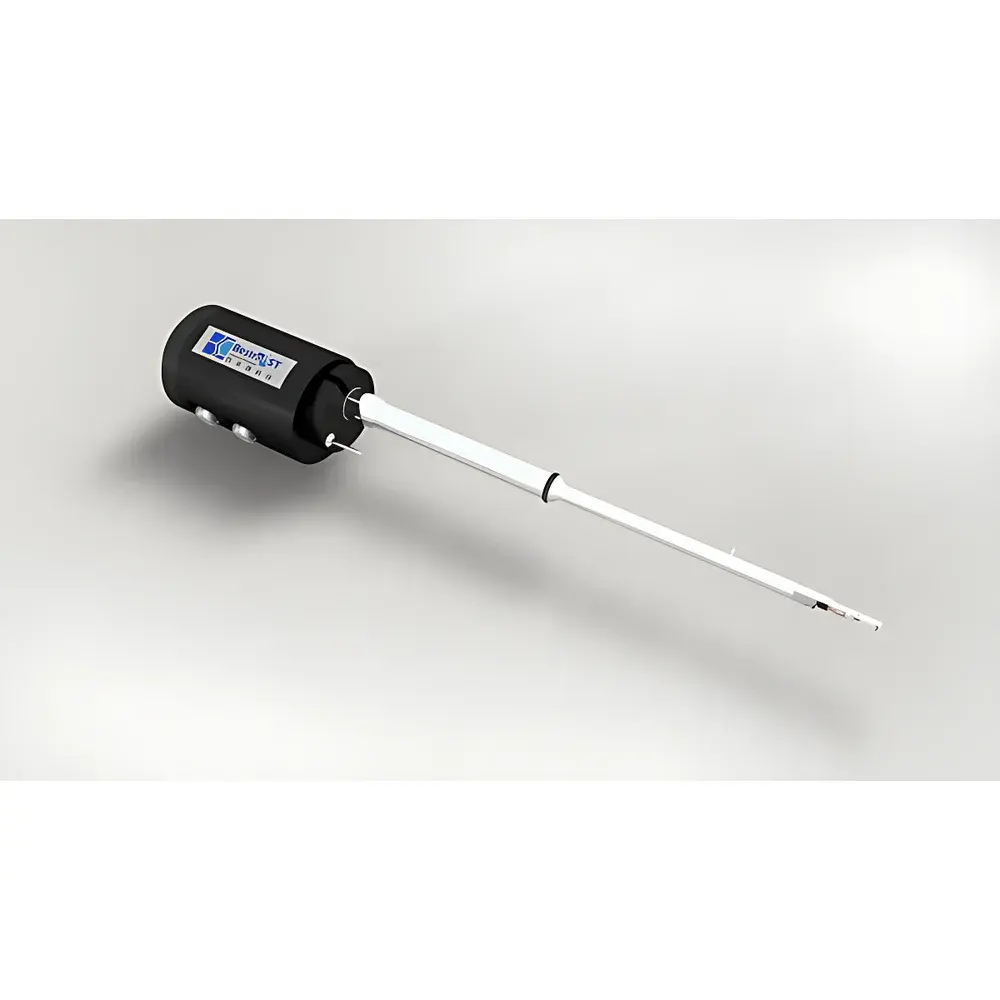
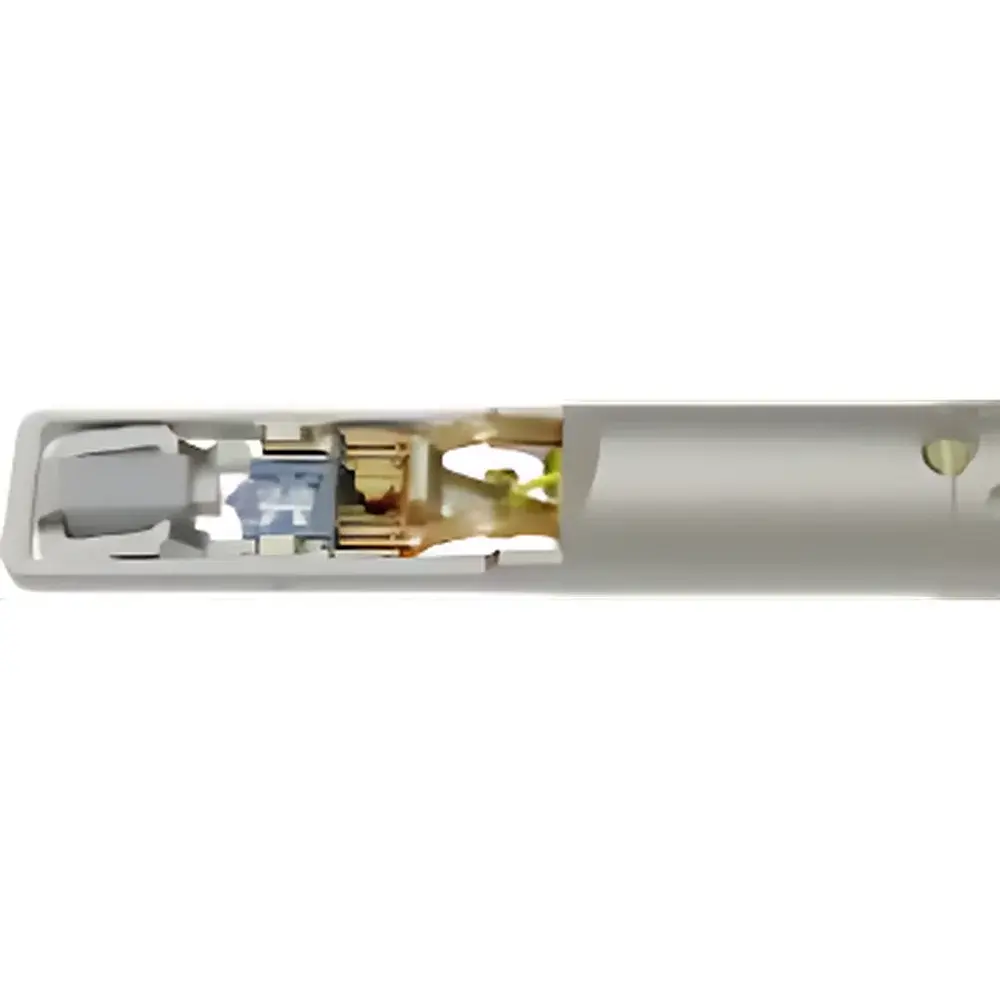
Bestron INSTEMS-MET In Situ TEM Dual-Tilt Electromechanical-Thermal Integrated System
| Brand | Bestron |
|---|---|
| Model | INSTEMS-MET |
| Type | In Situ TEM Dual-Axis Tilt Sample Holder with Integrated Mechanical, Electrical, and Thermal Actuation |
| Heating Range | RT to 1200 °C |
| Temperature Accuracy | < 0.1 °C |
| Max. Driving Force | > 100 mN |
| Drive Resolution | < 500 pm |
| Voltage Range | ±50 V (up to 150 V peak) |
| Current Range | 1 pA – 2 A |
| Dual-Axis Tilt | α/β ±25° |
| Spatial Resolution (TEM-compatible) | ≤ 0.1 nm |
| Sample Drift | < 50 pm/s |
| EDS-Compatible | Yes |
| Heating Rate | > 10,000 °C/s |
Overview
The Bestron INSTEMS-MET In Situ TEM Dual-Tilt Electromechanical-Thermal Integrated System is a high-precision, multi-physics sample holder engineered for atomic-resolution transmission electron microscopy (TEM) under simultaneous mechanical loading, thermal stimulation, and electrical biasing. Built upon monolithic MEMS chip architecture and integrated piezoelectric actuation, the system enables true tri-field coupling—mechanical stress, temperature modulation, and current/voltage application—within standard TEM column constraints. Unlike conventional single- or dual-field holders, the INSTEMS-MET preserves full dual-axis tilt functionality (±25° in both α and β axes), ensuring unobstructed crystallographic access while maintaining sub-angstrom imaging stability (< 50 pm/s drift). Its design conforms to JEOL, Thermo Fisher (FEI), and Hitachi TEM pole-piece geometries and is optimized for compatibility with high-brightness field-emission guns and aberration-corrected optics. The system operates within the physical and electromagnetic boundary conditions required for quantitative in situ TEM, supporting diffraction contrast, HRTEM, STEM, and time-resolved EELS/EDS acquisition during active multi-field perturbation.
Key Features
- Tri-field coupling capability: Independent yet synchronized control of mechanical displacement (force >100 mN), thermal excitation (RT–1200 °C, accuracy 104 °C/s), and electrical biasing (±50 V DC / up to 150 V pulsed; current 1 pA–2 A)
- Dual-axis mechanical tilt: Full ±25° rotation in both α and β axes without compromising MEMS heater or electrode alignment—enabling zone-axis orientation, grain boundary analysis, and dislocation dynamics tracking
- Atomic-scale stability: Active thermal drift compensation and low-noise piezoelectric positioning yield sustained sample stability <50 pm/s, validated under 300 kV TEM operation
- MEMS-based sensing and actuation: On-chip Pt resistance thermometry, four-point probe electrodes, and integrated strain gauges provide real-time feedback for closed-loop control
- Sub-nanometer spatial resolution: Compatible with ≤0.1 nm information limits in Cs-corrected TEM/STEM, verified via lattice-fringe imaging of Si[110] and Au[112]
- EDS-compatible geometry: Minimal X-ray absorption path and non-magnetic construction ensure quantitative energy-dispersive spectroscopy during in situ experiments
Sample Compatibility & Compliance
The INSTEMS-MET accommodates standard 3-mm TEM half-grid specimens with thicknesses ≤100 nm (for electron transparency) and supports lamellae prepared by FIB-SEM or electropolishing. It is compatible with lift-out workflows and cryo-transfer when used with optional vacuum interlocks. All materials—including Ti–6Al–4V structural components, sputtered Pt/Ti electrodes, and AlN-based heating elements—meet ASTM F899 (standard specification for surgical stainless steels) and ISO 10993-5 biocompatibility screening thresholds, ensuring suitability for functional oxide, battery cathode, and semiconductor heterostructure studies. The system supports GLP-compliant data traceability through hardware-timestamped metadata logging and satisfies foundational requirements for FDA 21 CFR Part 11 audit trails when paired with validated acquisition software.
Software & Data Management
Control is executed via Bestron’s INSTEMS Control Suite v4.2—a modular, Python-extendable platform supporting synchronized hardware triggering across TEM acquisition systems (e.g., Gatan DigitalMicrograph®, Thermo Fisher Velox™). The suite records time-stamped voltage, current, temperature, force, and tilt-angle data at ≥1 kHz sampling, exported in HDF5 format with embedded MIAME-compliant metadata. Real-time parameter mapping (e.g., strain vs. resistivity vs. local lattice distortion) is enabled via API integration with MATLAB, Python (NumPy/SciPy), and HyperSpy. All firmware updates undergo IEC 62304 Class B validation, and software binaries are digitally signed to meet ISO 13485 medical device development standards.
Applications
- Dynamic phase transformation in Ni-based superalloys under coupled thermal–mechanical loading
- In situ electromigration and void nucleation in Cu interconnects at elevated temperatures
- Atomic-scale evolution of solid-electrolyte interphases (SEI) in Li-ion battery anodes under simultaneous bias and heating
- Thermally activated dislocation nucleation and climb in Mg alloys observed via 4D-STEM strain mapping
- Real-time observation of ferroelectric domain wall motion under electric field and thermal gradient
- Interface reaction kinetics at metal/oxide heterojunctions relevant to power electronics packaging
FAQ
Is the INSTEMS-MET compatible with aberration-corrected TEM platforms?
Yes—the holder maintains mechanical rigidity and electromagnetic quietness essential for sub-0.1 nm resolution on Cs-corrected instruments operating at 80–300 kV.
What is the maximum permissible sample thickness for reliable thermal uniformity?
For homogeneous heating to 1200 °C with <1% lateral gradient, samples should be ≤50 nm thick in the central 5 µm region of the MEMS window.
Can the system perform four-point probe electrical measurements during tilt?
Yes—on-chip electrode routing and kinematic decoupling ensure stable contact resistance (<5 Ω) across the full ±25° tilt range.
Does the holder support vacuum bake-out prior to TEM insertion?
Yes—rated for 24-hour bake-out at 150 °C under ≤1×10⁻⁷ mbar, with outgassing rates verified per ASTM E595.
Is third-party software integration supported for automated experiment sequencing?
Yes—RESTful API and LabVIEW driver packages are provided for integration with custom automation frameworks and synchrotron-linked TEM workflows.





