
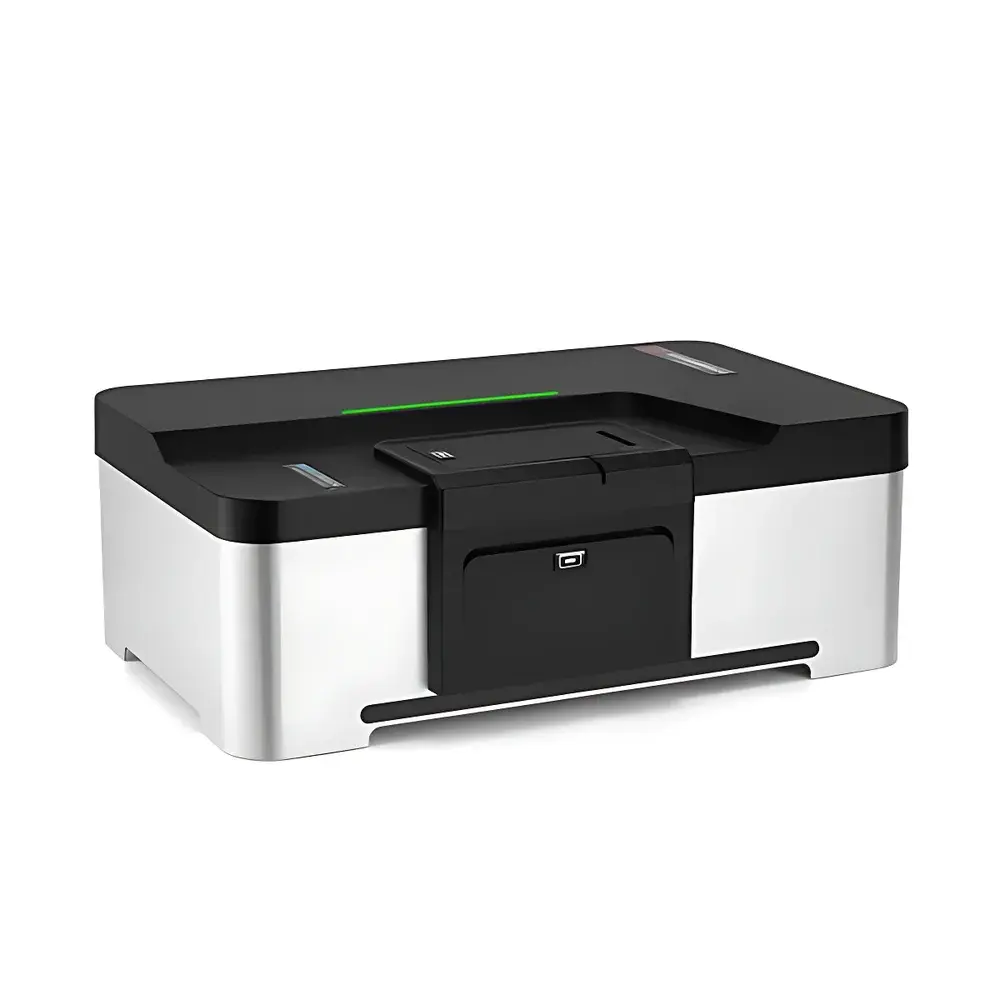
Bettersize BeNano 180 Nanoparticle Size Analyzer
| Brand | Bettersize |
|---|---|
| Origin | Liaoning, China |
| Manufacturer | Bettersize Instruments Co., Ltd. |
| Model | BeNano 180 |
| Particle Size Range | 0.3 nm – 10 μm |
| Size Measurement Reproducibility | ≤1% |
| Temperature Control Range | −15 °C to 120 °C |
| Temperature Control Accuracy | ±0.1 °C |
| Measurement Time | ≤60 s |
| Detection Angle | 173° (backscattering) + optional 11.2° |
| Laser Wavelength | 671 nm (solid-state laser) |
| Correlator | Multi-speed mode, 25 ns minimum sampling interval, 4000 channels, 10¹¹ dynamic linear range |
| Detector | APD |
| Sample Volume | ≥40 μL (customizable) |
| Max. Sample Concentration | ≤40% w/v |
| Analysis Algorithms | Cumulants, General Purpose, CONTIN, NNLS |
| Supported Measurements | Hydrodynamic Diameter (D<sub>H</sub>), Polydispersity Index (PDI), Diffusion Coefficient (D), Interparticle Interaction Parameter (k<sub>D</sub>), Intensity/Volume/Area/Number Distributions, Molecular Weight (342 Da – 2 × 10⁷ Da), Solution Viscosity & Refractive Index, Microrheological Parameters (G*, G′, G″, η*, J) |
Overview
The Bettersize BeNano 180 Nanoparticle Size Analyzer is a high-precision optical instrument engineered for the characterization of nanoscale colloidal systems using Dynamic Light Scattering (DLS) and Static Light Scattering (SLS). Designed for rigorous laboratory environments, it employs advanced backscattering detection at 173°—optimized for high-concentration samples—and optionally supports low-angle (11.2°) measurement for dilute dispersions. The system utilizes a stable 671 nm solid-state laser and an avalanche photodiode (APD) detector with ultra-wide dynamic range (10¹¹), enabling reliable signal acquisition across diverse nanoparticle types, including proteins, polymers, liposomes, quantum dots, and inorganic colloids. Its core measurement principle relies on quantifying temporal fluctuations in scattered light intensity induced by Brownian motion, followed by autocorrelation analysis to derive the diffusion coefficient (D). Using the Stokes–Einstein equation, D is converted into hydrodynamic diameter (DH). The BeNano 180 further extends its analytical scope to molecular weight determination and microrheology via multi-mode correlator architecture and integrated temperature control.
Key Features
- Precision Temperature Control: Dual-zone Peltier-based thermal management enables operation from −15 °C to 120 °C with ±0.1 °C stability—critical for studying thermal transitions (e.g., protein denaturation, polymer LCST/UCST behavior) and ensuring measurement repeatability.
- Flexible Optical Configuration: Standard 173° backscattering geometry minimizes multiple scattering effects in turbid or concentrated suspensions (up to 40% w/v); optional 11.2° forward-scatter module enhances sensitivity for sub-1 nm species and low-refractive-index particles.
- High-Speed Correlation Architecture: Real-time correlator with 25 ns minimum sampling resolution, 4000 delay channels, and adaptive gain control ensures robust data capture even under rapid diffusion conditions or transient aggregation events.
- Multi-Algorithm Data Processing: Supports industry-standard inversion methods—Cumulants (for monomodal distributions), General Purpose (non-negative least squares, NNLS), CONTIN (for highly polydisperse systems), and model-free distribution fitting—enabling method-appropriate interpretation per ISO 22412 and ASTM E2490.
- Integrated Microrheology Capability: Derives viscoelastic parameters—including complex modulus (G*), storage modulus (G′), loss modulus (G″), complex viscosity (η*), and creep compliance (J)—directly from DLS-derived mean-squared displacement (MSD), eliminating the need for mechanical rheometry for soft materials.
Sample Compatibility & Compliance
The BeNano 180 accommodates aqueous and organic dispersions, biological macromolecules, emulsions, and nanoparticle suspensions with minimal sample volume (≥40 μL). It complies with key regulatory and quality frameworks relevant to pharmaceutical, biotech, and materials R&D laboratories: data integrity supports audit trails aligned with FDA 21 CFR Part 11 requirements when used with validated software configurations; measurement protocols are traceable to ISO 22412 (DLS), ISO 13321 (photon correlation spectroscopy), and USP <729> (light scattering for liposomal products). Optional integration with FFF or SEC/GPC separation systems enables orthogonal, calibration-free size and molar mass distribution profiling—meeting ICH Q5E comparability assessment needs.
Software & Data Management
Control and analysis are performed via BeNano Software Suite—a Windows-based platform supporting GLP-compliant workflows. Features include automated temperature ramping with real-time particle size trend logging, time-resolved stability monitoring (e.g., aggregation kinetics), batch processing with customizable report templates (PDF/Excel), and secure user access levels. Raw correlator data (.cor), processed size distributions (.csv), and metadata (instrument settings, calibration logs, environmental conditions) are stored in structured directories with SHA-256 checksums for data integrity verification. Export formats comply with FAIR principles and support downstream integration with LIMS or ELN systems.
Applications
- Characterization of therapeutic nanoparticles (liposomes, LNPs, polymeric micelles) for mRNA/DNA delivery
- Stability assessment of monoclonal antibodies and biosimilars under thermal, pH, or excipient stress
- Quality control of catalyst nanoparticles, quantum dots, and metal oxide colloids in advanced materials synthesis
- Method development for regulatory submissions requiring particle size distribution per ICH Q5A(R2) and Q5E
- Structure–property relationships in stimuli-responsive hydrogels and supramolecular assemblies via temperature- and time-resolved DLS
- Supporting formulation development through simultaneous size, zeta potential (with optional module), and microrheological profiling
FAQ
What is the smallest detectable particle size with the BeNano 180?
The theoretical lower limit is 0.3 nm under optimal conditions (e.g., high refractive index contrast, low background noise, and stable temperature); actual resolution depends on sample optical properties and signal-to-noise ratio.
Can the BeNano 180 measure zeta potential?
No—zeta potential measurement is not supported in the base BeNano 180 configuration. A separate Zeta module or complementary instrument is required for electrophoretic light scattering (ELS) analysis.
Is the system compatible with GPC/SEC or FFF coupling?
Yes—optional Flow Mode hardware and software enable seamless interfacing with size-exclusion chromatography (SEC), gel permeation chromatography (GPC), or field-flow fractionation (FFF) systems for orthogonal, separation-based sizing and molar mass distribution analysis.
How does the BeNano 180 handle highly concentrated or turbid samples?
The 173° backscattering geometry significantly reduces multiple scattering artifacts, allowing accurate sizing up to 40% w/v concentration without dilution—subject to sample-specific optical density and viscosity constraints.
Does the software support 21 CFR Part 11 compliance?
Yes—when deployed with role-based user authentication, electronic signatures, and full audit trail functionality enabled, the BeNano Software Suite meets foundational requirements for regulated environments; site-specific validation documentation must be established per organizational SOPs.



